


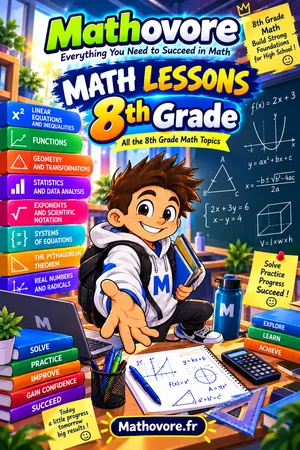
Key takeaway: Grade 8 math on Mathovore has 18 chapters on irrational numbers, exponents, linear equations, functions, transformations, the Pythagorean theorem and scatter plots. Each chapter supplies one lesson page, practice problems, a unit test and an online quiz.
Grade 8 math chapters
Rational and Irrational Numbers
Skills you build: The number system widens beyond fractions. Learners convert repeating decimals to fractions, recognize that roots of non-perfect squares are irrational, estimate such values between consecutive integers, place them on a number line, and compare rational and irrational numbers.
Properties of Integer Exponents
Skills you build: Exponent properties are used to simplify numerical expressions. Students apply product, quotient, and power rules, evaluate zero and negative exponents, rewrite expressions with positive exponents only, and explain why the rules work by expanding powers into repeated factors.
Square Roots and Cube Roots
Skills you build: Roots are treated as solutions to simple equations. Learners solve x^2 = p and x^3 = p, recognize perfect squares and cubes, give both a positive and negative square root when appropriate, estimate non-perfect roots, and see why the square root of 2 is irrational.
Scientific Notation
Skills you build: Very large and very small quantities become manageable. Learners write numbers as a * 10^n, convert back to standard form, compare values by their exponents, multiply and divide in scientific notation, and choose sensible units for things like distances in space or sizes of cells.
Proportional Relationships and Slope
Skills you build: Slope is explained as steepness that stays constant. Students graph proportional relationships, read unit rates off lines, compare two relationships shown in different forms, and use similar right triangles to show why the ratio of rise to run is the same everywhere.
Solving Linear Equations
Skills you build: Equations with variables on both sides are solved step by step. Students distribute, combine like terms, and keep balance with inverse operations, then determine whether an equation has one solution, none, or infinitely many, and show the reasoning behind each conclusion.
Systems of Linear Equations
Skills you build: Two linear equations are solved together. Learners find the intersection by graphing, substitution, or elimination, decide when a system has no solution or infinitely many, and set up equations from real contexts such as comparing phone plans or ticket sales.
Introduction to Functions
Skills you build: Rules that link inputs to outputs take shape. Learners decide whether a relation is a function from tables, graphs, and mappings, compare functions given in different forms, identify linear and nonlinear examples, and describe rates of change in context.
Linear Functions and Modeling
Skills you build: Straight-line models are built from real situations. Learners find rate of change and initial value from tables, graphs, and descriptions, write y = mx + b, interpret slope and intercept in words, and sketch qualitative graphs that show where a function rises, falls, or levels off.
Translations, Reflections and Rotations
Skills you build: Figures move across the coordinate plane by rule. Students translate, reflect over either axis, and rotate about the origin, write the coordinate changes, sequence several moves, and explain why the image keeps the same lengths and angles as the original.
Congruence, Dilations and Similarity
Skills you build: Shapes are compared through transformations. Students describe sequences of translations, reflections, rotations, and dilations that map one figure onto another, track coordinates, decide whether figures are congruent or similar, and use scale factors to find missing lengths.
Angles, Parallel Lines and Triangles
Skills you build: Parallel lines and triangles supply a toolkit of angle facts. Learners use the triangle angle sum and exterior angle theorem, identify corresponding and alternate angles formed by a transversal, write proofs in words, and use angle-angle reasoning to show triangles are similar.
The Pythagorean Theorem
Skills you build: Right triangles unlock many measurement tasks. Learners explain why a^2 + b^2 = c^2 holds, find missing legs or hypotenuses, use the converse to test for right angles, and apply the theorem to ladders, diagonals, and distances in three-dimensional figures.
Distance in the Coordinate Plane
Skills you build: The Pythagorean Theorem is applied on a grid. Learners draw a right triangle between two points, treat horizontal and vertical changes as legs, compute distance with the distance formula, and use the result for perimeters, side lengths, and map problems.
Volume of Cylinders, Cones and Spheres
Skills you build: Curved solids get their volume formulas. Learners compute volumes of cylinders, cones, and spheres, relate a cone to a cylinder with the same base and height, work in terms of pi or with decimals, and solve problems about tanks, scoops, and balls.
Scatter Plots and Association
Skills you build: Pairs of measurements are graphed to reveal relationships. Students construct scatter plots, describe the direction, strength, and shape of the association, identify clusters and outliers, and tell the difference between positive, negative, linear, and nonlinear patterns.
Lines of Best Fit and Linear Models
Skills you build: Messy data meet a simple model. Students draw a line that follows a scatter plot, judge how well it fits, write its equation, use it to predict values, and interpret the slope and y-intercept as meaningful quantities in the situation.
Two-Way Tables
Skills you build: Categorical data are organized in rows and columns. Learners fill in joint frequencies and totals, compute relative frequencies by row or column, compare percentages across groups, and decide whether the table suggests an association between two characteristics, such as sport and grade.
What math do 8th graders learn?
Eighth grade moves students from arithmetic to the language of functions. They study irrational numbers, integer exponents, square roots and scientific notation. Then they connect slope, linear equations and systems to graphs.
The course spans numbers, algebra, functions, geometry and data. Each chapter above names its codes, for example 8.NS.A.1 for rational and irrational numbers.
In what order should Grade 8 math chapters be studied?
Start with the number block: rational and irrational numbers, exponent properties, roots and scientific notation. These tools support everything else. Then connect proportional relationships to slope and solve linear equations.
Next come systems of linear equations and the introduction to functions, followed by linear models. Geometry then covers translations, reflections, rotations, congruence, dilations, similarity and angle facts. The Pythagorean theorem and distance in the coordinate plane come after that, along with volumes of cylinders, cones and spheres.
Finish with scatter plots, lines of best fit and two-way tables. Those chapters tie algebra to real data.
What should a student know before 8th grade math?
Students should handle signed rational numbers, proportional relationships and two-step equations from Grade 7. Familiarity with percent and scale drawings also helps. Algebra tiles or simple tables can fill gaps quickly.
If equation solving is weak, spend extra time on the linear equations chapter. Almost every later chapter depends on it.
How do Grade 8 math tests prepare students for high school?
Each 45-minute test mixes procedures with explanations, which mirrors high school work. Students must justify steps, not just state answers. The scoring guide shows how to award credit for correct reasoning.
Scores across several tests reveal patterns. A student who loses points on every graph question, for example, needs more practice with slope.
Is 8th grade math the same as Algebra 1?
Not exactly. Grade 8 builds the foundation, while Algebra 1 extends it with quadratics, polynomials and exponential models. Some schools offer Algebra 1 in Grade 8 for advanced students. Even then, the chapters here make a useful review.
Students who plan to skip ahead should check that exponents, linear functions and systems feel solid first.
What comes after Grade 8 math?
Algebra 1 follows for most students, and Geometry comes next. The Pythagorean theorem and transformations from Grade 8 return in both courses.
Grade 8 math: questions from teachers
How big is the Grade 8 course?
The course has 18 chapters, from rational and irrational numbers to two-way tables.
Is the Pythagorean theorem included?
Yes. One chapter covers it, and another applies it to distance in the coordinate plane.
Are there answer keys for the tests?
Yes. Each test key shows worked solutions and a scoring guide out of 20 points.
Can I print the lessons?
Yes. All documents print as PDFs in US Letter format.

