

Key takeaway: This grade 8 scientific notation lesson explains how to write huge and tiny numbers as a coefficient between 1 and 10 times a power of ten. It covers standards 8.EE.A.3-4, so 8th grade students also learn to compare sizes and multiply or divide these numbers.
Watch the decimal point travel. Its direction decides the sign of the exponent.
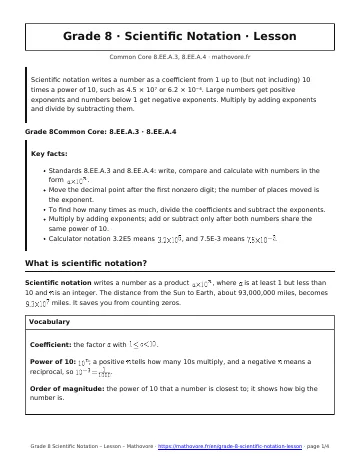
Scientific notation writes a number as a coefficient from 1 up to (but not including) 10 times a power of 10, such as 4.5 × 10⁷ or 6.2 × 10⁻⁴. Large numbers get positive exponents and numbers below 1 get negative exponents. Multiply by adding exponents and divide by subtracting them.
Grade 8 Scientific Notation Lesson: key facts
- Standards 8.EE.A.3 and 8.EE.A.4: write, compare and calculate with numbers in the form \(a\times 10^{n}\).
- Move the decimal point after the first nonzero digit; the number of places moved is the exponent.
- To find how many times as much, divide the coefficients and subtract the exponents.
- Multiply by adding exponents; add or subtract only after both numbers share the same power of 10.
- Calculator notation 3.2E5 means \(3.2\times 10^{5}\), and 7.5E-3 means \(7.5\times 10^{-3}\).
What is scientific notation?
Scientific notation writes a number as a product \(a\times 10^{n}\), where \(a\) is at least 1 but less than 10 and \(n\) is an integer. The distance from the Sun to Earth, about 93,000,000 miles, becomes \(9.3\times 10^{7}\) miles. It saves you from counting zeros.
Coefficient: the factor \(a\) with \(1\le a<10\).
Power of 10: \(10^{n}\); a positive \(n\) tells how many 10s multiply, and a negative \(n\) means a reciprocal, so \(10^{-3}=\frac{1}{1000}\).
Order of magnitude: the power of 10 that a number is closest to; it shows how big the number is.
How do you write a number in scientific notation?
- Move the decimal point so that it sits just after the first nonzero digit.
- Count the places you moved it.
- Use that count as the exponent: positive when the original number is 10 or more, negative when it is less than 1.
Worked example. For 380,000,000, the point moves 8 places left, so it is \(3.8\times 10^{8}\). For 0.00062, the point moves 4 places right, so it is \(6.2\times 10^{-4}\).
How do you compare numbers in scientific notation?
Compare exponents first; the larger exponent wins when the coefficients are between 1 and 10. To find how many times as much one number is as another, divide: \(\frac{6\times 10^{8}}{3\times 10^{5}}=2\times 10^{3}\), so the first is 2,000 times as large.
How do you calculate with scientific notation?
- Multiply: multiply the coefficients and add the exponents. \((3\times 10^{4})(2\times 10^{3})=6\times 10^{7}\).
- Divide: divide the coefficients and subtract the exponents.
- Add or subtract: rewrite both numbers with the same power of 10 first.
- Fix the coefficient: \((4\times 10^{5})(5\times 10^{-2})=20\times 10^{3}=2\times 10^{4}\).
A calculator shows \(3.2\times 10^{5}\) as 3.2E5, and \(7.5\times 10^{-3}\) as 7.5E-3. Pick units that keep numbers readable: miles for city distances, inches for a sheet of paper.
Scientific Notation: frequently asked questions
Why must the coefficient be at least 1 and less than 10?
This rule gives each number exactly one scientific-notation form, so numbers are easy to compare. For example, \(45\times 10^{3}\) is rewritten as \(4.5\times 10^{4}\).
What does a negative exponent mean?
It means the number is less than 1. Since \(10^{-3}=\frac{1}{1000}\), the number \(2\times 10^{-3}\) is 0.002.
How do you tell which of two numbers in scientific notation is larger?
Compare the exponents first. The larger exponent gives the larger number. If the exponents match, compare the coefficients: \(6.1\times 10^{4}\) is larger than \(5.9\times 10^{4}\).
How do you add numbers in scientific notation?
Rewrite one number so both have the same power of 10, add the coefficients, and then fix the coefficient if needed. So \(4.8\times 10^{5}+3.7\times 10^{6}=0.48\times 10^{6}+3.7\times 10^{6}=4.18\times 10^{6}\).
What does E mean on a calculator?
E stands for “times 10 to the power”. The display 1.8E7 means \(1.8\times 10^{7}\), which is 18,000,000. The display 4E-5 means 0.00004.
How do you write a number in scientific notation?
Move the decimal point until one nonzero digit stands to its left. Then count the moves. For 380,000,000, the point moves 8 places left, so the result is \(3.8\times 10^{8}\). For 0.00062, the point moves 4 places right, so the exponent is negative, and the result is \(6.2\times 10^{-4}\).
How do you compare and order scientific notation numbers?
Compare the exponents first, because a larger power of ten wins. For example, \(3.9\times 10^{6}\) beats \(4.2\times 10^{5}\). When the exponents match, compare the coefficients. Negative exponents need care, since \(2.5\times 10^{-2}\) is larger than \(9.9\times 10^{-4}\).
How do you calculate with scientific notation?
To multiply, multiply the coefficients and add the exponents. So \((3\times 10^{4})(2\times 10^{3})=6\times 10^{7}\). To divide, divide the coefficients and subtract the exponents. If the coefficient leaves the range from 1 to 10, shift the point once more, for example \(20\times 10^{3}\) becomes \(2\times 10^{4}\).
- A calculator display such as 3.2E5 means \(3.2\times 10^{5}\).
- To add, first match the exponents.
Why does the notation matter?
Astronomers, doctors and engineers use it to keep very large and very small measurements readable.
How should you practice powers of ten next?
Write five numbers from news headlines in standard form, and then convert each one. After that, multiply two of them and fix the coefficient. Finally, translate a calculator display back to a plain number to test your sense of size.

See every chapter on the Grade 8 math page.