


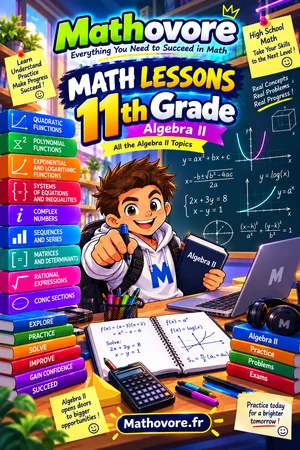
Key takeaway: Algebra 2 math on Mathovore has 20 chapters, from complex numbers and polynomial functions to logarithms, trigonometric graphs and statistical inference. Each chapter combines instruction, graded practice, an assessment and a quick self-check, all with keys.
Algebra 2 math chapters
Real and Complex Numbers
Skills you build: This chapter extends the number system past the real line. You will classify numbers into their nested sets, define the imaginary unit i, write numbers as a + bi, perform arithmetic with complex values including conjugates, and find patterns in the powers of i.
Quadratic Equations with Complex Solutions
Skills you build: What happens when a parabola never touches the x-axis? You will use the discriminant to predict the type of solutions, apply the quadratic formula when it is negative, choose between square roots and completing the square, and explain why complex answers arrive as conjugate pairs.
Radicals and Rational Exponents
Skills you build: Roots and fractional powers turn out to be two notations for one idea. You will evaluate nth roots, convert between radical and rational-exponent form, simplify radicals using exponent laws, and solve radical equations while testing every candidate answer for extraneous solutions.
Polynomial Functions and Their Graphs
Skills you build: Learn to predict a polynomial graph before plotting it. You will read end behavior from degree and leading coefficient, find zeros from factored form, explain how multiplicity makes a graph cross or bounce, bound the turning points, and sketch a curve that fits all the clues.
Polynomial Division and the Remainder Theorem
Skills you build: Dividing polynomials unlocks factoring of higher-degree expressions. You will carry out long division and synthetic division, use the Remainder Theorem to evaluate a polynomial quickly, apply the Factor Theorem to confirm roots, and prove polynomial identities by expanding both sides.
Rational Expressions and Equations
Skills you build: Fractions with variables follow the same logic as numerical fractions. You will factor to simplify, state excluded values, multiply, divide, add, and subtract with common denominators, clear denominators to solve rational equations, and set up work-rate problems from real situations.
Rational Functions and Their Graphs
Skills you build: Graphing a quotient of polynomials means finding where it breaks. You will locate vertical and horizontal asymptotes, spot removable holes, transform the basic reciprocal curve into y = a/(x - h) + k, and model inverse variation with equations and graphs.
Transformations of Functions
Skills you build: Rather than plotting points one at a time, you will change a parent graph on purpose. You will apply horizontal and vertical shifts, stretches, compressions, and reflections, write the equation that matches a picture, classify even and odd symmetry, and graph root functions.
Function Operations, Composition and Inverses
Skills you build: Functions can be combined, nested, and reversed. You will add, multiply, and compose functions, work out the domain of the result, solve for an inverse algebraically, verify it by composition, and sketch an inverse as the reflection of the original graph across y = x.
Exponential Functions and the Number e
Skills you build: Here you build models for quantities that multiply by a fixed factor over time. You will distinguish growth from decay, write equations from data, compare doubling time with half-life, and see how compounding more and more often leads to the constant e and continuous growth.
Logarithms and Logarithmic Functions
Skills you build: A logarithm answers the question of which exponent produces a given number. You will convert between exponential and log form, graph log functions and their transformations, apply the product, quotient, and power properties to expand or condense expressions, and switch bases with the change-of-base formula.
Solving Exponential and Logarithmic Equations
Skills you build: Solving equations where the unknown sits in an exponent or inside a logarithm takes practice. You will match bases, take logs of both sides, check for extraneous roots, and apply the results to half-life decay, compound interest, and rewriting expressions to expose a hidden growth rate.
Sequences and Series
Skills you build: Patterns that grow by adding or multiplying are the subject here. You will write explicit and recursive rules for arithmetic and geometric sequences, express sums in sigma notation, derive and use closed formulas for series, and model savings plans and loan payments.
Radians and the Unit Circle
Skills you build: Trigonometry moves beyond triangles here. You will measure angles in radians, convert between radians and degrees, place any angle on the unit circle, read off sine and cosine using reference angles and signs, and use the Pythagorean identity to find a missing ratio.
Graphs of Trigonometric Functions
Skills you build: Sine and cosine waves describe anything that repeats. You will read amplitude, period, phase shift, and midline from an equation, graph a sinusoid in a systematic sequence of steps, and write trigonometric models that fit tides, daylight hours, or a rotating wheel.
Probability: Sample Spaces, Independence and Conditional Probability
Skills you build: Counting outcomes carefully is the foundation of every probability model. You will list sample spaces, combine events with unions, intersections, and complements, compute conditional probability, test independence, and organize multi-step experiments with tree diagrams and two-way tables.
Data, Normal Distributions and Statistical Inference
Skills you build: Measuring spread and judging how unusual a value is sit at the heart of this chapter. You will compute mean and standard deviation, use the 68-95-99.7 rule and z-scores, tell surveys from experiments and observational studies, and estimate a margin of error by simulation.
Structure of Expressions and Modeling with Equations
Skills you build: Expressions become tools for revealing structure. You will factor and recognize patterns, translate word situations into equations and inequalities, solve f(x) = g(x) using graphs and tables, expand powers with the Binomial Theorem, and see why complex numbers complete the solution of quadratics.
Interpreting and Comparing Functions
Skills you build: Reading a function means more than evaluating it. You will identify intercepts, intervals of increase, and extrema, restrict a domain to fit a context, compute average rate of change, complete the square to expose a vertex, and compare functions given as graphs, tables, or formulas.
Statistical Experiments, Simulation and Decisions
Skills you build: This chapter trains you to judge evidence from data. You will test whether an observed result is plausible under a model using simulation, compare two treatments in an experiment, critique statistical reports for flaws, and apply probability to make fair, defensible decisions.
What math do students learn in Algebra 2?
Algebra 2 widens the toolkit from Algebra 1. Students meet complex numbers, higher-degree polynomials, rational functions and logarithms. They also study sequences, series, radians and the graphs of sine and cosine.
Common Core strands include Number and Quantity, Algebra, Functions and Statistics. Codes such as N-CN.A.1 and F-TF.A.1 head the relevant chapters.
In what order should Algebra 2 math chapters be studied?
Begin with real and complex numbers, then solve quadratics that have complex solutions. Radicals and rational exponents follow. Polynomial functions, division and the remainder theorem come next, and they lead into rational expressions and rational functions.
After that, study transformations, function composition and inverses. These ideas make the exponential and logarithmic chapters much clearer, including the number e and equation solving.
Sequences and series come next, then radians, the unit circle and trigonometric graphs. Probability and normal distributions precede the closing chapters on modeling, comparing functions and statistical experiments.
What should a student know before Algebra 2?
Students should factor quadratics, graph linear and quadratic functions, and use exponent rules without hesitation. Solving systems of equations is also assumed. Geometry adds right-triangle trigonometry, which prepares the trig chapters here.
If factoring still feels slow, return to the Algebra 1 factoring chapter. It speeds up almost every Algebra 2 topic.
Why is Algebra 2 considered a gateway course?
Many colleges ask for Algebra 2 on applications, and it underlies science, economics and computing courses. Logarithms and exponentials describe growth, while trigonometry describes cycles. Students who master both are ready for Precalculus. Furthermore, the modeling chapters show how exponentials fit real data such as loans and populations.
Standardized tests such as the ACT and SAT also draw heavily on these topics.
How should a student practice Algebra 2 efficiently?
Plan about thirty minutes per sitting. Do the worksheet in two sittings, with the harder half on a separate day. Check each answer against the key, and rewrite any method that differed. Then take the quiz to confirm the idea, and sit the test when the quiz score is steady.
What comes after Algebra 2?
Precalculus follows for students heading toward calculus, and statistics courses serve other paths. Functions, logarithms and trigonometry from this course return in both.
Algebra 2 math: what families ask
How many chapters make up Algebra 2?
Twenty chapters cover numbers, functions, trigonometry and data.
Are logarithms covered?
Yes. Two chapters cover logarithmic functions and solving exponential and logarithmic equations.
Do tests include answer keys?
Yes, and each key explains how to give partial credit.
Is it printable?
Yes. All documents print in US Letter format.

