


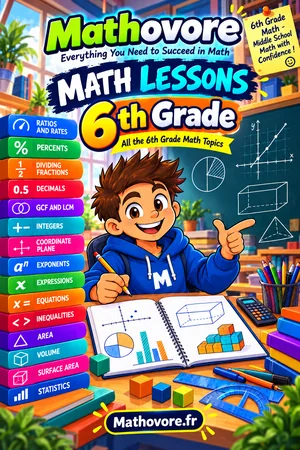
Key takeaway: Grade 6 math on Mathovore has 20 chapters that cover ratios, fraction division, negative numbers, equations, area and volume, and statistics. Each chapter adds a lesson, a long worksheet, a timed test and a short quiz, all with answer keys.
Grade 6 math chapters
Ratios and Ratio Language
Skills you build: Comparing quantities by multiplication is the core idea. Students write ratios in several forms, tell part-to-part from part-to-whole, generate equivalent ratios, complete ratio tables, plot pairs on the coordinate plane, and reason with tape diagrams in everyday contexts.
Percents
Skills you build: Percent is treated as a rate per hundred. Learners convert among percents, fractions, and decimals, find a percent of a quantity, find the whole when given a part, determine what percent one number is of another, and model with tape diagrams and double number lines.
Converting Measurement Units
Skills you build: Moving between units is treated as multiplying by one. Students build conversion factors for length, weight, and capacity in customary and metric systems, convert step by step, compare measurements given in different units, and judge whether an answer is reasonable.
Dividing Fractions
Skills you build: Dividing by a fraction stops being mysterious. Students find reciprocals, change mixed numbers to improper fractions, divide using multiplication by the reciprocal, picture quotients with bar models and number lines, and solve word problems about equal portions and servings.
Multi-Digit Division
Skills you build: Division of large numbers becomes a routine students trust. They repeat divide, multiply, subtract, and bring down, interpret remainders in context, estimate with compatible numbers to catch slips, and verify quotients by multiplying back and adding the remainder.
Adding, Subtracting, Multiplying and Dividing Decimals
Skills you build: Decimal calculation becomes dependable. Students line up place values to add and subtract, place the decimal point correctly in products, divide by decimals after shifting both numbers, estimate to check reasonableness, and solve money and measurement problems.
Greatest Common Factor and Least Common Multiple
Skills you build: Factors and multiples solve practical puzzles. Learners list factors, find prime factorizations, compute the greatest common factor and least common multiple, rewrite sums using the distributive property, and decide which one answers questions about equal groups or repeating schedules.
Integers, Opposites and Absolute Value
Skills you build: Numbers below zero get a home on the number line. Learners compare and order positive and negative numbers, find opposites, interpret absolute value as distance, and use integers to describe temperatures, elevations, debts, and other real situations.
The Coordinate Plane
Skills you build: Locating points in all four quadrants is the starting skill. Learners plot ordered pairs, read signs to name quadrants, reflect points across axes, find distances along horizontal and vertical lines, and use coordinates to draw polygons and solve map-style problems.
Exponents and Order of Operations
Skills you build: Students write repeated multiplication as powers, evaluate expressions like 3^4, and read powers of ten. They follow the agreed order of operations, including grouping symbols, to simplify multi-step numerical expressions and explain why different orders produce different results.
Writing and Evaluating Algebraic Expressions
Skills you build: Letters start standing in for numbers. Students translate phrases like three more than twice a number into expressions, name terms, coefficients, and constants, evaluate expressions by substituting values, and use formulas such as the volume of a cube.
One-Step Equations
Skills you build: Equations are presented as balanced scales. Students undo addition, subtraction, multiplication, or division with inverse operations, apply the same step to both sides, solve with whole numbers, fractions, and decimals, and check solutions by substitution into the original equation.
Writing and Graphing Inequalities
Skills you build: A single value gives way to a whole set of answers. Students translate phrases like at least or no more than into symbols, test numbers as possible solutions, graph inequalities on number lines with open or closed circles, and model constraints from real situations.
Dependent and Independent Variables
Skills you build: Cause and effect appear in equations, tables, and graphs. Learners identify which quantity depends on the other, write equations like d = 65t, build tables of values, place variables on the correct axes, and describe how one quantity changes as the other does.
Area of Triangles, Quadrilaterals and Polygons
Skills you build: Area of flat shapes grows beyond rectangles. Learners compose and decompose triangles, parallelograms, and trapezoids, apply the matching formulas with a perpendicular height, break composite figures into simpler pieces, and report answers in square units.
Volume of Rectangular Prisms
Skills you build: Volume is built from layers of unit cubes. Learners apply V = l * w * h and V = Bh to prisms with fractional edges, find missing dimensions by dividing, pack cubes of fractional edge length, and solve problems with tanks, boxes, and storage.
Surface Area and Nets
Skills you build: Three-dimensional solids are unfolded into flat nets. Learners identify the faces of prisms and pyramids, calculate the area of each face, add them to find surface area, use formulas for cubes and rectangular prisms, and solve wrapping and painting problems.
Statistical Questions and Data Displays
Skills you build: Students learn to ask questions whose answers vary and to collect data that answers them. They draw dot plots, histograms, and box plots, describe each distribution by center, spread, and shape, and match the display to the type of data.
Mean, Median, Range, IQR and Mean Absolute Deviation
Skills you build: Describing a data set with a few numbers is the goal. Students compute mean, median, range, interquartile range, and mean absolute deviation, then decide which measure best represents the data and how an unusual value pulls one measure more than another.
What math do 6th graders learn?
Sixth grade is the year when arithmetic turns into algebra. Students meet ratios and rates, divide fractions by fractions, and place negative numbers on a number line. They also write expressions with letters and solve their first equations.
The standards fall into five domains: Ratios and Proportional Relationships, The Number System, Expressions and Equations, Geometry, and Statistics and Probability. Every chapter on this page lists the matching codes, such as 6.RP.A.1 for ratio language.
In what order should Grade 6 math chapters be studied?
Begin with ratios, unit rates, percents and unit conversions. These chapters rely on multiplication and fractions from Grade 5, so they feel familiar. Next, move to dividing fractions, multi-digit division and decimal operations.
Then work through number theory and integers: greatest common factor, least common multiple, opposites and absolute value. The coordinate plane follows naturally, because it uses all four quadrants.
After that, tackle exponents, order of operations, algebraic expressions, one-step equations and inequalities. Dependent and independent variables link algebra to graphs. Geometry and data close the year, covering area, volume, surface area and nets, then measures of center and spread.
What should a student know before 6th grade math?
A student should multiply and divide whole numbers fluently and add fractions with unlike denominators. Decimal place value up to thousandths also matters. In addition, Grade 5 volume and the first quadrant of the coordinate plane prepare students for the work ahead.
If these skills feel shaky, review the matching Grade 5 chapters first. A week of review often saves a month of confusion later.
How can parents use Grade 6 math worksheets, tests and quizzes?
Pick one chapter per week. On Monday, read the lesson together and talk through the worked examples. On Tuesday and Wednesday, the student completes half of the worksheet each evening.
Check the answers on Thursday and fix every miss. Friday is quiz day, and the following Monday is a good time for the 45-minute test. This calm rhythm fits around sports and other activities.
What are the hardest topics in 6th grade math?
Most families report trouble with dividing fractions, percents and negative numbers. These ideas break habits built on whole numbers. Visual models help: bar diagrams for ratios and number lines for integers.
The answer keys show these models step by step, so students can copy the method on similar problems.
What comes after Grade 6 math?
Grade 7 deepens proportional reasoning with percent problems, scale drawings and probability. Students also learn to add and subtract rational numbers and solve two-step equations. Strong ratio skills from Grade 6 make that year much smoother.
Grade 6 math: frequently asked questions
What math is taught in Grade 6?
Grade 6 math covers five Common Core domains: Ratios and Proportional Relationships, The Number System, Expressions and Equations, Geometry, and Statistics and Probability.
How are these Grade 6 chapters organized?
Each chapter follows one group of Common Core standards and offers six resources: a one-page lesson, a long worksheet, a worksheet key, a timed test, a test key with scoring guide, and an online quiz.
Are the worksheets printable?
Yes. Every lesson, worksheet, test and answer key can be downloaded as a printable PDF in US Letter format.
How should a student use these resources?
Read the lesson, do the worksheet without looking at the answers, check every step with the answer key, take the quiz online, then take the timed test.
Do these pages match state standards?
The chapters follow the Common Core State Standards for Mathematics, used by most US states; the exact standard codes are listed at the top of every page.
How big is the Grade 6 course?
The course has 20 chapters, from ratios and unit rates to mean absolute deviation.
Is 6th grade math hard?
It is a big step because letters and negative numbers appear. Short daily practice and the worked answer keys make the jump manageable.

