


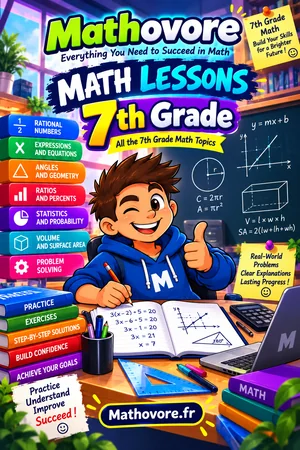
Key takeaway: Grade 7 math on Mathovore has 21 chapters about proportional relationships, percent problems, rational numbers, equations, geometry and probability. Every chapter brings a lesson, practice sheet, timed test and online quiz, each with a key.
Grade 7 math chapters
Unit Rates with Fractions
Skills you build: Rates now involve fractional quantities. Students divide fractions to find unit rates such as miles per hour when distance is a fraction, simplify complex fractions, convert units first when needed, and use unit rates to solve and compare real-world problems.
Proportional Relationships
Skills you build: Students decide whether two quantities are proportional by checking for a constant ratio in tables, graphs, and descriptions. They identify the constant of proportionality as a unit rate, test whether a graph passes through the origin, and explain what points on it represent.
Adding and Subtracting Integers and Rational Numbers
Skills you build: Signed numbers behave predictably once you see the pattern. Learners add on number lines, use opposites that sum to zero, rewrite subtraction as adding the opposite, work with fractions and decimals below zero, and interpret distance between two numbers as an absolute value.
Multiplying and Dividing Integers and Rational Numbers
Skills you build: Sign rules are explained, not just memorized. Learners multiply and divide positive and negative integers, fractions, and decimals, justify why a negative times a negative is positive, recognize that dividing by zero is undefined, and solve real-world problems with signed quantities.
Two-Step Inequalities
Skills you build: Inequalities gain a second step. Learners solve forms like 2x + 3 > 11, reverse the sign when dividing by a negative, graph solution sets on number lines, interpret what the solutions mean in a budget or time story, and compare them with equation answers.
Scale Drawings
Skills you build: Maps, blueprints, and models are read with proportional thinking. Learners convert between drawing and actual lengths using a scale, turn scales into scale factors, compute actual areas, redraw figures at a different scale, and check that results make sense.
Angle Relationships
Skills you build: Angle facts become tools for finding unknowns. Students recognize complementary, supplementary, vertical, and adjacent angles in diagrams, write and solve simple equations from those relationships, and justify each measurement with the property that supports it.
Area, Surface Area and Volume of Prisms
Skills you build: Measurement of solids is built from familiar flat shapes. Learners find areas of triangles, quadrilaterals, and composite figures, then compute surface area and volume of right prisms, track square versus cubic units, and solve problems about boxes, tents, and containers.
Equations of Proportional Relationships
Skills you build: Proportional situations are written as y = kx. Learners find the constant from tables, graphs, and stories, write equations for cost, distance, and conversion problems, and interpret specific points, such as (1, r), on a line through the origin.
Percent Problems: Tax, Tips, Markups and Discounts
Skills you build: Everyday money situations drive the practice. Learners calculate sales tax, tips, markups, discounts, and commissions, chain successive percent changes, explain why two discounts do not simply add, and write and solve equations to find a missing price or rate.
Percent Increase, Percent Decrease and Percent Error
Skills you build: Change is measured relative to a starting amount. Students compute percent increase, decrease, and error, use multipliers like 1.15 or 0.80 for quick calculations, work backward to recover an original value, and compare changes across different base amounts.
Rational Numbers: Decimals, Fractions and Word Problems
Skills you build: Fractions and decimals are shown to be two views of the same numbers. Learners convert fractions to terminating or repeating decimals using long division, compute with mixed signs, and solve multi-step word problems that mix whole numbers, fractions, and decimals.
Equivalent Expressions
Skills you build: Rewriting is the main action. Students combine like terms, expand with the distributive property, factor out common numbers, work with rational coefficients, and explain how two different-looking expressions describe the same quantity in a context such as a discount or a perimeter.
Two-Step Equations
Skills you build: Equations of the forms px + q = r and p(x + q) = r are solved with care. Students undo operations in the right order, choose between dividing first or distributing, compare arithmetic and algebraic solutions, and write equations for stories involving rational numbers.
Drawing Geometric Figures and Constructing Triangles
Skills you build: Can these measurements make a triangle? Learners test side lengths with the triangle inequality, draw figures with a ruler, protractor, or compass, decide when given conditions produce one triangle, many, or none, and reason about angle sums.
Circumference and Area of Circles
Skills you build: Circles bring pi into everyday calculations. Students relate diameter and radius, use C = 2 * pi * r and A = pi * r^2, give answers exactly in terms of pi or as decimal approximations, and handle half circles and rings in practical settings.
Random Sampling and Making Inferences
Skills you build: Conclusions about a large group start with a small one. Students tell populations from samples, spot biased methods, choose random sampling strategies, use sample proportions to estimate population counts, and see how sample-to-sample variation affects confidence in a prediction.
Comparing Two Populations
Skills you build: Two data sets are set side by side. Learners compare means or medians with measures of spread, express the gap between centers as a multiple of the variability, judge how much the distributions overlap, and draw cautious conclusions about the populations behind random samples.
Probability of Compound Events
Skills you build: Probability grows from single events to combinations. Students list sample spaces with organized lists, tables, and tree diagrams, count outcomes of multi-step experiments, compute probabilities of compound events, and run simulations to estimate chances that are hard to calculate.
Cross Sections of 3D Figures
Skills you build: Slicing solids in the imagination is the key skill. Students predict and sketch the two-dimensional shapes formed when a plane cuts prisms, pyramids, cylinders, cones, and spheres, and describe how the angle and position of the cut change the result.
Probability and Probability Models
Skills you build: Likelihood gets a number between 0 and 1. Students distinguish theoretical from experimental probability, build models for equally likely and unequal outcomes, collect data from trials, compare predicted and observed frequencies, and predict how often an event occurs in many repetitions.
What math do 7th graders learn?
Seventh grade stretches proportional thinking across many topics. Students compute unit rates with fractions, write equations for proportional relationships, and solve real percent problems. They also operate on all rational numbers, including negative fractions and decimals.
The course draws on five Common Core domains, and the chapter list above shows where each standard appears.
How should students order Grade 7 math chapters?
Open with the proportion cluster: unit rates, proportional relationships and their equations. Percent chapters come next, covering tax, tips, markups, discounts, percent change and percent error. Those skills appear in daily life, which keeps motivation high.
Then study integers and rational numbers. Adding and subtracting come before multiplying and dividing, and the decimal and fraction connections close that block.
Algebra follows with equivalent expressions, two-step equations and two-step inequalities. Geometry brings scale drawings, triangle constructions, cross sections, circles, angle relationships and prism measures. Statistics and probability finish the course, from random sampling to compound events.
What should a student know before 7th grade math?
Students need confident ratio language, unit rates and simple percents from Grade 6. They should also place integers on a number line and solve one-step equations. Without these tools, signed-number operations feel arbitrary.
A quick check works well. Ask the student to solve 3x = 15 and to compare -4 with -7. Hesitation signals a chapter worth reviewing.
How can teachers use Grade 7 math tests and quizzes?
Run a quiz as a ten-minute opener after each lesson block. Use the test at the end of a unit, then grade it with the scoring guide, which awards partial credit out of 20 points.
Percent chapters suit project work. Students can price a school-store sale and compute the markup, then compare their results against the answer key.
Why is 7th grade math important?
This year is a bridge to formal algebra. Students who master proportional reasoning and signed numbers rarely struggle with linear equations in Grade 8. Weak spots, on the other hand, tend to grow.
Probability and sampling also appear on state tests, so steady practice pays off in spring.
What comes after Grade 7 math?
Grade 8 introduces slope, systems of equations, functions and the Pythagorean theorem. Proportional relationships from Grade 7 become linear graphs. Students who finish Grade 8 can enter Algebra 1 with confidence.
Grade 7 math: questions from families
How big is the Grade 7 course?
The course has 21 chapters, from unit rates with fractions to compound probability.
Do the worksheets have answer keys?
Yes. Each worksheet has 20 or more problems and a worked answer key.
Are there Grade 7 tests?
Yes. Each chapter has a 45-minute test scored out of 20 points, with its own key.
Can students take quizzes online?
Yes. Each chapter has a 10-question quiz that runs on screen.

