



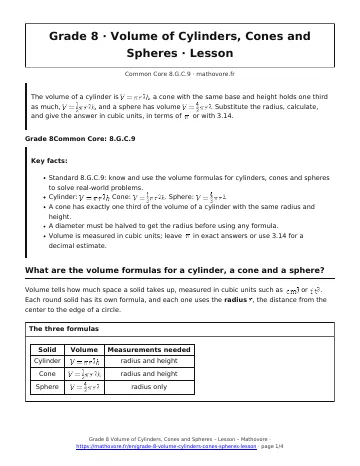
The volume of a cylinder is \(V=\pi r^{2}h\), a cone with the same base and height holds one third as much, \(V=\frac{1}{3}\pi r^{2}h\), and a sphere has volume \(V=\frac{4}{3}\pi r^{3}\). Substitute the radius, calculate, and give the answer in cubic units, in terms of \(\pi\) or with 3.14.
Key facts:
- Standard 8.G.C.9: know and use the volume formulas for cylinders, cones and spheres to solve real-world problems.
- Cylinder: \(V=\pi r^{2}h\). Cone: \(V=\frac{1}{3}\pi r^{2}h\). Sphere: \(V=\frac{4}{3}\pi r^{3}\).
- A cone has exactly one third of the volume of a cylinder with the same radius and height.
- A diameter must be halved to get the radius before using any formula.
- Volume is measured in cubic units; leave \(\pi\) in exact answers or use 3.14 for a decimal estimate.
What are the volume formulas for a cylinder, a cone and a sphere?
Volume tells how much space a solid takes up, measured in cubic units such as \(\text{cm}^{3}\) or \(\text{ft}^{3}\). Each round solid has its own formula, and each one uses the radius \(r\), the distance from the center to the edge of a circle.
| Solid | Volume | Measurements needed |
|---|---|---|
| Cylinder | \(V=\pi r^{2}h\) | radius and height |
| Cone | \(V=\frac{1}{3}\pi r^{2}h\) | radius and height |
| Sphere | \(V=\frac{4}{3}\pi r^{3}\) | radius only |
The cylinder formula is base area times height: the circle \(\pi r^{2}\) is repeated \(h\) times .
How are the three volumes related?
Take a cone and a cylinder with the same radius and the same height. Filling the cone with water and pouring it into the cylinder takes exactly three times , so the cone is one third of the cylinder. A sphere of radius \(r\) fits snugly in a cylinder of radius \(r\) and height \(2r\), and it fills exactly two thirds of that cylinder.
How do you find the volume step by step?
- Write the formula for the solid.
- Find the radius. If a diameter is given, divide it by 2.
- Substitute the radius and the height, and square or cube the radius first.
- Multiply, and write the answer in cubic units.
Worked example. A paper cone cup has a diameter of 6 cm and a height of 10 cm. The radius is \(6: 2=3\text{ cm}\), so \(V=\frac{1}{3}\pi(3)^{2}(10)=\frac{1}{3}\pi\cdot 90=30\pi\text{ cm}^{3}\). With 3.14, \(V\approx 94.2\text{ cm}^{3}\).
When should the answer keep \(\pi\) and when should it use 3.14?
Leave \(\pi\) in the answer when the problem says “in terms of \(\pi\)”: \(30\pi\text{ cm}^{3}\) is exact. Replace \(\pi\) with 3.14 when a real-world question needs a number, such as how many cups a tank holds. Round only at the very end.
Volume of Cylinders, Cones and Spheres: frequently asked questions
What is the formula for the volume of a cylinder?
The volume of a cylinder is \(V=\pi r^{2}h\), where \(r\) is the radius of the base and \(h\) is the height. For \(r=2\text{ in}\) and \(h=5\text{ in}\), \(V=\pi(4)(5)=20\pi\text{ in}^{3}\).
Why does a cone have one third of the volume of a cylinder?
A cone narrows to a point, so it fills less space than a cylinder with the same base and height. Pouring a full cone into that cylinder three times fills it exactly, which is why the cone formula has the factor \(\frac{1}{3}\).
How do you find the volume of a sphere from its diameter?
Divide the diameter by 2 to get the radius, then use \(V=\frac{4}{3}\pi r^{3}\). A ball with a 10 in diameter has \(r=5\text{ in}\), so \(V=\frac{4}{3}\pi(125)=\frac{500}{3}\pi\text{ in}^{3}\).
Should I use 3.14 or leave the answer in terms of pi?
Follow the directions. “In terms of \(\pi\)” means keep the symbol, as in \(36\pi\). When the problem asks for an approximation, replace \(\pi\) with 3.14 and round at the end, so \(36\pi\approx 113.04\).
What units does volume use?
Volume uses cubic units because it counts three-dimensional space. Lengths in centimeters give \(\text{cm}^{3}\), and lengths in feet give \(\text{ft}^{3}\). Always attach the cubic unit to the final answer.
See every chapter on the Grade 8 math page.