


This worksheet gives 24 problems on the properties of integer exponents for Grade 8, standard 8.EE.A.1. Early problems practice the product, quotient and power rules with positive exponents.
Later problems use zero and negative exponents to write equivalent numerical expressions. The last six are word problems, comparisons and error checks. Show every step and leave answers as powers or fractions when asked.
Problem 1: Expand and evaluate
Write \(2^{5}\) as repeated multiplication and find its value.
Problem 2: Write as a power
Write \(5\cdot5\cdot5\cdot5\) as a power and evaluate it.
Problem 3: Product rule
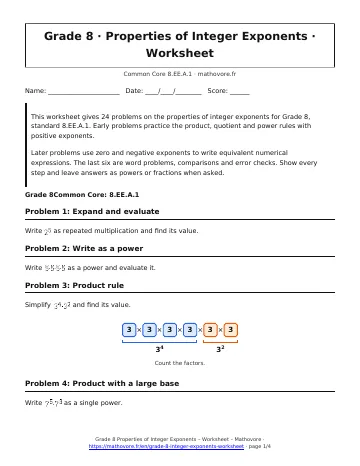
Simplify \(3^{4}\cdot3^{2}\) and find its value.
Problem 4: Product with a large base
Write \(7^{5}\cdot7^{3}\) as a single power.
Problem 5: Quotient rule
Simplify \(\frac{5^{9}}{5^{6}}\) and find its value.
Problem 6: Powers of ten
Simplify \(\frac{10^{8}}{10^{3}}\) and write the value as a whole number.
Problem 7: Power of a power
Simplify \((2^{3})^{2}\) and find its value.
Problem 8: Power of a larger base
Simplify \((4^{2})^{3}\) and find its value.
Problem 9: Zero exponent
Evaluate \(9^{0}\), \((-6)^{0}\) and \(4\cdot3^{0}\).
Problem 10: Negative exponents
Use the pattern in the table to find \(2^{-3}\). Then write \(5^{-2}\) as a fraction.
Problem 11: Negative power of ten
Write \(10^{-4}\) as a fraction and as a decimal.
Problem 12: Mixed exponents
Simplify \(3^{2}\cdot3^{-5}\) and write it as a fraction.
Problem 13: Negative plus positive
Simplify \(4^{-2}\cdot4^{5}\) and find its value.
Problem 14: Quotient with a negative result
Simplify \(\frac{6^{3}}{6^{5}}\) and write the answer as a fraction.
Problem 15: Negative power of a power
Simplify \((3^{-2})^{2}\) and write it as a fraction.
Problem 16: Power of a product
Use the power of a product rule to evaluate \((2\cdot5)^{3}\) and \((\frac{2}{3})^{3}\).
Problem 17: Fraction base, negative exponent
Evaluate \((\frac{3}{2})^{-2}\).
Problem 18: Find the missing exponent
Find the missing exponent in each equation: \(7^{?}\cdot7^{4}=7^{9}\); \(\frac{2^{8}}{2^{?}}=2^{3}\); \(3^{?}=\frac{1}{81}\).
Problem 19: Multi-step expression
Simplify \(\frac{(3^{5}\cdot3^{-2})^{2}}{3^{4}}\) and find its value.
Problem 20: Which is greater?
Maya says \(2^{-4}\) is greater than \(3^{-2}\) because 2 to the fourth is bigger. Compare the two numbers and decide whether she is right.
Problem 21: Doubling colony
A colony starts with 1 cell and doubles every hour. (a) Write the number of cells after 10 hours as a power of 2 and evaluate it. (b) Explain why \(2^{0}\) fits the starting count.
Problem 22: Gigabytes and kilobytes
A gigabyte is about \(10^{9}\) bytes and a kilobyte is about \(10^{3}\) bytes. How many kilobytes are in one gigabyte?
Problem 23: Find Noah's error
Noah wrote \(2^{3}\cdot2^{4}=4^{7}\). Explain his mistake and give the correct result.
Problem 24: Find Priya's error
Priya says \(2^{-3}=-8\). Explain the error and write the correct value.

See every chapter on the Grade 8 math page.