


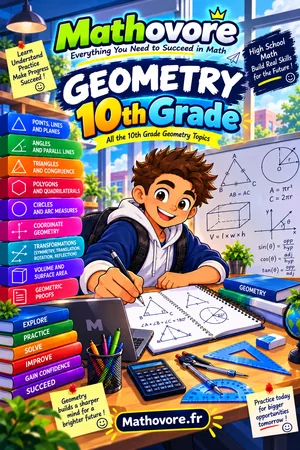
Key takeaway: Geometry math on Mathovore has 20 chapters covering proofs, transformations, congruent and similar triangles, right-triangle trigonometry, circles, coordinate geometry and volume. Every chapter pairs one explanation page with practice problems, a unit test and a short online check.
Geometry math chapters
Points, Lines, Planes, Segments and Angles
Skills you build: Geometry starts by agreeing on precise language. You will work from undefined terms to definitions of segments, rays, angles, and perpendicular lines, apply the Segment and Angle Addition Postulates, name angle pairs, and set up algebraic equations to find missing measures.
Logic and Two-Column Proofs
Skills you build: Logical argument is the backbone of geometry. You will write conditional statements with their converse, inverse, and contrapositive, tell inductive guesses from deductive conclusions, and organize a valid two-column proof in which every step carries a stated reason.
Parallel Lines, Transversals and Proofs
Skills you build: A transversal cutting two lines creates a family of angle pairs. You will name corresponding, alternate interior, and same-side angles, use parallelism to deduce equal or supplementary measures, prove lines parallel from angle evidence, and apply the Perpendicular Bisector Theorem in proofs.
Rigid Transformations
Skills you build: Movement without distortion is analyzed on the coordinate plane. You will translate, reflect, and rotate figures, write rules for each map, tell rigid from non-rigid transformations, identify line and rotational symmetry, and describe a composition of several transformations precisely.
Congruent Triangles: SSS, SAS, ASA, AAS and HL
Skills you build: Proving two figures identical needs only a few measurements. You will define congruence through rigid motions, apply the SSS, SAS, ASA, AAS, and HL criteria, explain why SSA and AAA fail, and write a clear proof that uses corresponding parts of congruent triangles.
Triangle Theorems and Points of Concurrency
Skills you build: Every triangle hides surprising regularities. You will prove the angle sum and exterior angle results, use midsegments and medians, construct the circumcenter, incenter, centroid, and orthocenter, and locate each center with coordinates to verify where lines concur.
Parallelograms and Special Quadrilaterals
Skills you build: Quadrilaterals are sorted by their properties and proved with them. You will use side, angle, and diagonal facts of parallelograms, prove that a quadrilateral qualifies, separate rectangles, rhombuses, and squares, contrast trapezoids with kites, and solve for missing measures.
Geometric Constructions
Skills you build: Without any measuring tools, you will create exact figures using a compass and straightedge. You will copy segments and angles, bisect both, build perpendicular and parallel lines, and inscribe an equilateral triangle, square, and regular hexagon in a circle while explaining why each works.
Dilations and Similarity Transformations
Skills you build: Scaling a figure leads straight to the idea of similarity. You will perform dilations about a center on the coordinate plane, explain how a scale factor changes lengths but preserves angles, show that figures are similar through transformations, and justify the AA criterion.
Similar Triangles and Proportions
Skills you build: Proportional reasoning reaches full strength with similar triangles. You will prove similarity using AA, SAS, and SSS criteria, apply the triangle proportionality theorem, exploit the altitude in a right triangle, and compute heights and distances that cannot be measured directly.
Right Triangle Trigonometry
Skills you build: Ratios of sides in right triangles solve problems that tape measures cannot. You will define sine, cosine, and tangent, explain why they depend on angle alone, use complementary relationships, apply special right triangles, and solve for every side and angle in applications.
Law of Sines, Law of Cosines and Triangle Area
Skills you build: Triangles without a right angle can still be solved completely. You will find area from two sides and the included angle, choose between the Law of Sines and the Law of Cosines, solve triangles from partial data, and recognize when the ambiguous case gives two answers.
Coordinate Geometry Proofs
Skills you build: Algebra becomes a proof tool when figures sit on a grid. You will apply the distance and midpoint formulas, test slopes for parallel and perpendicular lines, partition a segment in a given ratio, compute perimeter and area, and classify triangles and quadrilaterals by coordinates.
Circles: Chords, Arcs and Inscribed Angles
Skills you build: Angle relationships inside and outside a circle make a rich set of theorems. You will relate central and inscribed angles to arcs, prove that a semicircle gives a right angle, work with tangents, chords, and secants, and use properties of inscribed quadrilaterals.
Arc Length, Sector Area and Radians
Skills you build: Parts of a circle can be measured exactly with proportional reasoning. You will compute arc length and sector area from a central angle, define the radian as a ratio of arc to radius, and convert fluently between degrees and radians in applied problems.
Equation of a Circle
Skills you build: Circles meet algebra in this chapter. You will write the equation from a center and radius, extract both from an equation, complete the square to convert general form to standard form, and decide whether a given point lies inside, on, or outside the circle.
Area and Volume Formulas
Skills you build: Formulas for area and volume are explained, not just memorized. You will justify the circumference and area of a circle by dissection, use Cavalieri's principle, derive and apply volumes of cylinders, pyramids, cones, and spheres, and solve composite-solid problems with units.
Cross Sections, Solids of Rotation and Geometric Modeling
Skills you build: Three-dimensional thinking is applied to real objects here. You will describe cross sections of solids, identify the solid generated by rotating a flat shape, approximate everyday items with geometric figures, calculate density, and satisfy design constraints in modeling problems.
Probability: Independence, Conditional Probability and Fair Decisions
Skills you build: Chance is treated with the language of sets and counting. You will describe events with unions, intersections, and complements, test independence, read conditional probabilities from two-way tables, count with permutations and combinations, and judge whether a game or decision is fair.
Parabolas from Focus and Directrix, and Tangent Lines to a Circle
Skills you build: Two classic curves and lines meet in this chapter. You will derive a parabola's equation from its focus and directrix, read focus and directrix back from an equation, prove that a tangent is perpendicular to the radius, and construct tangents from an external point.
What math do students learn in Geometry?
High school Geometry teaches students to reason from definitions to conclusions. They write two-column proofs, study rigid motions, and prove triangles congruent. Later chapters add similarity, trigonometric ratios, circle theorems and solid formulas.
The main Common Core strands are Congruence, Similarity and Right Triangles, Circles, Expressing Geometric Properties with Equations, and Modeling. Codes such as G-CO.A.1 label each chapter.
In what order should Geometry math chapters be studied?
Open with points, lines, planes, segments and angles. Logic and proofs come second, and parallel lines with transversals give the first real proof practice. Rigid transformations then lead directly into congruent triangles and the criteria SSS, SAS, ASA, AAS and HL.
Triangle theorems, special quadrilaterals and constructions follow. After that, dilations and similarity introduce scale and proportion, which unlock right-triangle trigonometry and the laws of sines and cosines.
Coordinate proofs, circle theorems, arc length, sector area and the equation of a circle make up the next block. Area and volume formulas, cross sections and probability finish the year.
What should a student know before Geometry?
A student should solve linear equations and simplify radicals. Knowing how to plot points and find slope also helps. Moreover, Grade 8 work on the Pythagorean theorem and transformations gives a head start.
Weak algebra slows proofs and trigonometry more than any geometric idea does. Review it early.
How do you get better at geometry proofs?
Proofs feel hard because they ask for reasons, not just answers. Begin by marking a diagram with every given fact. Then list the theorems that could apply, and choose the shortest chain.
The answer keys write each proof in two columns with a reason for every line. Copying that format for new problems builds the habit quickly.
How do geometry tests and quizzes support learning?
Each test checks one chapter and mixes computation with proof. The key shows full credit and partial credit for incomplete arguments. Short quizzes check vocabulary and formulas, which students often forget between units.
What comes after Geometry?
Algebra 2 comes next in most schools, and it reuses coordinate geometry and trigonometric ideas. Students headed for Precalculus will meet radians and the unit circle again, so the arc length chapter pays off later.
Geometry math: questions from parents
How big is the Geometry course?
It has 20 chapters, from basic angle facts to parabolas and tangent lines.
Are constructions included?
Yes. One chapter covers compass and straightedge constructions.
Does it include trigonometry?
Yes. Two chapters cover right-triangle trigonometry and the laws of sines and cosines.
Can I print the answer keys?
Yes. Every key is a PDF in US Letter format.

