

Key takeaway: This grade 8 slope proportional worksheet holds 22 printable problems on unit rates, graphs and equations of lines. Standards 8.EE.B.5 and 8.EE.B.6 shape it for 8th grade, and complete solutions live on a separate page.
Label axes with units, because a slope without units loses its meaning.
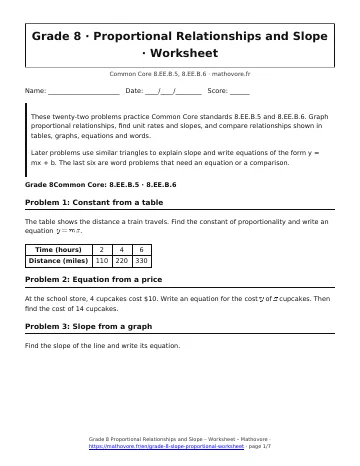
These twenty-two problems practice Common Core standards 8.EE.B.5 and 8.EE.B.6. Graph proportional relationships, find unit rates and slopes, and compare relationships shown in tables, graphs, equations and words.
Later problems use similar triangles to explain slope and write equations of the form y = mx + b. The last six are word problems that need an equation or a comparison.
Grade 8 Slope Proportional Worksheet: problems 1–5
1. Constant from a table
The table shows the distance a train travels. Find the constant of proportionality and write an equation \(y=mx\).
| Time (hours) | 2 | 4 | 6 |
|---|---|---|---|
| Distance (miles) | 110 | 220 | 330 |
2. Equation from a price
At the school store, 4 cupcakes cost $10. Write an equation for the cost \(y\) of \(x\) cupcakes. Then find the cost of 14 cupcakes.
3. Slope from a graph
Find the slope of the line and write its equation.
4. Negative slope
Find the slope of the line. Then write its equation.
5. Graph y = mx
Complete the table of values for \(y=\frac{3}{4}x\) when \(x=0\), \(4\) and \(8\). Then graph the line.
Grade 8 Slope Proportional Worksheet: problems 6–10
6. Slope and intercept
Name the slope and the \(y\)-intercept of each equation.
- \(y=-2x+5\)
- \(y=\frac{1}{3}x-4\)
- \(y=4x\)
7. Graph y = mx + b
Graph \(y=2x+1\). Start at the \(y\)-intercept and use the slope to find two more points.
8. Similar triangles
The small triangle has run 2 and rise 3. The large triangle has run 6. Find the rise of the large triangle, and explain why both triangles give the same slope.
9. Table versus equation
Bike A follows \(y=12x\), where \(y\) is miles after \(x\) hours. Bike B is shown in the table. Which bike is faster?
| Time (hours) | 2 | 3 | 5 |
|---|---|---|---|
| Distance (miles) | 28 | 42 | 70 |
10. Graph versus equation
The graph shows the pages printed by Printer A. Printer B prints pages by \(y=15x\), where \(x\) is minutes. Which printer is faster, and by how many pages per minute?
Grade 8 Slope Proportional Worksheet: problems 11–15
11. Compare with words
Noah’s hose fills 18 gallons in 4 minutes. Sofia’s hose is shown in the table. Whose hose fills faster, and by how much?
| Time (min) | 2 | 3 | 5 |
|---|---|---|---|
| Water (gal) | 8.4 | 12.6 | 21 |
12. Slope from two points
A line passes through \((1,3)\) and \((5,11)\). Find the slope, then write the equation in the form \(y=mx+b\).
13. Slope with negatives
Find the slope of the line through \((-2,4)\) and \((3,-6)\).
14. Proportional or not
Decide whether the table shows a proportional relationship. If not, write an equation for it.
| x | 0 | 1 | 2 | 3 |
|---|---|---|---|---|
| y | 2 | 5 | 8 | 11 |
15. Equation from a graph
Find the equation of the line shown on the graph. Write it in the form \(y=mx+b\) and name \(m\) and \(b\).
Grade 8 Slope Proportional Worksheet: problems 16–20
16. Missing coordinate
A proportional relationship passes through \((6,9)\). Find \(y\) when \(x=10\), and find \(x\) when \(y=21\).
17. Taxi fare
A taxi charges a $3 flat fee plus $2 for each mile. Write an equation for the cost \(y\) of an \(x\)-mile ride, name the slope and \(y\)-intercept, and find the cost of a 7-mile ride.
18. Ramp rise
A ramp rises 2 feet over a horizontal run of 24 feet. A second ramp has the same slope and a run of 30 feet. Find the rise of the second ramp.
19. Gym plans
Gym A charges a $20 sign-up fee plus $5 per visit. Gym B charges $9 per visit with no fee. Write an equation for each, find each cost for 10 visits, and tell which plan is a proportional relationship.
20. Savings race
The graph shows how much Diego and Aisha save. Write an equation for each person and find how much more Aisha saves per week than Diego.
Grade 8 Slope Proportional Worksheet: problems 21–22
21. Savings with a start
Mei’s savings account had $50 after 2 weeks and $90 after 6 weeks, and it grows at a constant rate. Find the weekly rate, write an equation, and tell how much she started with. Is the relationship proportional?
22. Draining a tank
A tank holds 120 gallons. It drains at a constant rate of 8 gallons per minute. Write an equation for the water \(y\) left after \(x\) minutes, name the slope and \(y\)-intercept, and find when the tank is empty.

What is on this 8th grade slope and proportional relationships worksheet?
Tables, prices and graphs through the origin open the set in problems 1 to 5. Next, \(y=mx+b\) arrives in problems 6 and 7. Meanwhile, the similar-triangle task in problem 8 links rise and run to a scale factor of 3, and the next three problems compare rates in different forms.
Which problems need extra care?
Negative slopes appear in problem 4 and problem 13, so track the signs when you subtract coordinates. The table in problem 14 starts at 2, which means it is not proportional. With the point \((6,9)\) in problem 16, the constant is 1.5, so any missing coordinate comes from multiplying or dividing.
How do the real-world problems use slope?
A taxi in problem 17 charges a $3 flat fee, so the line does not pass through the origin. Gym A in problem 19 adds a $20 sign-up fee, whereas gym B charges $9 per visit with no fee. Therefore the plans cross at one number of visits. The ramp in problem 18 rises 2 feet over 24 feet, so a 30-foot run lifts it 2.5 feet.
How can you avoid slope mistakes?
First, write the rise over the run with the same order for both points. Otherwise, one sign flips and the slope turns upside down. For example, going from \((2,3)\) to \((6,9)\) gives \(\frac{9-3}{6-2}=1.5\), but mixing the order gives -1.5. Next, check the answer against the picture, because a line that climbs must have a positive slope. In addition, test whether a graph passes through the origin before you call it proportional. Finally, give every rate its units, so the number tells a full story.
What is a good routine for proportional relationship problems?
First, scan the table. Next, divide each output by its input. Then compare the quotients. If they match, the relationship is proportional. Otherwise, it is not. Also, the graph of a proportional relationship is a line through the origin. Therefore, check the point \((0,0)\) at once. In problem 14, for example, the table starts at 2, so the test fails immediately. Meanwhile, problem 16 passes, because 9 divided by 6 is 1.5. After that, use 1.5 to fill the gaps. Finally, write the equation \(y=1.5x\) as your answer.
Likewise, a unit rate always answers a question. First, name the two quantities. Next, put the one you compare in the denominator. Then divide. Afterward, attach the units. Besides, a short label such as dollars per visit prevents confusion. Consequently, the rate in problem 19 reads as 9 dollars per visit for gym B. In contrast, gym A mixes a flat fee with a rate. Hence its line does not start at zero. Still, both plans follow a straight line.
How do you read slope from a graph?
First, pick two clear grid points. Next, count the rise. Then count the run. After that, divide the rise by the run. Also, watch the direction. If the line falls to the right, the slope is negative. Therefore, problems 4 and 13 need a minus sign. Meanwhile, a flat line has slope 0. Yet a vertical line has no slope at all. Thus, never write the run over the rise. Instead, keep the vertical change on top. Finally, simplify the fraction, because 6 over 4 equals 1.5.
Similarly, similar triangles share one slope. First, compare the legs of the small triangle. Next, compare the legs of the large one. Then check the scale factor of 3 from problem 8. As a result, the ratios match. Besides, this idea explains why every pair of points along one line yields an identical slope. Hence you may choose the easiest pair. Moreover, a ramp like the one in problem 18 uses the same idea. Finally, scale the rise by the run to find the height.
How should you check your work on this slope worksheet?
First, reread each question. Next, confirm the units. Then test one point in your equation. Also, sketch the graph quickly. If it looks wrong, rework the signs. After that, compare with the solutions page. Finally, log each miss, so the next practice set starts with the weak skill.
Next, time yourself on the taxi problem. Then retry it tomorrow. Also, explain the $3 fee aloud. As a result, the y-intercept stops feeling mysterious. Finally, praise small gains, so practice stays positive. Also, share one tip with a classmate, because teaching locks in the idea.
What should you do next with this slope worksheet?
Compare your lines with the solutions and recheck every sign. After that, graph problems 17 and 19 on one grid to see where the gym plans meet. When both graphs make sense, try the quiz.

See every chapter on the Grade 8 math page.