Solving Linear Equations: Grade 8 Math Quiz – PDF Download
Answer these ten multiple-choice questions on solving linear equations. Some questions use a picture and some ask how many solutions an equation has. Choose the single best answer, then read the explanation to learn from any mistakes.
Grade 8Common Core: 8.EE.C.7a · 8.EE.C.7b
🎯 Solving Linear Equations – Grade 8 math quiz
Score: 0 / 10
Answered: 0 / 10
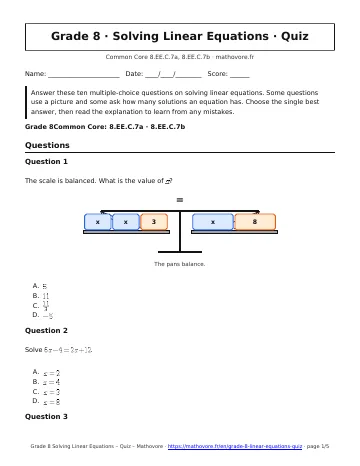
Question 1
The scale is balanced. What is the value of \(x\)?
The pans balance.
A\(5\)
B\(11\)
C\(\frac{11}{3}\)
D\(-5\)
Question 2
Solve \(6x-4=2x+12\).
A\(x=2\)
B\(x=4\)
C\(x=3\)
D\(x=8\)
Question 3
Solve \(3(x-4)=2x+5\).
A\(x=17\)
B\(x=9\)
C\(x=7\)
D\(x=-17\)
Question 4
The tape diagram shows an equation. What is \(x\)?
A tape diagram for an equation.
A\(x=18\)
B\(x=\frac{32}{3}\)
C\(x=6\)
D\(x=8\)
Question 5
How many solutions does \(4(x+3)=4x+9\) have?
AOne solution, \(x=3\)
BInfinitely many solutions
COne solution, \(x=0\)
DNo solution
Question 6
How many solutions does \(2(3x-1)+4=6x+2\) have?
ANo solution
BOne solution, \(x=0\)
CInfinitely many solutions
DOne solution, \(x=1\)
Question 7
The perimeter of this rectangle is 40 feet. What is \(x\)?
The perimeter is 40 feet.
A\(x=10\)
B\(x=30\)
C\(x=13\)
D\(x=12\)
Question 8
Solve \(\frac{1}{2}x+3=\frac{1}{4}x+7\).
A\(x=4\)
B\(x=40\)
C\(x=8\)
D\(x=16\)
Question 9
Ravi's work is shown. Which step contains his first error?
Ravi's solution.
AThe second step: subtracting \(3x\)
BThe first step: distributing
CThe third step: dividing by two
DThere is no error
Question 10
Solve \(0.5x+2.5=0.2x+4.3\).
A\(x=60\)
B\(x=\frac{18}{7}\)
C\(x=6\)
D\(x=8\)
🎉 Quiz complete!
0 / 10
Remember:
Standards 8.EE.C.7a and 8.EE.C.7b: solve linear equations with rational coefficients, and decide how many solutions an equation has.
Use the distributive property, \(a(b+c)=ab+ac\), and combine like terms before moving terms across.
Do the same operation to both sides to keep the equation balanced.
A false result like \(3=7\) means no solution; a true result like \(6=6\) means infinitely many solutions.
Always check by substituting the solution into the original equation.