Key takeaway: This grade 8 transformations test presents eight questions on translations, reflections and rotations, with 20 points to earn. It assesses 8.G.A.1 and 8.G.A.3 in eighth grade, and grading notes sit on a separate page.
Write every image as an ordered pair, because the key checks each coordinate.
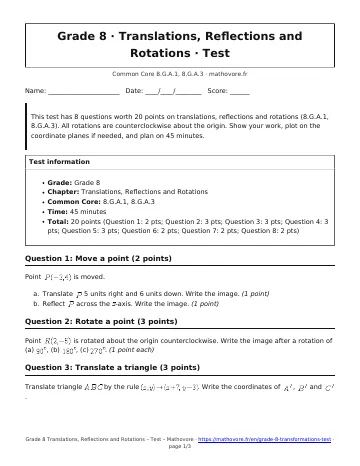
This test has 8 questions worth 20 points on translations, reflections and rotations (8.G.A.1, 8.G.A.3). All rotations are counterclockwise about the origin. Show your work, plot on the coordinate planes if needed, and plan on 45 minutes.
- Grade: Grade 8
- Chapter: Translations, Reflections and Rotations
- Common Core: 8.G.A.1, 8.G.A.3
- Time: 45 minutes
- Total: 20 points (Question 1: 2 pts; Question 2: 3 pts; Question 3: 3 pts; Question 4: 3 pts; Question 5: 3 pts; Question 6: 2 pts; Question 7: 2 pts; Question 8: 2 pts)
Grade 8 Transformations Test: questions 1–5
1. Move a point (2 points)
Point \(P(-3,4)\) is moved.
- Translate \(P\) 5 units right and 6 units down. Write the image. (1 point)
- Reflect \(P\) across the \(x\)-axis. Write the image. (1 point)
2. Rotate a point (3 points)
Point \(R(2,-5)\) is rotated about the origin counterclockwise. Write the image after a rotation of (a) \(90^{\circ}\), (b) \(180^{\circ}\), (c) \(270^{\circ}\). (1 point each)
3. Translate a triangle (3 points)
Translate triangle \(ABC\) by the rule \((x,y)\to(x+7,\,y-3)\). Write the coordinates of \(A^{\prime}\), \(B^{\prime}\) and \(C^{\prime}\).
4. Reflect a triangle (3 points)
- Reflect triangle \(DEF\) across the \(y\)-axis. Write the image vertices. (1 point)
- Reflect triangle \(DEF\) across the \(x\)-axis. Write the image vertices. (1 point)
- In triangle \(DEF\), side \(DE=4\) units and \(\angle D=45^{\circ}\). Write the length of the image of \(DE\) and the measure of the image of \(\angle D\) for part (a). (1 point)
5. Rotate a triangle (3 points)
Rotate triangle \(GHJ\) by \(90^{\circ}\) counterclockwise about the origin. Write the image vertices.
Grade 8 Transformations Test: questions 6–8
6. Name the motion (2 points)
Triangle \(ABC\) has vertices \(A(1,3)\), \(B(4,3)\), \(C(1,5)\). Its image has vertices \(A^{\prime}(-1,-3)\), \(B^{\prime}(-4,-3)\), \(C^{\prime}(-1,-5)\). Name the single rigid motion that was used and write its rule.
7. Properties of rigid motions (2 points)
Parallelogram \(ABCD\) has \(AB=7\text{ in}\), \(BC=4\text{ in}\) and \(\angle A=60^{\circ}\). It is rotated \(90^{\circ}\) about the origin to form \(A^{\prime}B^{\prime}C^{\prime}D^{\prime}\). Find \(A^{\prime}B^{\prime}\), \(B^{\prime}C^{\prime}\) and \(\angle A^{\prime}\), and tell whether \(\overline{A^{\prime}B^{\prime}}\) and \(\overline{C^{\prime}D^{\prime}}\) are parallel.
8. Find the original point (2 points)
Point \(S^{\prime}\) is at \((4,-7)\) after a \(270^{\circ}\) counterclockwise rotation about the origin. Find the original point \(S\).

What does the grade 8 transformations test include?
Point P at \((-3,4)\) is translated 5 right and 6 down, and then reflected. Point R at \((2,-5)\) is rotated through three different angles. Triangles ABC, DEF and GHJ are then translated, reflected and rotated.
One question shows an image and asks you to name the motion. Another uses a parallelogram with sides 7 and 4 and a 60-degree angle.
How should you study before the test?
Memorize the rules in a short table. Next, apply each rule to one point. Then try the reverse direction, such as finding the original point for an image at \((4,-7)\) after a 270-degree turn.
- Keep a ruler and graph paper handy for checking.
- Check that each image has the same side lengths.
How do you explain rigid motions?
State that side lengths and angles are unchanged, so the image is congruent. Because the key rewards the property, name it explicitly.
What should you do after the transformations test?
Compare your paper with the key and redraw each figure you missed. Next, rewrite each rule from memory. If the reverse question cost points, practice undoing rotations step by step.

See every chapter on the Grade 8 math page.