Key takeaway: This grade 8 volume cylinders cones worksheet supplies 23 printable problems on cylinders, cones, spheres and everyday containers. Its target is 8.G.C.9 in eighth grade, and the full solutions have their own page.
Write the formula before you substitute, since that single habit prevents most errors.
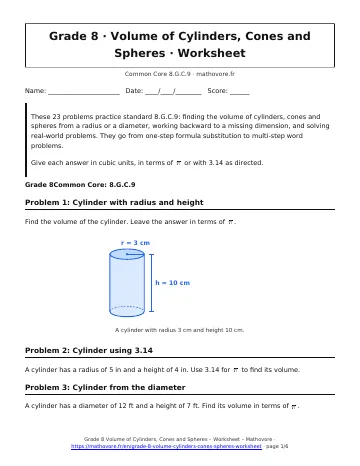
These 23 problems practice standard 8.G.C.9: finding the volume of cylinders, cones and spheres from a radius or a diameter, working backward to a missing dimension, and solving real-world problems. They go from one-step formula substitution to multi-step word problems.
Give each answer in cubic units, in terms of \(\pi\) or with 3.14 as directed.
Grade 8 Volume Cylinders Cones Worksheet: problems 1–5
1. Cylinder with radius and height
Find the volume of the cylinder. Leave the answer in terms of \(\pi\).
2. Cylinder using 3.14
A cylinder has a radius of 5 in and a height of 4 in. Use 3.14 for \(\pi\) to find its volume.
3. Cylinder from the diameter
A cylinder has a diameter of 12 ft and a height of 7 ft. Find its volume in terms of \(\pi\).
4. Cone with radius and height
Find the volume of the cone in terms of \(\pi\).
5. Cone using 3.14
A cone has a radius of 6 cm and a height of 9 cm. Use 3.14 for \(\pi\) to find its volume.
Grade 8 Volume Cylinders Cones Worksheet: problems 6–10
6. Cone from the diameter
A cone has a diameter of 10 m and a height of 12 m. Find its volume in terms of \(\pi\).
7. Sphere with a given radius
Find the volume of the sphere in terms of \(\pi\).
8. Sphere using 3.14
A sphere has a radius of 6 in. Use 3.14 for \(\pi\) to find its volume.
9. Sphere from the diameter
A sphere has a diameter of 10 ft. Find its volume in terms of \(\pi\), and then round to the nearest hundredth using 3.14.
10. Find the height of a cylinder
A cylinder has a volume of \(150\pi\text{ cm}^{3}\) and a radius of 5 cm. Find its height.
Grade 8 Volume Cylinders Cones Worksheet: problems 11–15
11. Find the radius of a cylinder
A cylinder has a volume of \(245\pi\text{ in}^{3}\) and a height of 5 in. Find its radius.
12. Find the height of a cone
A cone has a volume of \(96\pi\text{ ft}^{3}\) and a radius of 6 ft. Find its height.
13. Find the radius of a sphere
A sphere has a volume of \(288\pi\text{ cm}^{3}\). Find its radius.
14. Cylinder versus cone
A cylinder and a cone both have a radius of 4 cm and a height of 9 cm. Find the volume of each in terms of \(\pi\), and tell how the two volumes compare.
15. Volume of a hemisphere
A hemisphere is half of a sphere. A hemisphere-shaped dome has a radius of 9 m. Find its volume in terms of \(\pi\).
Grade 8 Volume Cylinders Cones Worksheet: problems 16–20
16. Soup can
A soup can has a diameter of 3 in and a height of 4 in. Use 3.14 for \(\pi\) to find how much soup the can holds.
17. Water storage tank
A cylindrical water tank has a radius of 4 ft and a height of 10 ft. (a) Use 3.14 for \(\pi\) to find its volume. (b) A pump fills the tank at 40 cubic feet per minute. About how many minutes does it take to fill the empty tank? Round to the nearest tenth.
18. Pile of sand
A pile of sand is shaped like a cone with a radius of 6 ft and a height of 5 ft. (a) Find the volume in terms of \(\pi\). (b) Use 3.14 to approximate it. (c) A dump truck carries 20 cubic feet of sand per load. How many loads are needed to move the whole pile?
19. Ice cream cone with a scoop
An ice cream cone has a radius of 1 in and a height of 4 in. A hemisphere-shaped scoop with the same radius sits on top. Find the total volume of ice cream and cone in terms of \(\pi\), and then with 3.14.
20. Basketball
A basketball has a diameter of 9 in. Use 3.14 for \(\pi\) to find the volume of air it holds, rounded to the nearest hundredth.
Grade 8 Volume Cylinders Cones Worksheet: problems 21–23
21. Tennis ball can
A can has a radius of 1.5 in and a height of 9 in, and holds 3 tennis balls, each with a radius of 1.5 in. Find the empty space in the can, in terms of \(\pi\) and then to the nearest tenth with 3.14.
22. Filling paper cups
A cylindrical jug has a radius of 3 in and a height of 8 in. Paper cups are cones with a radius of 2 in and a height of 3 in. How many full cups can be filled from a full jug?
23. Reshaping a ball of clay
Priya rolls a ball of clay with a radius of 3 cm, then flattens it into a cylinder with a radius of 3 cm without losing any clay. How tall is the cylinder?

What is on this 8th grade volume of cylinders and cones worksheet?
Problems 1 to 3 start with cylinders, including one with a diameter of 12 feet. Then problems 4 to 6 repeat the pattern with cones, and problems 7 to 9 use spheres. Next, problems 10 to 13 work backward, such as finding the radius of a sphere with volume \(288\pi\).
Which problems are tricky?
Problem 9 gives a diameter of 10 feet, so the radius is 5 and the exact volume is \(\frac{500}{3}\pi\). Problem 15 asks for a hemisphere of radius 9 meters, which is half a sphere. Problem 14 pairs a cylinder with a cone of identical size, so the cone ends up a third as large.
How do the real-world problems use volume?
A soup can has diameter 3 inches and height 4 inches, so use radius 1.5. A sand pile is a cone with radius 6 feet and height 5 feet. A basketball has diameter 9 inches, so the radius is 4.5. In the tennis can problem, three balls sit inside a can, so subtract their volume from the can to find the empty space. Finally, the clay problem asks how a ball reshaped into a cylinder keeps its volume.
Which formula should you choose for each solid?
First, name the shape. Next, write its formula. For a cylinder, use \(V=\pi r^{2}h\). Then, for a cone, take one third of that value. Meanwhile, a sphere uses \(V=\frac{4}{3}\pi r^{3}\). Also, a hemisphere is half of a sphere, so problem 15 halves the result. Therefore, a radius of 9 meters gives \(\frac{2}{3}\pi\cdot729=486\pi\) cubic meters. Finally, keep the answer in terms of pi until the end, because rounding early adds error.
Similarly, the radius causes most slips. First, check whether the problem gives a diameter. If so, halve it. For example, the 12-foot cylinder has radius 6, and the soup can has radius 1.5. Otherwise, the volume comes out four times too large. Next, cube the radius for a sphere, but square it for the other two solids. In addition, write the units as cubic feet or cubic inches. As a result, your answer shows what the number measures.
How do you work backward from a volume?
First, write the formula with the known volume. Next, replace everything you know. Then isolate the unknown. For the sphere with volume \(288\pi\), divide by \(\frac{4}{3}\pi\) to get \(r^{3}=216\). After that, take the cube root, so the radius is 6. Also, test the answer by cubing 6. Because \(6^{3}=216\), the check works. Besides, a quick estimate helps, since a radius near 6 should give a volume near 900. Finally, label the answer with units of length, not volume.
Meanwhile, the clay problem reuses one amount in two shapes. First, compute the ball’s volume. Next, set the cylinder formula equal to it. Then solve for the height. Consequently, no extra clay appears or vanishes. Likewise, the tennis can problem subtracts three ball volumes from the can. Therefore, the leftover space is the difference. Afterward, compare it with the can’s volume to see the fraction. Finally, restate the result in a sentence, so the work reads like an answer.
How can you compare solids with equal measurements?
First, picture a cylinder next to a cone that shares its base and its height. Next, recall that the cone holds one third as much. Therefore, three cones of sand fill the cylinder exactly. Also, problem 14 tests this idea. However, a sphere behaves differently, because its height equals its diameter. For example, a sphere of radius 3 holds \(36\pi\) cubic units, while a cylinder of radius 3 and height 6 holds \(54\pi\). Thus, the sphere fills two thirds of that cylinder. Besides, this fact lets you check an answer in seconds.
Meanwhile, the sand pile shows why cones matter. First, find the base area with radius 6. Then multiply by the height of 5. After that, divide by 3. Consequently, the pile holds \(60\pi\) cubic feet. Finally, compare it with a cylinder of the same size, so the difference feels real.
Next, try a quick self-test. First, cover the formulas. Then say each one from memory. Also, draw the three solids with labels. Afterward, solve one problem of each kind. In addition, time yourself, so speed grows with accuracy.
Then reward yourself after each correct set. Also, note any unit slips. Finally, retry the basketball problem, so the radius habit sticks.
How do you extend this worksheet?
Check your formula choice in the solutions, then redo each backward problem with new numbers. Next, measure a real can and a real ball at home and compute their volumes. If your answers match the labels closely, move on to the quiz.

See every chapter on the Grade 8 math page.