Key takeaway: This grade 8 transformations worksheet gives 26 printable problems on moving points and figures on the coordinate plane. It practices standards 8.G.A.1 and 8.G.A.3 in eighth grade, and complete solutions are on a separate page.
Plot every vertex, because a quick sketch exposes sign mistakes.
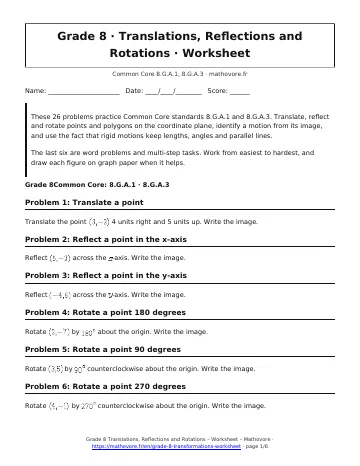
These 26 problems practice Common Core standards 8.G.A.1 and 8.G.A.3. Translate, reflect and rotate points and polygons on the coordinate plane, identify a motion from its image, and use the fact that rigid motions keep lengths, angles and parallel lines.
The last six are word problems and multi-step tasks. Work from easiest to hardest, and draw each figure on graph paper when it helps.
Grade 8 Transformations Worksheet: problems 1–5
1. Translate a point
Translate the point \((3,-2)\) 4 units right and 5 units up. Write the image.
2. Reflect a point in the x-axis
Reflect \((5,-3)\) across the \(x\)-axis. Write the image.
3. Reflect a point in the y-axis
Reflect \((-4,6)\) across the \(y\)-axis. Write the image.
4. Rotate a point 180 degrees
Rotate \((2,-7)\) by \(180^{\circ}\) about the origin. Write the image.
5. Rotate a point 90 degrees
Rotate \((3,5)\) by \(90^{\circ}\) counterclockwise about the origin. Write the image.
Grade 8 Transformations Worksheet: problems 6–10
6. Rotate a point 270 degrees
Rotate \((4,-1)\) by \(270^{\circ}\) counterclockwise about the origin. Write the image.
7. Translate a triangle
Translate triangle \(JKL\) using the rule \((x,y)\to(x+3,\,y-4)\). Write the coordinates of the image.
8. Reflect a triangle
Reflect triangle \(PQR\) across the \(y\)-axis. Write the coordinates of the image.
9. Reflect a trapezoid
Reflect trapezoid \(ABCD\) across the \(x\)-axis. Write the coordinates of the image.
10. Rotate a triangle 90 degrees
Rotate triangle \(DEF\) by \(90^{\circ}\) counterclockwise about the origin. Write the coordinates of the image.
Grade 8 Transformations Worksheet: problems 11–15
11. Rotate a parallelogram
Rotate parallelogram \(WXYZ\) with vertices \(W(1,1)\), \(X(5,1)\), \(Y(6,3)\), \(Z(2,3)\) by \(180^{\circ}\) about the origin. Write the image.
12. Rotate a triangle 270 degrees
Rotate triangle \(GHI\) with vertices \(G(-3,1)\), \(H(-3,4)\), \(I(-1,1)\) by \(270^{\circ}\) counterclockwise about the origin. Write the image.
13. Describe a translation
Segment \(AB\) has endpoints \(A(-2,1)\) and \(B(0,4)\). Its image has endpoints \(A^{\prime}(3,-3)\) and \(B^{\prime}(5,0)\). Describe the translation and write its rule.
14. Identify the reflection
Triangle \(A^{\prime}B^{\prime}C^{\prime}\) is the image of triangle \(ABC\) after one reflection. Across which axis was it reflected? Give the rule.
15. Identify the rotation
Triangle \(A^{\prime}B^{\prime}C^{\prime}\) is the image of triangle \(ABC\) after a rotation about the origin. Decide whether the rotation is \(90^{\circ}\), \(180^{\circ}\) or \(270^{\circ}\) counterclockwise.
Grade 8 Transformations Worksheet: problems 16–20
16. Write the rule
A motion sends \((2,5)\) to \((-2,5)\) and \((-3,7)\) to \((3,7)\). Name the motion and write its rule.
17. What stays the same
Triangle \(DEF\) has \(DE=6\text{ cm}\), \(EF=8\text{ cm}\) and \(\angle E=90^{\circ}\). It is reflected across the \(y\)-axis. Find \(D^{\prime}E^{\prime}\), \(E^{\prime}F^{\prime}\) and the measure of \(\angle E^{\prime}\).
18. Parallel lines
Line segment \(p\) joins \((1,1)\) and \((3,5)\). Segment \(q\) joins \((3,1)\) and \((5,5)\). Both are rotated \(180^{\circ}\) about the origin. Show that the images are parallel.
19. Translate, then reflect
Triangle \(ABC\) has vertices \(A(1,2)\), \(B(3,2)\), \(C(1,5)\). Translate it 2 units left and 3 units down, then reflect the result across the \(y\)-axis. Write the final image.
20. Rotate, then reflect
Triangle \(PQR\) has vertices \(P(1,1)\), \(Q(4,1)\), \(R(4,3)\). Rotate it \(90^{\circ}\) counterclockwise about the origin, then reflect the result across the \(x\)-axis. Write the final image.
Grade 8 Transformations Worksheet: problems 21–25
21. Park map
On a park map, a bench is at \((-6,2)\), where each unit is 1 yard. The designers place a second bench by reflecting the first across the \(y\)-axis, which is the center path. Where is the second bench, and how far apart are the benches?
22. Game piece
In a board game on a coordinate grid, Maya’s piece is at \((3,2)\). A card makes it rotate \(90^{\circ}\) counterclockwise about the origin, and a second card does it again. Where is the piece, and which single rotation gives the same result?
23. Wallpaper stamp
A stamp design has a vertex at \((1,1)\). Each new stamp is a translation of the previous one by 4 units right. Where is that vertex on the 4th stamp?
24. Find the original point
Point \(Q^{\prime}\) is at \((-3,8)\) after a \(270^{\circ}\) counterclockwise rotation about the origin. Find the original point \(Q\).
25. Two reflections
Reflect the point \((3,2)\) across the \(x\)-axis, then reflect the result across the \(y\)-axis. Which single rotation about the origin has the same result?
Grade 8 Transformations Worksheet: problems 26–26
26. Legs and the right angle
Right triangle \(ABC\) has \(A(1,1)\), \(B(5,1)\) and \(C(5,4)\). Rotate it \(90^{\circ}\) counterclockwise about the origin. Show that both legs keep their lengths and that the angle at \(B^{\prime}\) is still a right angle.

What is on this 8th grade transformations worksheet?
The first six problems move single points. They translate \((3,-2)\), reflect \((5,-3)\) and \((-4,6)\), and rotate \((2,-7)\), \((3,5)\) and \((4,-1)\). Then problems 7 to 12 move whole figures, from triangle \(JKL\) to parallelogram \(WXYZ\).
Which transformation problems are hardest?
Reverse questions ask you to name a motion from the image. In problem 13, segment \(AB\) lands at a new location, so compare endpoints to find the translation. Problem 16 sends \((2,5)\) to \((-2,5)\), so the x-coordinate flipped sign. Problem 24 asks for the original point, so undo a 270-degree turn.
Combined moves appear in problems 19 and 20. The order matters, so finish one motion before you begin the next.
How do the real-world problems use transformations?
A park map places a second bench by reflection. A board game card rotates a piece from \((3,2)\), and a wallpaper stamp repeats by a translation of fixed size. Therefore each story is one of the three rules in disguise.
How do you extend the 26 transformation problems?
Redo the three combined-motion problems with a different order and compare the images. Then check your answers with the solutions. When both orders make sense, take the quiz.

See every chapter on the Grade 8 math page.