Key takeaway: This grade 8 two way tables test contains nine questions worth 20 points about counts, totals and percents. It covers standard 8.SP.A.4 at the eighth-grade level, with the grading notes kept separately.
Say which total you divide by, since the key credits that choice.
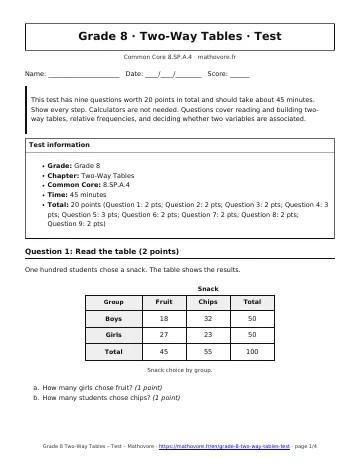
This test has nine questions worth 20 points in total and should take about 45 minutes. Show every step. Calculators are not needed. Questions cover reading and building two-way tables, relative frequencies, and deciding whether two variables are associated.
- Grade: Grade 8
- Chapter: Two-Way Tables
- Common Core: 8.SP.A.4
- Time: 45 minutes
- Total: 20 points (Question 1: 2 pts; Question 2: 2 pts; Question 3: 2 pts; Question 4: 3 pts; Question 5: 3 pts; Question 6: 2 pts; Question 7: 2 pts; Question 8: 2 pts; Question 9: 2 pts)
Grade 8 Two Way Tables Test: questions 1–5
1. Read the table (2 points)
One hundred students chose a snack. The table shows the results.
- How many girls chose fruit? (1 point)
- How many students chose chips? (1 point)
2. Complete the table (2 points)
Eighty students were asked whether they have a sibling and how they get to school. Fill in the two missing cells.
3. Build a table (2 points)
A class has 30 students: 18 girls and 12 boys. Twelve of the girls and 7 of the boys joined the chess club. Make a two-way table of gender and chess club membership, with totals.
4. Relative frequencies (3 points)
Use the snack table.
- What percent of the boys chose fruit? (1 point)
- What percent of the girls chose fruit? (1 point)
- Of the students who chose fruit, what percent are girls? (1 point)
5. Planner and homework (3 points)
One hundred students were asked whether they use a planner and whether they turned in all homework last week.
- Find the row relative frequencies, as percents. (2 points)
- Describe any association between using a planner and turning in homework. (1 point)
Grade 8 Two Way Tables Test: questions 6–9
6. Association or not? (2 points)
Students chose a trip. Do these data suggest an association between grade and trip choice? Justify with relative frequencies.
7. Counts or percents? (2 points)
At School A, 90 of 150 students ride the bus. At School B, 64 of 80 students ride the bus. Noah says the bus is more popular at School A because 90 is greater than 64. (a) Find the percent of riders at each school. (1 point) (b) Is Noah correct? Explain. (1 point)
8. Tally the responses (2 points)
Ten students named a favorite drink. The responses (gender-drink) are: Girl-Juice, Boy-Water, Boy-Water, Girl-Water, Girl-Juice, Boy-Juice, Girl-Juice, Boy-Water, Girl-Water, Boy-Water. Organize them in a two-way table with totals.
9. Choose the total (2 points)
The table shows how students get to school.
- What percent of seventh graders ride the bus? (1 point)
- Of the students who walk, what percent are eighth graders? Round to the nearest tenth. (1 point)

What does the grade 8 two way tables test include?
The first item reads a snack table of 100 students. Next, you fill two missing cells in a sibling and travel survey of 80. Then you build a table from a chess club story with 18 girls and 12 boys.
Relative frequency questions follow. You find what percent of boys chose fruit and compare rows to judge association.
How can you rehearse the table-building skills?
Practice building a table from a paragraph, because counts hide in sentences. Next, rehearse the three denominators: grand total, row total and column total. Finally, write a one-sentence conclusion about association.
- One question compares bus riders at two schools of different sizes.
- One task tallies ten drink responses.
How do you justify an association answer?
Quote two row percents and compare them. For example, if they are 40% and 41%, the link is weak. Because the key rewards numbers, always include them.
What should you do once the two-way table test is scored?
Match your percents to the key and mark the denominator you chose each time. Next, redo the build-a-table item with a new story. If the school comparison cost points, practice turning counts into percents before comparing.

See every chapter on the Grade 8 math page.