Key takeaway: This grade 8 square cube roots lesson explains how to undo a square or a cube with a radical. Standard 8.EE.A.2 guides it, so 8th grade students learn to solve \(x^{2}=p\) and \(x^{3}=p\) and to place roots such as \(\sqrt{50}\) on a number line.
Notice early that squares give two answers, whereas cubes give one.
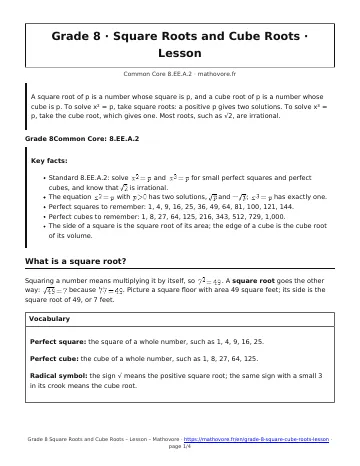
A square root of p is a number whose square is p, and a cube root of p is a number whose cube is p. To solve x² = p, take square roots: a positive p gives two solutions. To solve x³ = p, take the cube root, which gives one. Most roots, such as √2, are irrational.
Grade 8 Square Cube Roots Lesson: key facts
- Standard 8.EE.A.2: solve \(x^{2}=p\) and \(x^{3}=p\) for small perfect squares and perfect cubes, and know that \(\sqrt{2}\) is irrational.
- The equation \(x^{2}=p\) with \(p>0\) has two solutions, \(\sqrt{p}\) and \(-\sqrt{p}\); \(x^{3}=p\) has exactly one.
- Perfect squares to remember: 1, 4, 9, 16, 25, 36, 49, 64, 81, 100, 121, 144.
- Perfect cubes to remember: 1, 8, 27, 64, 125, 216, 343, 512, 729, 1,000.
- The side of a square is the square root of its area; the edge of a cube is the cube root of its volume.
What is a square root?
Squaring a number means multiplying it by itself, so \(7^{2}=49\). A square root goes the other way: \(\sqrt{49}=7\) because \(7\cdot7=49\). Picture a square floor with area 49 square feet; its side is the square root of 49, or 7 feet.
Perfect square: the square of a whole number, such as 1, 4, 9, 16, 25.
Perfect cube: the cube of a whole number, such as 1, 8, 27, 64, 125.
Radical symbol: the sign √ means the positive square root; the same sign with a small 3 in its crook means the cube root.
What is a cube root?
Cubing a number means using it as a factor three times , so \(3^{3}=27\). A cube root undoes that: \(\sqrt[3]{27}=3\). A cube-shaped box that holds 27 cubic inches has an edge of 3 inches. Unlike square roots, a cube root can be negative: \(\sqrt[3]{-8}=-2\) because \((-2)(-2)(-2)=-8\).
| \(n\) | 1 | 2 | 3 | 4 | 5 | 6 | 7 | 8 | 9 | 10 |
|---|---|---|---|---|---|---|---|---|---|---|
| \(n^{2}\) | 1 | 4 | 9 | 16 | 25 | 36 | 49 | 64 | 81 | 100 |
| \(n^{3}\) | 1 | 8 | 27 | 64 | 125 | 216 | 343 | 512 | 729 | 1,000 |
How do you solve x2 = p and x3 = p?
- Look at the exponent. A square calls for a square root; a cube calls for a cube root.
- For \(x^{2}=p\) with \(p>0\), write both answers: \(x=\sqrt{p}\) or \(x=-\sqrt{p}\).
- For \(x^{3}=p\), write the single answer \(x=\sqrt[3]{p}\); it has the same sign as \(p\).
- Check by raising your answer to the power.
Worked example. Solve \(x^{2}=49\). Both \(7\) and \(-7\) square to 49, so \(x=7\) or \(x=-7\). Now solve \(x^{3}=-125\): the only number that cubes to \(-125\) is \(-5\). The equation \(x^{2}=-9\) has no solution, because no real number squared is negative.
Why is the square root of 2 irrational?
Draw a square on a grid, then join the midpoints of its sides. The tilted square covers exactly half the big one. With a big square of area 4, the tilted square has area 2, so its side is \(\sqrt{2}\). Since \(1.4^{2}=1.96\) and \(1.5^{2}=2.25\), the number is between 1.4 and 1.5. But no fraction squares to exactly 2, so \(\sqrt{2}\) is irrational: its decimal never ends or repeats, and \(1.414\) is only an approximation.
Square Roots and Cube Roots: frequently asked questions
Does x² = 25 have one answer or two?
It has two: \(x=5\) and \(x=-5\), because both numbers square to 25. The symbol \(\sqrt{25}\) alone means only the positive root, 5.
Can you take the cube root of a negative number?
Yes. Because a negative times a negative times a negative is negative, \(\sqrt[3]{-27}=-3\). Only square roots of negative numbers are not real.
What is the difference between a perfect square and a perfect cube?
A perfect square is a whole number squared, like 36 from \(6^{2}\). A perfect cube is a whole number cubed, like 216 from \(6^{3}\). The number 64 is both.
How can you tell that the square root of 2 is irrational?
No fraction multiplied by itself equals exactly 2. Calculators show 1.41421356 and more digits that never end or repeat, so any decimal you write is only an approximation.
How do you estimate a square root that is not a perfect square?
Find the two perfect squares around it. Since \(49<50<64\), the number \(\sqrt{50}\) is between 7 and 8, and a little closer to 7.
What is the difference between a square root and a cube root?
A square root of 49 is a number whose square is 49, so it is 7. A cube root of 27 is a number whose cube is 27, so it is 3. Cube roots can be negative, since \(\sqrt[3]{-64}=-4\). Square roots of negative numbers do not appear in grade 8.
How do you solve x² = p and x³ = p?
For \(x^{2}=81\), apply a root to each side and keep both signs, so \(x=9\) or \(x=-9\). For \(x^{3}=216\), there is a single answer, \(x=6\). If extra terms appear, undo them first. In \(x^{2}+6=70\), subtract 6 to get 64, and then take the root.
How do you estimate a root that is not whole?
Find the perfect squares on each side. For example, 50 lies between 49 and 64, so \(\sqrt{50}\) is between 7 and 8, and it sits very close to 7. For cubes, 100 lies between 64 and 125, so \(\sqrt[3]{100}\) is between 4 and 5.
- A root of a non-perfect square, such as \(\sqrt{2}\), is irrational.
- Fractions and decimals work too, for instance \(x^{2}=0.64\) gives \(x=0.8\).
What should you try after learning roots?
Write the first twelve perfect squares and the first six perfect cubes from memory. Then solve three equations of each type, and mark which ones have two answers. Finally, estimate two roots between whole numbers to lock in the bracketing habit.

See every chapter on the Grade 8 math page.