



A proportional relationship is one where \(y=mx\) for a constant \(m\), and its graph is a straight line through the origin. The constant \(m\) is the unit rate and the slope of the line. Similar triangles show that the slope is the same between any two points on a line.
Key facts:
- Standards 8.EE.B.5 and 8.EE.B.6: graph proportional relationships, compare unit rates, and explain slope with similar triangles.
- A proportional relationship is \(y=mx\); the slope \(m\) is the unit rate.
- Slope is rise over run, \(\frac{y_2-y_1}{x_2-x_1}\), and is the same between any two points on a line.
- The equation \(y=mx+b\) has slope \(m\) and \(y\)-intercept \(b\).
- To compare two relationships, compare their unit rates.
What is a proportional relationship?
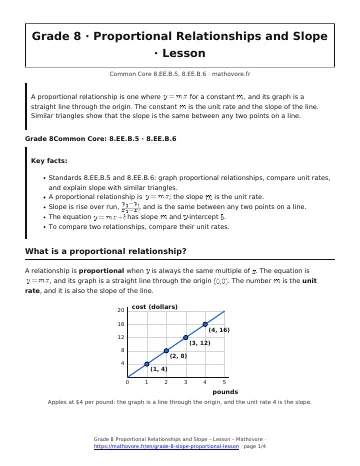
A relationship is proportional when \(y\) is always the same multiple of \(x\). The equation is \(y=mx\), and its graph is a straight line through the origin \((0,0)\). The number \(m\) is the unit rate, and it is also the slope of the line.
What is slope and why is it constant?
Slope: the ratio \(\frac{\text{rise}}{\text{run}}\) between any two points on a line. It is the same number everywhere on a line.
\(y\)-intercept: the point where the line crosses the \(y\)-axis. In \(y=mx+b\), it is \(b\).
Draw a right triangle under a line, with its horizontal side as the run and its vertical side as the rise. A bigger triangle on the same line is similar to the small one, so the ratios of their sides match. That is why the slope is the same for any two points.
How do you write y = mx + b?
When a line does not pass through the origin, add the starting value \(b\). In \(y=2x+1\), the slope is 2 and the line crosses the \(y\)-axis at 1. Lines with the same slope are parallel.
How do you compare two proportional relationships?
- Find the unit rate of each relationship, from a table, a graph, an equation or a sentence.
- Compare the two unit rates.
- The larger unit rate is the steeper line.
Worked example. Bike A follows \(y=12x\). Bike B travels 28 miles in 2 hours and 42 miles in 3 hours. For Bike B, \(\frac{28}{2}=\frac{42}{3}=14\) miles per hour. Since \(14>12\), Bike B is faster.
Proportional Relationships and Slope: frequently asked questions
How do you find the slope of a line?
Pick two points, subtract the \(y\)-values to get the rise and the \(x\)-values to get the run, then divide. For \((1,3)\) and \((5,11)\), the slope is \(\frac{11-3}{5-1}=2\).
Why is the graph of a proportional relationship a line through the origin?
When \(x=0\), \(y=m\cdot 0=0\), so the point \((0,0)\) is on the graph. Every other point has the same ratio \(\frac{y}{x}=m\), so the points line up in a straight line.
How do similar triangles explain slope?
Triangles drawn under a line share the same angles, so they are similar. Similar triangles have equal ratios of rise to run, so the slope is the same for every pair of points.
What is the difference between y = mx and y = mx + b?
The equation \(y=mx\) passes through the origin and is proportional. In \(y=mx+b\), the line crosses the \(y\)-axis at \(b\), so it is proportional only when \(b=0\).
How can you compare a graph with an equation?
Find the unit rate from each one. Read the slope from the graph and the coefficient of \(x\) from the equation, then compare the two numbers.
See every chapter on the Grade 8 math page.