Key takeaway: This grade 8 irrational numbers test offers nine questions for 20 points, and calculators stay in the bag. It assesses standards 8.NS.A.1-2 for 8th grade students, plus a scoring guide on its own page.
Show your work and write approximations with the symbol for approximately equal.
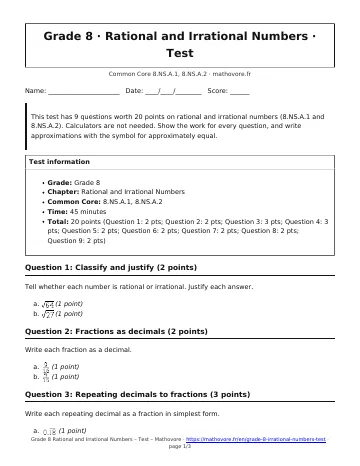
This test has 9 questions worth 20 points on rational and irrational numbers (8.NS.A.1 and 8.NS.A.2). Calculators are not needed. Show the work for every question, and write approximations with the symbol for approximately equal.
- Grade: Grade 8
- Chapter: Rational and Irrational Numbers
- Common Core: 8.NS.A.1, 8.NS.A.2
- Time: 45 minutes
- Total: 20 points (Question 1: 2 pts; Question 2: 2 pts; Question 3: 3 pts; Question 4: 3 pts; Question 5: 2 pts; Question 6: 2 pts; Question 7: 2 pts; Question 8: 2 pts; Question 9: 2 pts)
Grade 8 Irrational Numbers Test: questions 1–5
1. Classify and justify (2 points)
Tell whether each number is rational or irrational. Justify each answer.
- \(\sqrt{64}\) (1 point)
- \(\sqrt{27}\) (1 point)
2. Fractions as decimals (2 points)
Write each fraction as a decimal.
- \(\frac{9}{16}\) (1 point)
- \(\frac{4}{15}\) (1 point)
3. Repeating decimals to fractions (3 points)
Write each repeating decimal as a fraction in simplest form.
- \(0.\overline{18}\) (1 point)
- \(0.4\overline{3}\) (2 points)
4. Square root of 75 (3 points)
Consider \(\sqrt{75}\).
- Between which two consecutive integers is \(\sqrt{75}\)? (1 point)
- Estimate \(\sqrt{75}\) to the nearest tenth. (2 points)
5. Match points on a number line (2 points)
Points A, B, C and D are on the number line.
- Which point best represents \(\sqrt{10}\)? (1 point)
- Which point best represents \(\sqrt{13}\)? (1 point)
Grade 8 Irrational Numbers Test: questions 6–9
6. Compare numbers (2 points)
Compare each pair using \(<\), \(>\) or \(=\).
- \(\sqrt{20}\) and \(4.5\) (1 point)
- \(\pi\) and \(\frac{22}{7}\) (1 point)
7. Order from least to greatest (2 points)
Write in order from least to greatest: \(\sqrt{5}\), \(2.2\), \(\frac{9}{4}\), \(2.\overline{3}\).
8. Patio side length (2 points)
A square patio has an area of 55 square feet. Find the side length to the nearest tenth of a foot.
9. Pattern decimal (2 points)
Sofia says that \(0.121221222122221\)… (one 2 more each time after each 1) is rational because it follows a pattern. Is she correct? Explain.

What does the grade 8 irrational numbers test include?
Question 1 classifies \(\sqrt{64}\) and \(\sqrt{27}\), so you must justify each answer. Question 2 converts \(\frac{9}{16}\) and \(\frac{4}{15}\) to decimals. Then question 3 turns \(0.\overline{18}\) and \(0.4\overline{3}\) into fractions.
Questions 4 to 7 focus on estimation, number line points and ordering \(\sqrt{5}\), 2.2, \(\frac{9}{4}\) and \(2.\overline{3}\).
How should you prepare for this test?
First, memorize squares up to 15. Next, practice the subtraction method until you can do it in three lines. Finally, rehearse a comparison by squaring both sides.
- Question 8 asks for the side of a 55 square foot patio.
- Question 9 challenges Sofia’s pattern decimal with growing runs of 2s, so decide if it repeats.
How do you earn credit on justification questions?
State the fact that decides the answer. For example, say that the decimal never repeats, or that 64 is a perfect square. Because the key gives points for reasons, a one-line justification matters.
What should you do after the test?
Score your paper with the key and list each lost point. Then redo those questions on a clean sheet. If question 9 was missed, reread how a pattern can be endless without repeating.

See every chapter on the Grade 8 math page.