Key takeaway: This grade 8 congruence similarity test gives students 45 minutes for nine questions that total 20 points. It covers translations, reflections, rotations, dilations, scale factors, and similar rectangles. A separate key explains the scoring, so a teacher can grade the whole class quickly.
Students show the coordinate rule they use. They also describe a sequence of transformations that maps one triangle onto another.
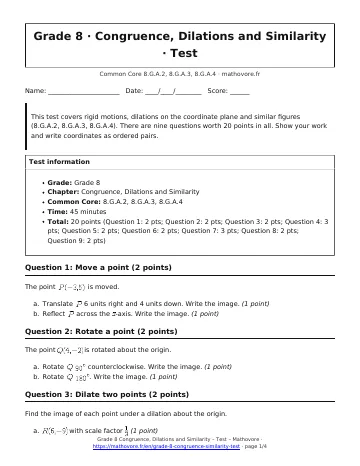
This test covers rigid motions, dilations on the coordinate plane and similar figures (8.G.A.2, 8.G.A.3, 8.G.A.4). There are nine questions worth 20 points in all. Show your work and write coordinates as ordered pairs.
- Grade: Grade 8
- Chapter: Congruence, Dilations and Similarity
- Common Core: 8.G.A.2, 8.G.A.3, 8.G.A.4
- Time: 45 minutes
- Total: 20 points (Question 1: 2 pts; Question 2: 2 pts; Question 3: 2 pts; Question 4: 3 pts; Question 5: 2 pts; Question 6: 2 pts; Question 7: 3 pts; Question 8: 2 pts; Question 9: 2 pts)
Grade 8 Congruence Similarity Test: questions 1–5
1. Move a point (2 points)
The point \(P(-3,5)\) is moved.
- Translate \(P\) 6 units right and 4 units down. Write the image. (1 point)
- Reflect \(P\) across the \(x\)-axis. Write the image. (1 point)
2. Rotate a point (2 points)
The point \(Q(4,-2)\) is rotated about the origin.
- Rotate \(Q\) \(90^{\circ}\) counterclockwise. Write the image. (1 point)
- Rotate \(Q\) \(180^{\circ}\). Write the image. (1 point)
3. Dilate two points (2 points)
Find the image of each point under a dilation about the origin.
- \(R(6,-9)\) with scale factor \(\frac{1}{3}\) (1 point)
- \(S(-2,5)\) with scale factor 4 (1 point)
4. Reflect and compare (3 points)
Triangle \(ABC\) is reflected across the \(y\)-axis to form triangle \(A^{\prime}B^{\prime}C^{\prime}\).
- Write the coordinates of \(A^{\prime}\), \(B^{\prime}\) and \(C^{\prime}\). (2 points)
- Is triangle \(A^{\prime}B^{\prime}C^{\prime}\) congruent to triangle \(ABC\)? Explain. (1 point)
5. Dilation of a triangle (2 points)
A right triangle has sides \(5\text{ ft}\), \(12\text{ ft}\) and \(13\text{ ft}\). It is dilated with scale factor 3.
- Find the three side lengths of the image. (1 point)
- Find the measure of the right angle in the image. Explain. (1 point)
Grade 8 Congruence Similarity Test: questions 6–9
6. Find a scale factor (2 points)
A dilation about the origin sends \(A(3,-2)\) to \(A^{\prime}(12,-8)\).
- Find the scale factor. (1 point)
- Find the image of \(B(-5,6)\). (1 point)
7. Show similarity (3 points)
Triangle \(ABC\) and triangle \(DEF\) are shown.
- Describe a sequence of a dilation about the origin and one rigid motion that maps \(ABC\) onto \(DEF\). (2 points)
- Are the triangles similar, congruent, both or neither? Explain. (1 point)
8. Similar rectangles (2 points)
A rectangle is 6 inches wide and 9 inches tall.
- Is it similar to a rectangle that is 8 inches wide and 12 inches tall? Explain. (1 point)
- Is it similar to a rectangle that is 10 inches wide and 16 inches tall? Explain. (1 point)
9. Two rigid motions (2 points)
Triangle \(XYZ\) has vertices \(X(1,2)\), \(Y(4,2)\), \(Z(4,6)\). It is translated 2 units left and 3 units down, and the result is reflected across the \(y\)-axis.
- Write the vertices of the final image. (1 point)
- Side \(XZ\) has length 5. What is the length of the matching side in the final image? Explain. (1 point)

What does the grade 8 congruence similarity test cover?
The first question moves P(-3, 5) with a translation and a reflection. Next, Q(4, -2) is rotated 90 degrees counterclockwise. After that, two points are dilated, such as R(6, -9) with scale factor one third. Together, these questions check the coordinate rules.
How do the three-point questions differ?
Triangle ABC is reflected across the y-axis, and students compare the original and the image. A second three-point question asks for a sequence of a dilation and a rigid motion that maps ABC onto DEF. Because order matters, students should write each step. Meanwhile, a right triangle with sides 5, 12, and 13 is dilated.
How should you manage the time?
Budget roughly 3 minutes per short item and a longer stretch for the sequence questions. First, finish the coordinate rule items. Then do the rectangle question, which asks whether 6 by 9 and 8 by 12 are similar. Finally, check each answer by measuring a side or an angle on your sketch.
Prepare for the transformations test
First, write the rotation rules on a card and test each on the point (3, -1). Next, practice finding a scale factor from two coordinates. When the test begins, plot at least one point from each problem, because a picture exposes sign errors.

See every chapter on the Grade 8 math page.