Key takeaway: This grade 8 scientific notation worksheet offers 25 printable problems on conversions, comparisons, operations and real measurements. It lines up with standards 8.EE.A.3-4 for 8th grade, and solutions are on a separate page.
Count decimal moves carefully, because one wrong move changes the exponent and the answer.
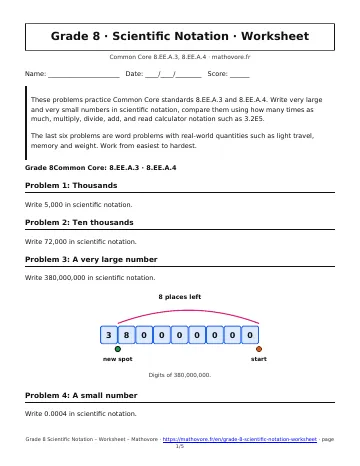
These problems practice Common Core standards 8.EE.A.3 and 8.EE.A.4. Write very large and very small numbers in scientific notation, compare them using how many times as much, multiply, divide, add, and read calculator notation such as 3.2E5.
The last six problems are word problems with real-world quantities such as light travel, memory and weight. Work from easiest to hardest.
Grade 8 Scientific Notation Worksheet: problems 1–5
1. Thousands
Write 5,000 in scientific notation.
2. Ten thousands
Write 72,000 in scientific notation.
3. A very large number
Write 380,000,000 in scientific notation.
4. A small number
Write 0.0004 in scientific notation.
5. Small number with two digits
Write 0.00062 in scientific notation.
Grade 8 Scientific Notation Worksheet: problems 6–10
6. Standard form
Write \(3.5\times 10^{5}\) in standard form.
7. Negative exponent to decimal
Write \(8.1\times 10^{-3}\) in standard form.
8. Millions
Write \(2.04\times 10^{6}\) in standard form.
9. Tiny decimal
Write 0.000000705 in scientific notation.
10. Compare two numbers
Compare \(4.2\times 10^{5}\) and \(3.9\times 10^{6}\). Write \(<\), \(>\) or \(=\) and explain.
Grade 8 Scientific Notation Worksheet: problems 11–15
11. Order small numbers
Order from least to greatest: \(6.1\times 10^{-3}\), \(2.5\times 10^{-2}\), \(9.9\times 10^{-4}\).
12. How many times as much?
How many times as large is \(6\times 10^{8}\) as \(3\times 10^{5}\)?
13. Small numbers: how many times
How many times as large is \(9\times 10^{-2}\) as \(3\times 10^{-5}\)?
14. Multiply
Find \((3\times 10^{4})(2\times 10^{3})\). Write the answer in scientific notation.
15. Multiply and fix
Find \((4\times 10^{5})(5\times 10^{-2})\). Write the answer in scientific notation.
Grade 8 Scientific Notation Worksheet: problems 16–20
16. Divide
Find \(\frac{8.4\times 10^{7}}{2.1\times 10^{3}}\). Write the answer in scientific notation.
17. Add
Find \(4.8\times 10^{5}+3.7\times 10^{6}\). Write the answer in scientific notation.
18. Calculator notation
A calculator displays 3.2E5. Another displays 7.5E-3. Write each value in standard form and in scientific notation.
19. Miles to feet
The distance from Chicago to Los Angeles is about 2,450 miles. One mile is 5,280 feet. Write the distance in feet using scientific notation.
20. Population comparison
A city has about \(2.5\times 10^{5}\) people. The country has about \(3\times 10^{8}\) people. About how many times as large is the population of the country?
Grade 8 Scientific Notation Worksheet: problems 21–25
21. Sunlight to Earth
Earth is \(9.3\times 10^{7}\) miles from the Sun. Light travels \(1.86\times 10^{5}\) miles per second. How many seconds does sunlight take to reach Earth? Give the answer in minutes and seconds too.
22. Stack of paper
One sheet of paper is \(4\times 10^{-3}\) inch thick. Jamal stacks \(5\times 10^{3}\) sheets. How tall is the stack? Write the answer in scientific notation.
23. Photos on a tablet
A tablet stores \(6.4\times 10^{10}\) bytes. Each photo uses \(4\times 10^{6}\) bytes. How many photos fit? Write the answer in scientific notation.
24. Snail on a trail
A garden snail crawls \(2\times 10^{-3}\) mile per hour. How far does it go in \(4\times 10^{2}\) hours? Write the answer in scientific notation and in standard form.
25. Earth and Moon
Earth weighs about \(1.3\times 10^{25}\) pounds. The Moon weighs about \(1.6\times 10^{23}\) pounds. About how many times as heavy is Earth as the Moon? Round to the nearest whole number.

What is on this 8th grade scientific notation worksheet?
Problems 1 to 5 convert thousands, millions and small decimals such as 0.00062. Then problems 6 to 9 reverse the direction, from \(3.5\times 10^{5}\) to standard form. After that, problems 10 to 13 compare and order numbers and ask how much larger one value is than another.
Which problems need extra care?
Ordering three small numbers in problem 11 means the most negative exponent is the smallest value. Next, \((4\times 10^{5})(5\times 10^{-2})\) in problem 15 gives a raw coefficient of 20, which must shift to \(2\times 10^{4}\). When adding in problem 17, rewrite one number first so the exponents match.
Calculator displays appear in problem 18, with calculator displays 3.2E5 and 7.5E-3, which many students misread.
How do the real-world problems use scientific notation?
Problem 19 converts 2,450 miles into feet with 5,280 feet per mile. In problem 21, sunlight crosses \(9.3\times 10^{7}\) miles at \(1.86\times 10^{5}\) miles per second, so divide to find the travel time. Meanwhile, problem 25 compares the weights of Earth and the Moon, which differ by a factor near 81.
What should follow these 25 powers-of-ten problems?
Open the solutions and redo every missed conversion on a fresh line. Later, practice problems 14 to 17 with new coefficients. When the sign of the exponent stops causing slips, try the quiz.

See every chapter on the Grade 8 math page.