Key takeaway: This grade 8 square cube roots worksheet offers 25 printable problems, from \(\sqrt{49}\) to a cube-shaped storage bin. It practices 8.EE.A.2 in eighth grade, and its worked solutions are published on another page.
Write both signs for every square equation, because dropping the negative root is the most common slip.
These problems practice Common Core standard 8.EE.A.2: evaluating square roots and cube roots of perfect squares and perfect cubes, and solving equations of the form \(x^{2}=p\) and \(x^{3}=p\). Early problems use whole numbers, then fractions and decimals.
The last seven problems are word problems about squares and cubes, including two estimates for numbers that are not perfect squares or cubes. Work from easiest to hardest.
Grade 8 Square Cube Roots Worksheet: problems 1–5
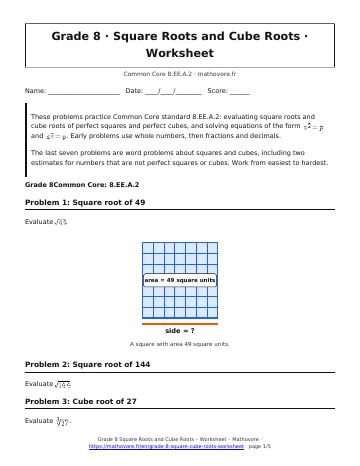
1. Square root of 49
Evaluate \(\sqrt{49}\).
2. Square root of 144
Evaluate \(\sqrt{144}\).
3. Cube root of 27
Evaluate \(\sqrt[3]{27}\).
4. Cube root of 125
Evaluate \(\sqrt[3]{125}\).
5. Cube root of a negative
Evaluate \(\sqrt[3]{-64}\).
Grade 8 Square Cube Roots Worksheet: problems 6–10
6. Two square roots
Solve \(x^{2}=81\).
7. A cube equation
Solve \(x^{3}=216\).
8. Another square equation
Solve \(x^{2}=169\).
9. A negative cube
Solve \(x^{3}=-343\).
10. Fraction square
Solve \(x^{2}=\frac{4}{25}\).
Grade 8 Square Cube Roots Worksheet: problems 11–15
11. Fraction cube
Solve \(x^{3}=\frac{8}{27}\).
12. Decimal square
Solve \(x^{2}=0.64\).
13. Decimal cube
Solve \(x^{3}=0.001\).
14. Undo, then take the root
Solve \(x^{2}+6=70\).
15. Between two integers
Between which two consecutive integers is \(\sqrt{50}\)? Mark where it belongs on the number line.
Grade 8 Square Cube Roots Worksheet: problems 16–20
16. Cube root estimate
Between which two consecutive integers is \(\sqrt[3]{100}\)?
17. Which number is irrational?
Exactly one of \(\sqrt{36}\), \(\sqrt{2}\), \(\sqrt[3]{8}\), \(\sqrt{100}\) is irrational. Name it and explain how the others are rational.
18. Compare a root and a decimal
Is \(\sqrt{30}\) less than or greater than 5.5? Show your reasoning.
19. Square garden fence
Maya’s square garden has an area of 196 square feet. She puts a fence around all four sides. Find the side length and the total length of fence.
20. Gift box
A cube-shaped gift box holds 343 cubic inches. Find the edge length and the area of one face.
Grade 8 Square Cube Roots Worksheet: problems 21–25
21. Square rug fringe
A square rug has an area of 20.25 square feet. Fringe costs $1.50 per foot and goes on all four sides. Find the side length and the cost of the fringe.
22. Storage cube
A cube-shaped storage bin holds 1,728 cubic inches. Find its edge length in inches, then in feet.
23. Playground laps
A square playground has an area of 2,500 square feet. Jamal jogs 3 laps around its edge. How far does he jog?
24. Side of a square patio
Sofia’s square patio has an area of 50 square feet. Estimate its side length to the nearest tenth of a foot.
25. Edge of a small cube
A cube has a volume of 40 cubic inches. Estimate its edge length to the nearest tenth of an inch.

What is on this 8th grade square and cube roots worksheet?
The first five problems evaluate radicals, including \(\sqrt[3]{-64}\). Next, problems 6 to 9 solve equations such as \(x^{2}=81\) and \(x^{3}=-343\). Then problems 10 to 13 move to fractions and decimals, like \(x^{3}=\frac{8}{27}\) and \(x^{3}=0.001\).
Which problems are hard for students?
Problem 14, \(x^{2}+6=70\), needs two steps, so subtract before you take the root. Problem 17 asks which of four numbers is irrational, and only \(\sqrt{2}\) qualifies because the others are whole. Problem 18 compares \(\sqrt{30}\) with 5.5, so square 5.5 and compare 30.25 with 30.
How do the real-world problems use roots?
A 196-square-foot garden has sides of 14 feet, so Maya needs 56 feet of fence. Likewise, a cube-shaped gift box of 343 cubic inches has an edge of 7. A rug with area 20.25 square feet has side 4.5, and fringe along four sides costs by the foot. Finally, the patio and small cube in the last two problems need estimates to the nearest tenth.
How can you avoid root mistakes?
First, remember that \(x^{2}=81\) has two answers, 9 and -9. In contrast, \(x^{3}=-343\) has only one, which is -7. Next, estimate before you calculate, because \(\sqrt{30}\) must sit between 5 and 6. Besides, a quick check by squaring catches slips at once. For example, 5.5 squared is 30.25, so \(\sqrt{30}\) is slightly less than 5.5. Finally, write the units for area and volume, since square feet and cubic inches mean different things.
What steps solve an equation like x squared equals 81?
First, ask which number times itself gives 81. Next, remember the negative partner. Then write both answers, 9 and -9. Also, check each one by squaring. If both work, you are done. However, the cube case behaves differently. For \(x^{3}=-343\), only -7 works. Therefore, a cube root keeps the sign of the number inside. Meanwhile, a square root of a negative number is not real. Thus, \(x^{2}=-4\) has no solution. Finally, state that fact clearly, because it is a complete answer.
Similarly, two-step equations need order. First, undo the addition or subtraction. Next, take the root. In problem 14, for instance, subtract 6 from 70 to get 64. Then take the square root and list 8 and -8. After that, substitute 8 back to confirm \(8^{2}+6=70\). Besides, fractions follow the same path. Because \(2^{3}=8\) and \(3^{3}=27\), the root of \(\frac{8}{27}\) is \(\frac{2}{3}\). Likewise, 0.001 has cube root 0.1, since \(0.1\cdot0.1\cdot0.1=0.001\).
How do you estimate a root without a calculator?
First, find the two perfect squares around your number. Next, locate the number between them. Take 30, which falls between the squares 25 and 36, so its root lies between 5 and 6. Then test the midpoint. Because 5.5 squared is 30.25, the root is a little less than 5.5. As a result, problem 18 answers itself. Also, round only at the end. Otherwise, small errors pile up. Finally, say whether the root is rational, because \(\sqrt{2}\) never ends or repeats.
Meanwhile, area and volume problems use the same moves. First, write the formula. Next, set it equal to the given number. Then take the proper root. Afterward, attach units. Consequently, a 196-square-foot garden has sides of 14 feet. Likewise, the 343-cubic-inch box has an edge of 7 inches. Finally, reread the question, because perimeter and area ask for different things.
Next, build a habit of quick checks. Then add a short note beside each answer. Also, circle every place where a sign could hide. In addition, mark the problems that took longest. After that, redo those first tomorrow.
What is a smart next step after this worksheet?
Check each root by squaring or cubing your answer. After that, redo the equations where you gave only one solution. When both signs feel natural, move on to the quiz.

See every chapter on the Grade 8 math page.