Key takeaway: This grade 8 systems of equations test holds nine tasks worth 20 points across graphing, algebra and word problems. It tests 8.EE.C.8 for eighth graders, and grading notes live on their own page.
Show each step, since the key gives partial credit for sound methods.
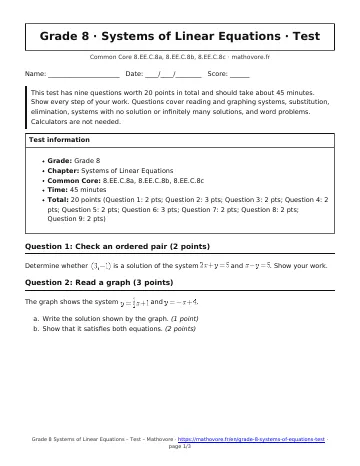
This test has nine questions worth 20 points in total and should take about 45 minutes. Show every step of your work. Questions cover reading and graphing systems, substitution, elimination, systems with no solution or infinitely many solutions, and word problems. Calculators are not needed.
- Grade: Grade 8
- Chapter: Systems of Linear Equations
- Common Core: 8.EE.C.8a, 8.EE.C.8b, 8.EE.C.8c
- Time: 45 minutes
- Total: 20 points (Question 1: 2 pts; Question 2: 3 pts; Question 3: 2 pts; Question 4: 2 pts; Question 5: 2 pts; Question 6: 3 pts; Question 7: 2 pts; Question 8: 2 pts; Question 9: 2 pts)
Grade 8 Systems of Equations Test: questions 1–5
1. Check an ordered pair (2 points)
Determine whether \((3,-1)\) is a solution of the system \(2x+y=5\) and \(x-y=5\). Show your work.
2. Read a graph (3 points)
The graph shows the system \(y=\frac{1}{2}x+1\) and \(y=-x+4\).
- Write the solution shown by the graph. (1 point)
- Show that it satisfies both equations. (2 points)
3. Solve by graphing (2 points)
Graph \(y=x+1\) and \(y=-2x+7\) on the grid. State the solution of the system.
4. Substitution (2 points)
Solve the system: \(y=4x-5\) and \(2x+y=7\).
5. Elimination (2 points)
Solve the system: \(3x+4y=18\) and \(3x-2y=0\).
Grade 8 Systems of Equations Test: questions 6–9
6. Multiply both equations (3 points)
Solve the system: \(3x+2y=8\) and \(2x+5y=-2\).
7. How many solutions? (2 points)
Tell how many solutions each system has. Give a reason.
- \(2x-y=4\) and \(y=2x+3\) (1 point)
- \(4x+2y=6\) and \(y=-2x+3\) (1 point)
8. School store (2 points)
Diego buys 3 notebooks and 4 pens for $11.50. Aisha buys 3 notebooks and 2 pens for $9.50. Find the price of one notebook and one pen.
9. Gym memberships (2 points)
Gym A charges $45 to join plus $25 per month. Gym B charges $75 to join plus $20 per month. The graph shows the total cost. After how many months do the two gyms cost the same, and what is that cost?

What does the grade 8 systems of equations test ask?
The first task checks whether \((3,-1)\) solves \(2x+y=5\) and \(x-y=5\). After that, a graph shows \(y=\frac{1}{2}x+1\) and \(y=-x+4\), and you read the crossing point. Then you graph \(y=x+1\) and \(y=-2x+7\) yourself.
Algebra tasks follow, using \(y=4x-5\) with \(2x+y=7\), then \(3x+4y=18\) with \(3x-2y=0\).
How do you prepare for this systems test?
Start by solving one system by each method. Next, practice the harder case where both equations need multipliers, such as \(3x+2y=8\) with \(2x+5y=-2\). Finally, review how to spot parallel lines from slopes.
- A school store task sets up two equations with notebooks and pens.
- Another task compares a $45 fee plus $25 monthly with $75 plus $20.
How do you explain solution counts?
Compare slopes and intercepts. Same slope with different intercepts means no solution. Because the key rewards the reason, state both comparisons.
Which method fits which question on the test?
First, scan each pair of equations. If one variable already stands alone, as in \(y=4x-5\), substitution is fastest. Therefore, replace y in \(2x+y=7\) and solve \(6x-5=7\) to get \(x=2\). Then find \(y=3\). In contrast, \(3x+4y=18\) with \(3x-2y=0\) shares the same x-term. As a result, subtraction removes x at once, leaving \(6y=18\). Next, \(y=3\) gives \(x=2\), so both algebra tasks end at the same point. Also, notice that coincidence, because it helps you check.
Meanwhile, the pair \(3x+2y=8\) and \(2x+5y=-2\) needs more work. First, multiply the top equation by 5 and the bottom by 2. Then the y-terms match at 10y. After that, subtract to reach \(11x=44\). Consequently, \(x=4\) and \(y=-2\). Finally, test both numbers in each original equation, since a slip in either multiplier shows up there.
How do you check a point on the systems test?
First, put the x-value in the first equation. Next, do the same for the second. For instance, \((3,-1)\) gives \(2(3)+(-1)=5\) in the first equation. However, the second gives \(3-(-1)=4\), not 5. Therefore, the point fails, so it is not a solution. Also, graph readers should confirm the crossing, because a rough picture may mislead. Besides, the lines \(y=\frac{1}{2}x+1\) and \(y=-x+4\) meet at \((2,2)\). Finally, write the pair as an ordered pair, not as two loose numbers.
Likewise, the plan comparison asks when two costs match. First, write one equation for each plan. Next, set the totals equal. Then solve for the month. After that, say what the answer means in the story. Thus, a number alone earns less credit than a sentence.
Next, rehearse the parallel case. Then compare slopes aloud. Also, finish with a sentence about solution counts. As a result, the last question feels routine.
What should you do after the systems test?
Check your paper against the key and redo each lost step. Next, make up a gym comparison of your own and solve it by graphing. If the double-multiplier item was hard, rehearse choosing which variable to cancel.

See every chapter on the Grade 8 math page.