
Key takeaway: This grade 8 integer exponents lesson teaches the rules that let you rewrite a power with the same base in a simpler way. It covers standard 8.EE.A.1, so 8th grade students learn to add, subtract and multiply exponents, and to read zero and negative exponents correctly.
Study each rule with its example first. Then check yourself on the practice pages, because small sign slips are the most common loss of points.
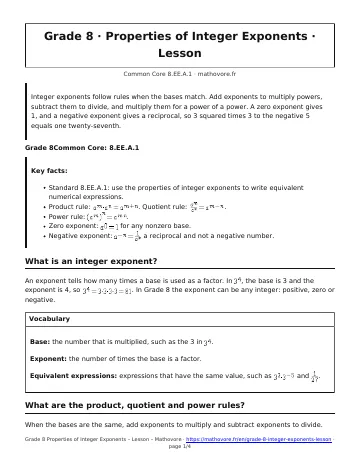
Integer exponents follow rules when the bases match. Add exponents to multiply powers, subtract them to divide, and multiply them for a power of a power. A zero exponent gives 1, and a negative exponent gives a reciprocal, so 3 squared times 3 to the negative 5 equals one twenty-seventh.
Grade 8 Integer Exponents Lesson: key facts
- Standard 8.EE.A.1: use the properties of integer exponents to write equivalent numerical expressions.
- Product rule: \(a^{m}\cdot a^{n}=a^{m+n}\). Quotient rule: \(\frac{a^{m}}{a^{n}}=a^{m-n}\).
- Power rule: \((a^{m})^{n}=a^{mn}\).
- Zero exponent: \(a^{0}=1\) for any nonzero base.
- Negative exponent: \(a^{-n}=\frac{1}{a^{n}}\), a reciprocal and not a negative number.
What is an integer exponent?
An exponent tells how many times a base is used as a factor. In \(3^{4}\), the base is 3 and the exponent is 4, so \(3^{4}=3\cdot3\cdot3\cdot3=81\). In Grade 8 the exponent can be any integer: positive, zero or negative.
Base: the number that is multiplied, such as the 3 in \(3^{4}\).
Exponent: the number of times the base is a factor.
Equivalent expressions: expressions that have the same value, such as \(3^{2}\cdot3^{-5}\) and \(\frac{1}{27}\).
What are the product, quotient and power rules?
When the bases are the same, add exponents to multiply and subtract exponents to divide. For example \(3^{2}\cdot3^{3}\) has five factors of 3 in all, so it equals \(3^{5}\).
In a quotient, matching factors cancel. In \(\frac{5^{5}}{5^{2}}\) two factors of 5 cancel, leaving \(5^{3}\).
| Rule | In symbols | Example |
|---|---|---|
| Product | \(a^{m}\cdot a^{n}=a^{m+n}\) | \(2^{3}\cdot2^{4}=2^{7}\) |
| Quotient | \(\frac{a^{m}}{a^{n}}=a^{m-n}\) | \(\frac{5^{6}}{5^{2}}=5^{4}\) |
| Power of a power | \((a^{m})^{n}=a^{mn}\) | \((3^{2})^{4}=3^{8}\) |
| Power of a product | \((ab)^{n}=a^{n}b^{n}\) | \((2\cdot3)^{2}=2^{2}\cdot3^{2}\) |
| Zero exponent | \(a^{0}=1\) | \(7^{0}=1\) |
| Negative exponent | \(a^{-n}=\frac{1}{a^{n}}\) | \(4^{-2}=\frac{1}{16}\) |
What do zero and negative exponents mean?
Look at the pattern in the powers of 2. Each step to the right divides by 2, so the value keeps halving. That forces \(2^{0}=1\) and \(2^{-1}=\frac{1}{2}\). A negative exponent means a reciprocal, not a negative number.
How do you generate equivalent numerical expressions?
- Check that the bases match; if not, look for a common base.
- Apply the product, quotient or power rule to combine exponents.
- Rewrite a negative exponent as a reciprocal.
- Evaluate if a number is needed.
Worked example. Simplify \(3^{2}\cdot3^{-5}\). Add exponents: \(2+(-5)=-3\), so the product is \(3^{-3}\). Rewrite as a reciprocal: \(\frac{1}{3^{3}}=\frac{1}{27}\).
The power rule works the same way: \((2^{3})^{2}\) means two copies of \(2^{3}\), so multiply the exponents to get \(2^{6}=64\).
Properties of Integer Exponents: frequently asked questions
Why does any number to the zero power equal 1?
Dividing \(\frac{5^{3}}{5^{3}}\) gives 1, and the quotient rule gives \(5^{0}\). Both must agree, so \(5^{0}=1\). This works for every nonzero base.
Is a negative exponent a negative number?
No. The negative sign in the exponent means take the reciprocal. For example \(2^{-3}=\frac{1}{8}\), which is positive.
Can I add exponents when the bases are different?
No. The product rule needs the same base. \(2^{3}\cdot3^{2}\) is 8 times 9, which is 72, and it is not a power of 6.
What is the difference between the product rule and the power rule?
The product rule adds exponents for \(a^{m}\cdot a^{n}\). The power rule multiplies exponents for \((a^{m})^{n}\). Writing out the factors shows which one applies.
How do I write a number such as 0.001 with an exponent?
Count the place value. \(0.001=\frac{1}{1000}=\frac{1}{10^{3}}\), which is \(10^{-3}\).
What are the rules of integer exponents in 8th grade?
When the bases match, the product rule adds exponents. For example, \(3^{4}\cdot3^{2}=3^{6}\), because six factors of 3 appear in a row. The quotient rule subtracts them, so \(\frac{5^{9}}{5^{6}}=5^{3}\). Meanwhile, a power of a power multiplies, so \((2^{3})^{2}=2^{6}\).
What do zero and negative exponents mean?
Any nonzero base with exponent 0 equals 1. For instance, \(9^{0}=1\) and \((-6)^{0}=1\). A negative exponent never pushes the value below zero. Instead, it flips the base into a reciprocal, so \(2^{-3}=\frac{1}{8}\).
A table helps here. Each step down in the exponent divides by 2, so the row 8, 4, 2, 1 continues with \(\frac{1}{2}\), \(\frac{1}{4}\) and \(\frac{1}{8}\).
How do you avoid mistakes with integer exponents?
- Never multiply the bases: \(2^{3}\cdot2^{4}\) stays base 2, so the result is \(2^{7}\), not \(4^{7}\).
- Never turn \(2^{-3}\) into \(-8\), because a reciprocal is positive here.
- Do not add exponents when the bases differ.
How do you write equivalent numerical expressions?
First, combine every power of the same base. Next, apply the exponent rules one step at a time. Finally, write any negative exponent as a fraction. For example, \(3^{2}\cdot3^{-5}\) becomes \(3^{-3}\), which equals \(\frac{1}{27}\).
What should you do after learning these exponent rules?
Next, try the worksheet and start with the powers of ten, since they appear again in scientific notation. After that, finish with the quiz. If negative exponents still feel strange, rebuild the halving table until the pattern is automatic.

See every chapter on the Grade 8 math page.