



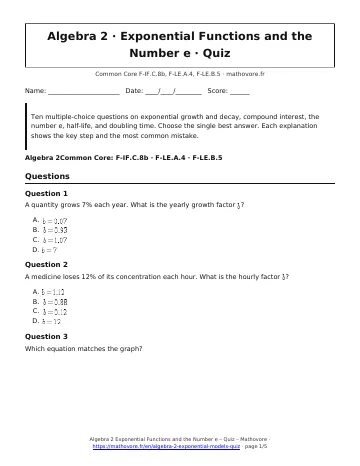
Ten multiple-choice questions on exponential growth and decay, compound interest, the number e, half-life, and doubling time. Choose the single best answer. Each explanation shows the key step and the most common mistake.
Algebra 2Common Core: F-IF.C.8b · F-LE.A.4 · F-LE.B.5
🎯 Exponential Functions and the Number e – Algebra 2 math quiz
Question 1
A quantity grows 7% each year. What is the yearly growth factor \(b\)?
A
\(b=0.07\)
B
\(b=0.93\)
C
\(b=1.07\)
D
\(b=7\)
Question 2
A medicine loses 12% of its concentration each hour. What is the hourly factor \(b\)?
A
\(b=1.12\)
B
\(b=0.88\)
C
\(b=0.12\)
D
\(b=12\)
Question 3
Which equation matches the graph?The graph of an exponential function.
A
\(y=3\cdot 2^{x}\)
B
\(y=2\cdot 3^{x}\)
C
\(y=3\cdot 0.5^{x}\)
D
\(y=3x+3\)
Question 4
Find the balance of $500 at 6% compounded annually for 3 years.
A
$590.00
B
$595.51
C
$598.34
D
$631.24
Question 5
Which value is closest to the number \(e\)?
A
about 3.142
B
about 1.618
C
about 2.178
D
about 2.718
Question 6
Which formula gives the balance with continuous compounding?
A
\(A=P(1+r)^{t}\)
B
\(A=P\left(1+\frac{r}{n}\right)^{nt}\)
C
\(A=P+rt\)
D
\(A=Pe^{rt}\)
Question 7
What is the half-life of the quantity shown?A decaying quantity.
A
8 hours
B
4 hours
C
24 hours
D
12 hours
Question 8
How long does it take money to double at 3% interest compounded yearly?
A
23.45 years
B
33.33 years
C
24.00 years
D
66.67 years
Question 9
About how long does the balance in the graph take to reach $2,000?A balance A(t) = 1,000(1.05)ᵗ and the line A = 2,000.
A
about 7 years
B
about 20 years
C
about 14 years
D
about 28 years
Question 10
Solve \(5\cdot 3^{t}=45\) for \(t\).
A
\(t=9\)
B
\(t=3\)
C
\(t=2\)
D
\(t=15\)
🎉 Quiz complete!
0 / 10
Remember:
- y = a·bᵗ: a is the initial value and b is the factor per period.
- Percent rate r gives b = 1 + r for growth and b = 1 − r for decay.
- Compound interest: A = P(1 + r/n)^(nt); continuous: A = Pe^(rt) with e ≈ 2.71828.
- Half-life model: A = A₀(1/2)^(t/h); doubling time at rate r is ln 2 ÷ ln(1 + r).
- To solve a·bᵗ = d for t, isolate bᵗ and take a logarithm: t = ln(d/a) ÷ ln b.
See every chapter on the Algebra 2 math page.