
Key takeaway: This algebra 2 trig unit circle lesson teaches how a radian measures an angle and how the unit circle defines sine, cosine and tangent for any angle. The content lines up with F-TF.A.2 and F-TF.C.8. First, you convert between degrees and radians. Next, you read coordinates \((\cos\theta,\sin\theta)\) from the circle. Finally, you use the Pythagorean identity to find a missing ratio when only one is known. Worked examples show each move, so you can follow the reasoning before you try the practice pages.
A radian measures an angle by the arc it cuts off divided by the radius, so a full circle is 2π radians. On the unit circle, the point at angle θ has coordinates (cos θ, sin θ), which defines sine, cosine and tangent for any angle. Every such point satisfies sin²θ + cos²θ = 1.
Algebra 2 Trig Unit Circle Lesson: key facts
- \(\theta=\frac{s}{r}\), so \(180^{\circ}=\pi\) radians and \(360^{\circ}=2\pi\) radians.
- Arc length is \(s=r\theta\) when \(\theta\) is in radians.
- The unit circle point at angle \(\theta\) is \((\cos\theta,\ \sin\theta)\).
- Use the reference angle and the quadrant signs to evaluate any angle.
- Pythagorean identity: \(\sin^{2}\theta+\cos^{2}\theta=1\).
What is a radian?
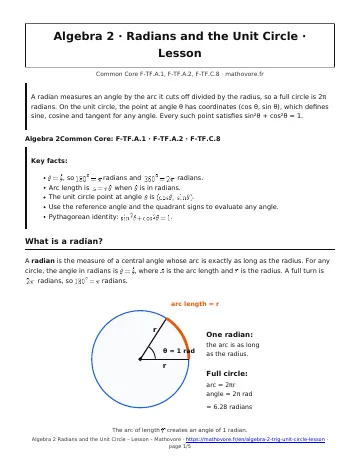
A radian is the measure of a central angle whose arc is exactly as long as the radius. For any circle, the angle in radians is \(\theta=\frac{s}{r}\), where \(s\) is the arc length and \(r\) is the radius. A full turn is \(2\pi\) radians, so \(180^{\circ}=\pi\) radians.
Example: a sector with radius 10 inches and central angle \(\frac{3\pi}{5}\) has arc length \(s=10\cdot\frac{3\pi}{5}=6\pi\) inches, about 18.85 inches. Because radians are a ratio of two lengths, they have no units, and formulas like \(s=r\theta\) work without any conversion factor.
Degrees to radians: multiply by \(\frac{\pi}{180}\). Radians to degrees: multiply by \(\frac{180}{\pi}\). Arc length: \(s=r\theta\) with \(\theta\) in radians.
| Degrees | \(30^{\circ}\) | \(45^{\circ}\) | \(60^{\circ}\) | \(90^{\circ}\) | \(180^{\circ}\) | \(360^{\circ}\) |
|---|---|---|---|---|---|---|
| Radians | \(\frac{\pi}{6}\) | \(\frac{\pi}{4}\) | \(\frac{\pi}{3}\) | \(\frac{\pi}{2}\) | \(\pi\) | \(2\pi\) |
What is the unit circle?
The unit circle has radius 1 and its center at the origin. The terminal side of an angle \(\theta\) in standard position meets the circle at the point \((\cos\theta,\ \sin\theta)\). Then \(\tan\theta=\frac{\sin\theta}{\cos\theta}\), which is undefined where \(\cos\theta=0\). This works for every real angle, positive or negative.
Negative angles turn clockwise, and angles larger than \(2\pi\) wrap around the circle again. For example, \(-\frac{\pi}{3}\) and \(\frac{5\pi}{3}\) end at the same point, so they have the same sine and cosine. On the axes, the points are \((1,0)\), \((0,1)\), \((-1,0)\) and \((0,-1)\) for \(0\), \(\frac{\pi}{2}\), \(\pi\) and \(\frac{3\pi}{2}\).
How do you find sine and cosine of any angle?
Find the reference angle, the acute angle between the terminal side and the x-axis, then attach signs by quadrant.
Example: \(\theta=\frac{5\pi}{6}\) is in Quadrant II with reference angle \(\frac{\pi}{6}\). So \(\sin\theta=\frac{1}{2}\), \(\cos\theta=-\frac{\sqrt{3}}{2}\), and \(\tan\theta=-\frac{\sqrt{3}}{3}\).
What is the Pythagorean identity?
Every point \((\cos\theta,\ \sin\theta)\) is on a circle of radius 1, so \(\sin^{2}\theta+\cos^{2}\theta=1\) for all angles.
Worked example: \(\sin\theta=\frac{3}{5}\) and \(\theta\) is in Quadrant II. Find \(\cos\theta\) and \(\tan\theta\).
- \(\cos^{2}\theta=1-(\frac{3}{5})^{2}=\frac{16}{25}\).
- Cosine is negative in Quadrant II, so \(\cos\theta=-\frac{4}{5}\).
- \(\tan\theta=\frac{3/5}{-4/5}=-\frac{3}{4}\).
Radians and the Unit Circle: frequently asked questions
Why do we use radians instead of degrees?
Radians tie an angle directly to arc length through \(s=r\theta\), with no conversion factor. This makes formulas in algebra and calculus simpler, and it is the standard unit for trigonometric functions of real numbers.
How do I convert between degrees and radians?
Multiply degrees by \(\frac{\pi}{180}\) to get radians, and multiply radians by \(\frac{180}{\pi}\) to get degrees. For example, \(60^{\circ}=\frac{\pi}{3}\) radians.
What are the coordinates on the unit circle?
The point at angle \(\theta\) is \((\cos\theta,\ \sin\theta)\). The x-coordinate is the cosine and the y-coordinate is the sine of the angle.
Why is tangent undefined at \(\frac{\pi}{2}\)?
Tangent is sine divided by cosine. At \(\frac{\pi}{2}\) the point is \((0,1)\), so the cosine is 0 and the division is impossible.
How do I find cosine when I only know sine?
Use \(\cos^{2}\theta=1-\sin^{2}\theta\) and take the square root. Pick the sign from the quadrant: cosine is positive in Quadrants I and IV and negative in II and III.
What does one radian measure?
Picture a string as long as the radius, laid along the edge of a circle. The angle it opens is one radian, so a full turn holds \(2\pi\) of them. Because \(180^{\circ}=\pi\), multiply degrees by \(\frac{\pi}{180}\) to convert. For example, \(135^{\circ}\) becomes \(\frac{3\pi}{4}\). With a radius of 6 inches and an angle of \(\frac{\pi}{3}\), the arc is \(s=r\theta=2\pi\) inches.
How does the algebra 2 trig unit circle lesson find exact values?
Start with the point at angle \(\theta\) on a circle of radius 1. Its x-coordinate is cosine, and its y-coordinate is sine. Then reduce any angle to a reference angle in the first quadrant. After that, attach the sign that the quadrant demands. Take \(\frac{7\pi}{6}\): its reference angle is \(\frac{\pi}{6}\), and both coordinates are negative, so the point is \((-\frac{\sqrt{3}}{2},-\frac{1}{2})\).
How do you find a missing ratio from the identity?
Every point on the circle obeys \(\sin^{2}\theta+\cos^{2}\theta=1\). Suppose \(\cos\theta=\frac{5}{13}\) in Quadrant IV. Then \(\sin^{2}\theta=1-\frac{25}{169}=\frac{144}{169}\), so \(\sin\theta=-\frac{12}{13}\), because sine is negative below the x-axis. A common slip is to forget the sign. Tangent follows as sine divided by cosine, and it is undefined whenever cosine is 0, as at \(\frac{\pi}{2}\).
Where should you go after the circle?
Sketch the circle from memory, then label the special angles in each quadrant without a chart. Once that feels easy, model a rider on a Ferris wheel with \(h=30+25\sin\theta\). Seeing height change with angle prepares you for the graphs of sine and cosine.

See every chapter on the Algebra 2 math page.