


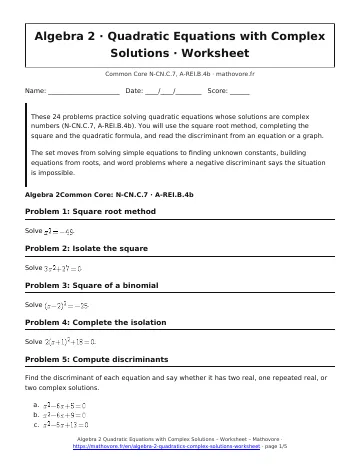
These 24 problems practice solving quadratic equations whose solutions are complex numbers (N-CN.C.7, A-REI.B.4b). You will use the square root method, completing the square and the quadratic formula, and read the discriminant from an equation or a graph.
The set moves from solving simple equations to finding unknown constants, building equations from roots, and word problems where a negative discriminant says the situation is impossible.
Problem 1: Square root method
Solve \(x^{2}=-49\).
Problem 2: Isolate the square
Solve \(3x^{2}+27=0\).
Problem 3: Square of a binomial
Solve \((x-2)^{2}=-25\).
Problem 4: Complete the isolation
Solve \(2(x+1)^{2}+18=0\).
Problem 5: Compute discriminants
Find the discriminant of each equation and say whether it has two real, one repeated real, or two complex solutions.
- \(x^{2}-6x+5=0\)
- \(x^{2}-6x+9=0\)
- \(x^{2}-6x+13=0\)
Problem 6: Match graphs to discriminants
Each graph shows \(y=ax^{2}+bx+c\). Match graphs I, II, and III to \(D > 0\), \(D=0\), and \(D < 0\), and state the number of real solutions of \(ax^{2}+bx+c=0\) for each.
Problem 7: Graph and solve
The graph of \(y=x^{2}+4x+5\) is shown. How many real solutions does \(x^{2}+4x+5=0\) have? Then find all solutions.
Problem 8: Quadratic formula
Use the quadratic formula to solve \(x^{2}-2x+10=0\).
Problem 9: Complete the square
Solve \(x^{2}+6x+13=0\) by completing the square.
Problem 10: Larger coefficients
Solve \(x^{2}-8x+25=0\).
Problem 11: Leading coefficient not 1
Solve \(2x^{2}-4x+5=0\). Write the answer in simplest form.
Problem 12: Fractions in the answer
Solve \(3x^{2}+2x+1=0\).
Problem 13: Rearrange first
Solve \(x^{2}=2x-17\).
Problem 14: Expand then solve
Solve \(x(x+6)=-10\).
Problem 15: Find a constant
For \(x^{2}+6x+k=0\), find the values of \(k\) that give (a) exactly one real solution and (b) two complex solutions.
Problem 16: Verify a complex solution
Show that \(1-2i\) is a solution of \(x^{2}-2x+5=0\).
Problem 17: Build an equation from its roots
The roots of \(x^{2}+bx+c=0\) are the points shown. Read the roots, then find \(b\) and \(c\).
Problem 18: Conjugate roots
One root of \(x^{2}+bx+c=0\), where \(b\) and \(c\) are real, is \(2-5i\). Find the other root, \(b\), and \(c\).
Problem 19: Does the ball reach 100 feet?
Priya kicks a ball. Its height in feet after \(t\) seconds is \(h=-16t^{2}+64t\). Solve \(h=100\) and explain what the answer says about the ball.
Problem 20: Revenue at the school store
The revenue from selling a school sweatshirt at price \(p\) dollars is \(R=-5p^{2}+100p\) dollars. Can the revenue be exactly \(\$600\)? Solve \(R=600\) and interpret the result.
Problem 21: Find the error
Ethan solves \(x^{2}-6x+10=0\) and writes \(x=\frac{6\pm\sqrt{-4}}{2}=\frac{6\pm 2}{2}\), so \(x=4\) or \(x=2\). Explain his mistake, show that \(x=4\) fails, and give the correct solutions.
Problem 22: Garden with perimeter 20 feet
Aisha wants a rectangular garden with perimeter 20 ft and area 30 sq ft. Let \(w\) be the width. Write and solve an equation for \(w\), then explain whether the garden is possible.
Problem 23: Integer values of k
Find all integers \(k\) for which \(x^{2}+kx+16=0\) has two non-real solutions. How many are there?
Problem 24: Sum and product of solutions
Solve \(2x^{2}+8x+11=0\). Then verify that the sum of the solutions is \(-\frac{b}{a}\) and the product is \(\frac{c}{a}\).

See every chapter on the Algebra 2 math page.