


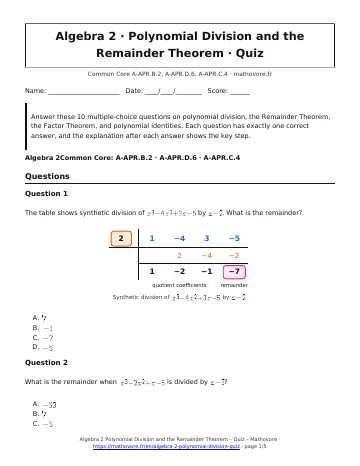
Answer these 10 multiple-choice questions on polynomial division, the Remainder Theorem, the Factor Theorem, and polynomial identities. Each question has exactly one correct answer, and the explanation after each answer shows the key step.
The table shows synthetic division of \(x^{3}-4x^{2}+3x-5\) by \(x-2\). What is the remainder?
What is the remainder when \(x^{3}-2x^{2}+x-5\) is divided by \(x-3\)?
What is the quotient when \(x^{2}+x-12\) is divided by \(x-3\)?
If \(p(5)=0\) for a polynomial \(p(x)\), which statement must be true?
A polynomial of degree \(5\) is divided by a polynomial of degree \(2\). What is the degree of the quotient?
The graph of a cubic polynomial \(f\) crosses the x-axis at \(-3\), \(1\), and \(2\). Which is a factor of \(f(x)\)?
A right triangle has legs \(2xy\) and \(x^{2}-y^{2}\). For \(x=3\) and \(y=1\) the legs are \(6\) and \(8\). Which expression gives the hypotenuse, and what is its length?
What is the remainder when \(x^{3}+1\) is divided by \(x+1\)?
What is \((x^{3}-8)\div(x-2)\)?
Which expression is equal to \((x^{2}-y^{2})^{2}+(2xy)^{2}\) for all \(x\) and \(y\)?
🎉 Quiz complete!
Remember:
- Standards A-APR.B.2, A-APR.D.6, and A-APR.C.4: remainders, division of polynomials, and polynomial identities.
- Division statement: \(p(x)=d(x)q(x)+r(x)\) where the remainder has smaller degree than the divisor.
- Remainder Theorem: dividing \(p(x)\) by \(x-c\) leaves remainder \(p(c)\).
- Factor Theorem: \(x-c\) is a factor of \(p(x)\) if and only if \(p(c)=0\).
- Identity: \((x^{2}+y^{2})^{2}=(x^{2}-y^{2})^{2}+(2xy)^{2}\) generates Pythagorean triples.
See every chapter on the Algebra 2 math page.