
Key takeaway: This algebra 2 polynomial functions test contains eight questions and totals 20 points. It covers degree and end behavior, zeros and multiplicity, factoring by grouping, a graph-to-equation task, a sketch, turning points, trail elevation and an open box. A calculator is allowed. Show all work for full credit.
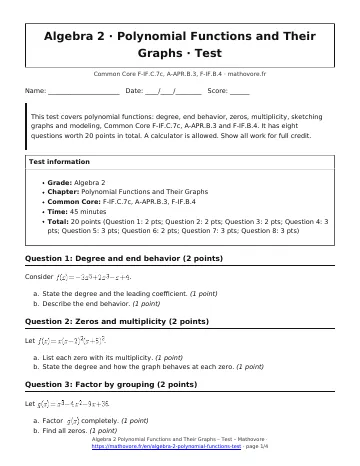
This test covers polynomial functions: degree, end behavior, zeros, multiplicity, sketching graphs and modeling, Common Core F-IF.C.7c, A-APR.B.3 and F-IF.B.4. It has eight questions worth 20 points in total. A calculator is allowed. Show all work for full credit.
- Grade: Algebra 2
- Chapter: Polynomial Functions and Their Graphs
- Common Core: F-IF.C.7c, A-APR.B.3, F-IF.B.4
- Time: 45 minutes
- Total: 20 points (Question 1: 2 pts; Question 2: 2 pts; Question 3: 2 pts; Question 4: 3 pts; Question 5: 3 pts; Question 6: 2 pts; Question 7: 3 pts; Question 8: 3 pts)
Algebra 2 Polynomial Functions Test: questions 1–5
1. Degree and end behavior (2 points)
Consider \(f(x)=-3x^{5}+2x^{3}-x+4\).
- State the degree and the leading coefficient. (1 point)
- Describe the end behavior. (1 point)
2. Zeros and multiplicity (2 points)
Let \(f(x)=x(x-2)^{2}(x+5)^{3}\).
- List each zero with its multiplicity. (1 point)
- State the degree and how the graph behaves at each zero. (1 point)
3. Factor by grouping (2 points)
Let \(g(x)=x^{3}-4x^{2}-9x+36\).
- Factor \(g(x)\) completely. (1 point)
- Find all zeros. (1 point)
4. Equation from a graph (3 points)
The graph of a polynomial function of degree \(3\) is shown.
- Name each zero and its multiplicity. (1 point)
- Find the leading coefficient. (1 point)
- Write the function in factored form. (1 point)
5. Sketch a graph (3 points)
Sketch the graph of \(f(x)=x(x-3)(x+2)\). Label the zeros and show the end behavior.
Algebra 2 Polynomial Functions Test: questions 6–8
6. Turning points (2 points)
- What is the greatest number of turning points a polynomial of degree \(6\) can have? (1 point)
- The graph below rises on both ends. State the least possible degree and whether the leading coefficient is positive or negative. (1 point)
7. Trail elevation (3 points)
A trail’s elevation in feet relative to its start is \(e(x)=x(x-2)(x-6)\) after \(x\) miles. The table shows values for whole miles.
| \(x\) | \(0\) | \(1\) | \(2\) | \(3\) | \(4\) | \(5\) | \(6\) | \(7\) |
|---|---|---|---|---|---|---|---|---|
| \(e(x)\) | \(0\) | \(5\) | \(0\) | \(-9\) | \(-16\) | \(-15\) | \(0\) | \(35\) |
- At which distances is the trail level with the start? (1 point)
- Between which distances is the trail below the start? (1 point)
- What is the lowest elevation in the table, and at which mile? (1 point)
8. Open box (3 points)
Ethan makes an open box from a \(9\)-inch by \(15\)-inch sheet by cutting a square of side \(x\) inches from each corner and folding up the sides.
- Write a function \(V(x)\) for the volume of the box. (1 point)
- State a sensible domain. (1 point)
- Compare \(V(2)\) and \(V(3)\). Which cut gives the greater volume? (1 point)

What should you expect on the first three questions?
The opening question uses \(f(x)=-3x^{5}+2x^{3}-x+4\), so state the degree, the leading coefficient and both ends. Next, list zeros of \(x(x-2)^{2}(x+5)^{3}\) with their multiplicities. Then factor \(x^{3}-4x^{2}-9x+36\) by grouping. Pair the first two terms and the last two, and a common binomial appears.
How do you tackle the graph questions?
For the cubic graph, name each zero and its multiplicity before you write the equation. Then use a given point to find the leading coefficient. In the sketch question, label zeros and show both ends. Finally, remember that a sixth-degree function turns at most five times , so check the graph against that cap.
What do the modeling questions ask?
The trail elevation \(e(x)=x(x-2)(x-6)\) comes with a table, so find where the trail is above the start. The open box from a 9 by 15 inch sheet has volume \(x(9-2x)(15-2x)\). Therefore the domain is \(0
How should you spend the last minutes?
Check each equation by substituting a zero and one extra point. Then confirm that every sketch shows the correct crossing or touching behavior. Afterward, score with the key and note which multiplicity rule you missed, if any.

See every chapter on the Algebra 2 math page.