

Key takeaway: This algebra 2 transformations functions test has nine questions on shifts of absolute value, mapping points, writing an equation, even and odd symmetry, square root and cube root graphs, a stretch and reflection, an exponential asymptote and a skid-speed model. Use graph paper, and label key points on every graph.
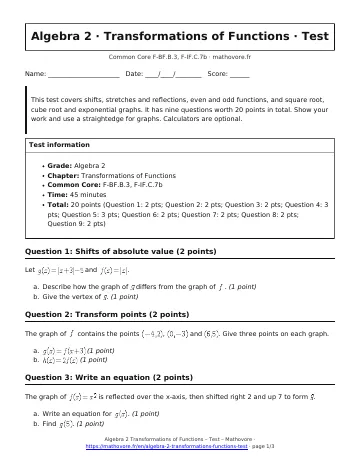
This test covers shifts, stretches and reflections, even and odd functions, and square root, cube root and exponential graphs. It has nine questions worth 20 points in total. Show your work and use a straightedge for graphs. Calculators are optional.
- Grade: Algebra 2
- Chapter: Transformations of Functions
- Common Core: F-BF.B.3, F-IF.C.7b
- Time: 45 minutes
- Total: 20 points (Question 1: 2 pts; Question 2: 2 pts; Question 3: 2 pts; Question 4: 3 pts; Question 5: 3 pts; Question 6: 2 pts; Question 7: 2 pts; Question 8: 2 pts; Question 9: 2 pts)
Algebra 2 Transformations Functions Test: questions 1–5
1. Shifts of absolute value (2 points)
Let \(g(x)=|x+3|-5\) and \(f(x)=|x|\).
- Describe how the graph of \(g\) differs from the graph of \(f\). (1 point)
- Give the vertex of \(g\). (1 point)
2. Transform points (2 points)
The graph of \(f\) contains the points \((-4,2)\), \((0,-3)\) and \((6,5)\). Give three points on each graph.
- \(g(x)=f(x+3)\) (1 point)
- \(h(x)=2f(x)\) (1 point)
3. Write an equation (2 points)
The graph of \(f(x)=x^{2}\) is reflected over the x-axis, then shifted right 2 and up 7 to form \(g\).
- Write an equation for \(g(x)\). (1 point)
- Find \(g(5)\). (1 point)
4. Even and odd (3 points)
Determine whether each function is even, odd or neither. Show the work.
- \(f(x)=2x^{4}-x^{2}\) (1 point)
- \(g(x)=x^{3}-5x\) (1 point)
- \(h(x)=x^{2}+3x\) (1 point)
5. Graph a square root (3 points)
Graph \(y=\sqrt{x+1}-2\) and state its domain and range.
Algebra 2 Transformations Functions Test: questions 6–9
6. Cube root from a graph (2 points)
Write an equation of the form \(y=\sqrt[3]{x-h}+k\) for the graph.
7. Stretch and reflect (2 points)
The graph of \(g(x)=-\frac{1}{2}|x|+4\) is a transformation of \(f(x)=|x|\).
- Describe every transformation. (1 point)
- Find \(g(6)\). (1 point)
8. Exponential graph (2 points)
The graph of \(g(x)=2^{x}-4\) is shown.
- State the horizontal asymptote. (1 point)
- State the x-intercept. (1 point)
9. Skid speed (2 points)
A car’s speed in miles per hour is \(s(d)=\sqrt{24d}\), where \(d\) is the skid length in feet.
- Find the speed for a 24-foot skid. (1 point)
- Find the skid length for a speed of 36 mph. (1 point)

What do the first three questions test?
The first describes \(g(x)=|x+3|-5\) as a transformation of \(|x|\), so read left 3 and down 5. The second gives points \((-4,2)\), \((0,-3)\) and \((6,5)\) on \(f\) and asks for three points on each new graph. Apply inside changes to the x-coordinate and outside changes to the y-coordinate. Then write the equation after a reflection over the x-axis, a shift right 2 and a lift of 7.
How should you approach symmetry and graphs?
For each function, substitute \(-x\), simplify and compare with the original. Show that work, because the verdict alone earns no credit. Next, graph \(\sqrt{x+1}-2\) from its starting point at \((-1,-2)\) and state the domain and range. Read the cube root graph’s center first to find \(h\) and \(k\).
What do the last three questions ask?
Describe every change in \(-\frac{1}{2}|x|+4\): a reflection, a vertical compression and a lift. State the horizontal asymptote of \(2^{x}-4\). Finally, use \(s(d)=\sqrt{24d}\) to find a speed from a skid length.
What should you check before you finish?
Verify one point of every graph in its equation. Then check that each domain statement matches the starting point of the curve. Afterward, score with the key and record which direction rule caused errors.

See every chapter on the Algebra 2 math page.