

Key takeaway: This algebra 2 exponential log equations test is built from nine questions scored out of 20, and a calculator is allowed. Therefore, students solve with common bases, use logarithms, combine logs and apply the methods to interest and half-life. Also, round only at the end unless a question says otherwise. Because every log answer needs a domain check, show that step.
This 45-minute test has 9 questions worth 20 points. A calculator is allowed. Show every step, and round only at the end unless a question says otherwise.
- Grade: Algebra 2
- Chapter: Solving Exponential and Logarithmic Equations
- Common Core: F-LE.A.4, A-SSE.B.3c
- Time: 45 minutes
- Total: 20 points (Question 1: 2 pts; Question 2: 2 pts; Question 3: 2 pts; Question 4: 3 pts; Question 5: 2 pts; Question 6: 2 pts; Question 7: 3 pts; Question 8: 2 pts; Question 9: 2 pts)
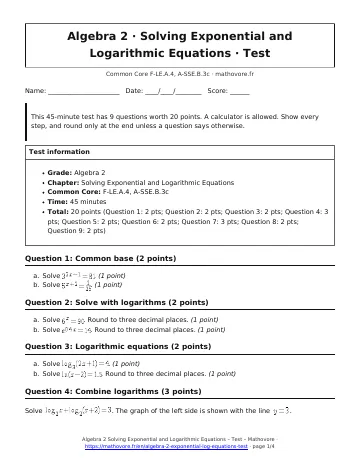
Algebra 2 Exponential Log Equations Test: questions 1–5
1. Common base (2 points)
- Solve \(3^{2x-1}=81\). (1 point)
- Solve \(5^{x+2}=\frac{1}{25}\). (1 point)
2. Solve with logarithms (2 points)
- Solve \(6^{x}=90\). Round to three decimal places. (1 point)
- Solve \(e^{0.4x}=14\). Round to three decimal places. (1 point)
3. Logarithmic equations (2 points)
- Solve \(\log_{3}(2x+1)=4\). (1 point)
- Solve \(\ln(x-2)=1.5\). Round to three decimal places. (1 point)
4. Combine logarithms (3 points)
Solve \(\log_{2} x+\log_{2}(x+2)=3\). The graph of the left side is shown with the line \(y=3\).
- Write the equation without logarithms. (1 point)
- Solve the equation. (1 point)
- Identify any extraneous solution and explain why. (1 point)
5. Quotient of logarithms (2 points)
Solve \(\log_{5}(3x+2)-\log_{5} x=1\).
Algebra 2 Exponential Log Equations Test: questions 6–9
6. Quadratic form (2 points)
Solve \(3^{2x}-10\cdot 3^{x}+9=0\).
7. Compound interest (3 points)
Priya deposits \$2,500 at 3.6% compounded monthly. The balance is \(A=2500(1+\frac{0.036}{12})^{12t}\) after \(t\) years.
- Write the equation for the time when the balance is \$4,000. (1 point)
- Solve it. Round to the nearest hundredth of a year. (2 points)
8. Half-life (2 points)
A 120 g sample of iodine-131 has half-life 8 days, so \(N(t)=120(\frac{1}{2})^{t/8}\).
- When do 15 g remain? (1 point)
- When do 40 g remain? Round to the nearest hundredth of a day. (1 point)
9. Equivalent forms (2 points)
A balance grows as \(P(t)=800(1.06)^{t}\). (a) Write \(P\) as \(800e^{kt}\) and give \(k\) to four decimal places. (1 point) (b) Find the equivalent monthly growth rate as a percent to three decimal places. (1 point)

Which topics appear on the algebra 2 exponential log equations test?
Question 1 uses common bases, so \(3^{2x-1}=81\) gives \(x=\frac{5}{2}\). Then \(5^{x+2}=\frac{1}{25}\) gives \(x=-4\). Meanwhile, question 2 uses logs, and \(6^{x}=90\) gives about 2.512. Likewise, question 3 rewrites \(\log_{3}(2x+1)=4\), which gives \(x=40\). Because \(\ln(x-2)=1.5\) needs an exponential, the second answer is \(2+e^{1.5}\approx 6.482\).
What is a realistic schedule for the test?
Questions 1 to 3 are quick, so a quarter of the hour covers them. Then questions 4 to 6 deserve a longer stretch. Question 4 combines \(\log_{2} x+\log_{2}(x+2)=3\) into \(x^{2}+2x=8\), so x is 2. After that, save the last stretch for the interest and half-life questions. Finally, keep a few minutes to recheck each domain.
Where do students lose points?
Often, students forget to isolate the power before taking a log. Also, some keep an extraneous root. Instead, test each candidate in the original. In addition, a few round midway through a compound interest problem. Thus the calculator memory should hold the unrounded value. Otherwise, the last digit may drift.
How can you prepare for this test?
Make a short list of the steps for each equation type. Then solve one example of each with a timer. Also, rehearse the substitution check for log equations. As a result, the real test will feel routine.

See every chapter on the Algebra 2 math page.