Key takeaway: This algebra 2 rational expressions quiz includes ten multiple-choice items on excluded values, simplifying, least common denominators, graphs with holes, extraneous roots and tank filling. One choice is right each time, and the explanation shows the typical trap. Allow roughly a quarter of an hour.
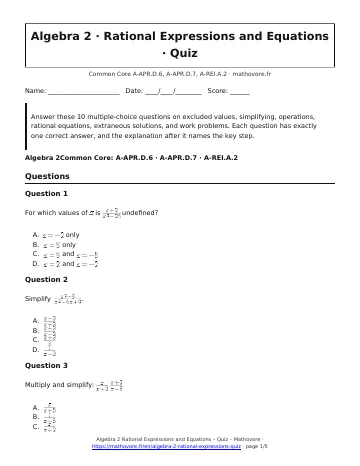
Answer these 10 multiple-choice questions on excluded values, simplifying, operations, rational equations, extraneous solutions, and work problems. Each question has exactly one correct answer, and the explanation after it names the key step.
Question 1
For which values of \(x\) is \(\frac{x+2}{x^{2}-25}\) undefined?
Question 2
Simplify \(\frac{x^{2}-9}{x^{2}-6x+9}\).
Question 3
Multiply and simplify: \(\frac{x}{x+2}\cdot\frac{x+2}{x-5}\).
Question 4
What is the LCD of \(\frac{1}{x^{2}-4}\) and \(\frac{1}{x+2}\)?
Question 5
Solve \(\frac{4}{x+1}=\frac{2}{x}\).
Question 6
The graph is the line \(y=x+2\) with a hole at \((3,5)\). Which expression has this graph?
Question 7
The graphs show both sides of \(\frac{x}{x-3}=\frac{3}{x-3}\). How many solutions does the equation have?
Question 8
Pipe A fills a tank in \(3\) hours and pipe B fills it in \(6\) hours. How long do they take together?
Question 9
Rewrite \(\frac{x+5}{x+2}\) as a constant plus a fraction.
Question 10
Add: \(\frac{1}{x}+\frac{1}{x+1}\).
🎉 Quiz complete!
Remember:
- Standards A-APR.D.6, A-APR.D.7, and A-REI.A.2: rewrite, operate on, and solve with rational expressions.
- Excluded values are the zeros of the denominator, and they remain even after canceling.
- Dividing means multiplying by the reciprocal; adding needs a common denominator.
- Always check solutions of a rational equation: an extraneous solution makes a denominator zero.
- Work problems add rates: \(\frac{1}{a}+\frac{1}{b}=\frac{1}{t}\).
Which quiz questions test simplifying?
Question 1 asks where \(\frac{x+2}{x^{2}-25}\) is undefined, so factor and read \(x=\pm 5\). Next, \(\frac{x^{2}-9}{x^{2}-6x+9}\) simplifies to \(\frac{x+3}{x-3}\). The product in question 3 cancels \((x+2)\), leaving \(\frac{x}{x-5}\). A tempting wrong option cancels the \(x\) terms instead of factors.
How do the LCD and addition questions work?
For \(\frac{1}{x^{2}-4}\) and \(\frac{1}{x+2}\), the LCD is \((x-2)(x+2)\), since the second denominator is already a factor of the first. Adding \(\frac{1}{x}+\frac{1}{x+1}\) gives \(\frac{2x+1}{x(x+1)}\). Rewriting \(\frac{x+5}{x+2}\) gives \(1+\frac{3}{x+2}\).
What do the graph and equation questions show?
A line \(y=x+2\) with a hole at \((3,5)\) comes from \(\frac{x^{2}-x-6}{x-3}\). The equation \(\frac{4}{x+1}=\frac{2}{x}\) gives \(x=1\). In another item, \(\frac{x}{x-3}=\frac{3}{x-3}\) seems to give \(x=3\), but that value is extraneous, so no solutions remain. Finally, two pipes that fill a tank in 3 and 6 hours work together in 2 hours.
How should you read your result?
With nine or ten right, you are ready for the unit test. A lower score points to a specific habit, such as skipping the factoring step. Redo two worksheet problems on that habit before you try the quiz again.

See every chapter on the Algebra 2 math page.