



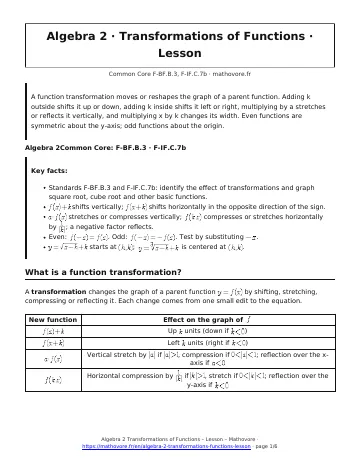
A function transformation moves or reshapes the graph of a parent function. Adding k outside shifts it up or down, adding k inside shifts it left or right, multiplying by a stretches or reflects it vertically, and multiplying x by k changes its width. Even functions are symmetric about the y-axis; odd functions about the origin.
Key facts:
- Standards F-BF.B.3 and F-IF.C.7b: identify the effect of transformations and graph square root, cube root and other basic functions.
- \(f(x)+k\) shifts vertically; \(f(x+k)\) shifts horizontally in the opposite direction of the sign.
- \(a\cdot f(x)\) stretches or compresses vertically; \(f(kx)\) compresses or stretches horizontally by \(\frac{1}{|k|}\); a negative factor reflects.
- Even: \(f(-x)=f(x)\). Odd: \(f(-x)=-f(x)\). Test by substituting \(-x\).
- \(y=\sqrt{x-h}+k\) starts at \((h,k)\); \(y=\sqrt[3]{x-h}+k\) is centered at \((h,k)\).
What is a function transformation?
A transformation changes the graph of a parent function \(y=f(x)\) by shifting, stretching, compressing or reflecting it. Each change comes from one small edit to the equation.
| New function | Effect on the graph of \(f\) |
|---|---|
| \(f(x)+k\) | Up \(k\) units (down if \(k< 0\)) |
| \(f(x+k)\) | Left \(k\) units (right if \(k< 0\)) |
| \(a\cdot f(x)\) | Vertical stretch by \(|a|\) if \(|a|>1\), compression if \(0< |a|< 1\); reflection over the x-axis if \(a< 0\) |
| \(f(kx)\) | Horizontal compression by \(\frac{1}{|k|}\) if \(|k|>1\), stretch if \(0< |k|< 1\); reflection over the y-axis if \(k< 0\) |
How do shifts work?
A number added outside the function moves the graph vertically. A number added inside moves it horizontally, in the direction opposite to the sign. For \(y=|x-3|+2\), the vertex moves from \((0,0)\) to \((3,2)\): right 3 because of \(x-3\), up 2 because of \(+2\).
How do stretches, compressions and reflections work?
Multiplying the output by \(a\) multiplies every y-coordinate by \(a\). For \(f(x)=x^{2}\), the point \((2,4)\) moves to \((2,8)\) on \(y=2x^{2}\) and to \((2,-4)\) on \(y=-x^{2}\). Multiplying the input by \(k\) divides every x-coordinate by \(k\), so \(f(2x)\) is half as wide as \(f(x)\).
What are even and odd functions?
Even: \(f(-x)=f(x)\) for every \(x\). The graph is symmetric about the y-axis, as with \(x^{2}\) and \(|x|\).
Odd: \(f(-x)=-f(x)\) for every \(x\). The graph is symmetric about the origin, as with \(x^{3}\) and \(\sqrt[3]{x}\).
Most functions are neither. For \(h(x)=x^{2}+x\), \(h(-x)=x^{2}-x\), which is not \(h(x)\) and not \(-h(x)\).
How do you graph a square root or cube root function?
- Find the starting point (square root) or center (cube root) from the shifts.
- Choose x-values that make the radicand a perfect square or cube.
- Apply the stretch and reflection to the y-values, then plot and connect.
Worked example. Graph \(y=2\sqrt{x-1}-3\). It starts at \((1,-3)\). Then \(x=2\) gives \(2(1)-3=-1\), \(x=5\) gives \(2(2)-3=1\) and \(x=10\) gives \(2(3)-3=3\). The domain is \(x\ge 1\) and the range is \(y\ge -3\).
Transformations of Functions: frequently asked questions
Why does f(x + 3) shift the graph left?
The output \(f(x+3)\) equals the old output at an x-value 3 larger. Each point of the original graph therefore appears 3 units farther left. For example, \(|x+3|\) has its vertex at \(x=-3\).
What is the difference between 2f(x) and f(2x)?
The factor \(2f(x)\) doubles every height, a vertical stretch. The factor \(f(2x)\) halves every x-coordinate, a horizontal compression. For \(f(x)=x^{2}\), \(f(2x)=4x^{2}\), which happens to equal \(4f(x)\).
How do you test whether a function is even or odd?
Compute \(f(-x)\) and simplify. If it equals \(f(x)\), the function is even. If it equals \(-f(x)\), it is odd. If neither, the function is neither. For \(f(x)=x^{3}+x\), \(f(-x)=-x^{3}-x=-f(x)\), so it is odd.
What are the domain and range of a square root function?
For \(y=a\sqrt{x-h}+k\), the radicand must be nonnegative, so the domain is \(x\ge h\). The range is \(y\ge k\) when \(a>0\) and \(y\le k\) when \(a< 0\). A cube root function has domain and range of all real numbers.
How does a transformation change an exponential function?
Adding \(k\) to \(2^{x}\) moves the horizontal asymptote to \(y=k\). Shifting left 1 gives \(2^{x+1}=2\cdot 2^{x}\), which is also a vertical stretch by 2, so the two descriptions give the same graph.
See every chapter on the Algebra 2 math page.