Key takeaway: This algebra 2 probability rules test has nine items on sample spaces, the addition rule with a Venn diagram, independence, a two-way table, a tree diagram and conditional probability. A calculator is allowed. Show every formula and substitution, and write answers as fractions or decimals.
This test covers sample spaces, events, the addition rule, independence, conditional probability, two-way tables and tree diagrams in Algebra 2. It has 9 questions worth 20 points. Allow 45 minutes, write fractions in lowest terms, and show your work for every answer.
- Grade: Algebra 2
- Chapter: Probability: Sample Spaces, Independence and Conditional Probability
- Common Core: S-CP.A.1, S-CP.A.2, S-CP.A.3, S-CP.A.4, S-CP.A.5, S-CP.B.6, S-CP.B.7
- Time: 45 minutes
- Total: 20 points (Question 1: 2 pts; Question 2: 2 pts; Question 3: 2 pts; Question 4: 2 pts; Question 5: 3 pts; Question 6: 3 pts; Question 7: 3 pts; Question 8: 2 pts; Question 9: 1 pt)
Algebra 2 Probability Rules Test: questions 1–5
1. Sample space of coin flips (2 points)
A fair coin is flipped three times .
- List all outcomes in the sample space. (1 point)
- Let \(A\) be “exactly two heads”. List the outcomes in \(A\) and find \(P(A)\). (1 point)
2. Events from a set of numbers (2 points)
A number is chosen at random from \(1,2,3,…,12\) written on slips. Let \(A\) be “even number” and \(B\) be “multiple of \(3\)”.
- List the outcomes in “\(A\) and \(B\)” and in “\(A\) or \(B\)”. (1 point)
- Find \(P(A\text{ or }B)\) and \(P(\text{not }A)\). (1 point)
3. Addition rule with a Venn diagram (2 points)
The Venn diagram shows \(40\) students in choir and drama. One student is chosen at random.
- Find \(P(\text{choir})\), \(P(\text{drama})\) and \(P(\text{choir and drama})\). (1 point)
- Use the addition rule to find \(P(\text{choir or drama})\), then find \(P(\text{neither})\). (1 point)
4. Independent or not (2 points)
Events \(A\) and \(B\) have \(P(A)=0.3\) and \(P(B)=0.6\).
- If \(P(A\text{ and }B)=0.18\), are \(A\) and \(B\) independent? Justify your answer. (1 point)
- If instead \(P(A\text{ and }B)=0.2\), find \(P(A|B)\). (1 point)
5. Two-way table of lunches (3 points)
The table shows \(120\) students by grade and lunch type. One student is chosen at random.
- Find \(P(\text{school lunch})\). (1 point)
- Find \(P(\text{10th}\,|\,\text{packed lunch})\). (1 point)
- Are “9th grade” and “school lunch” independent? Justify your answer. (1 point)
Algebra 2 Probability Rules Test: questions 6–9
6. Pens without replacement (3 points)
A box holds \(4\) black pens and \(2\) white pens. Two pens are drawn without replacement. The tree shows the probabilities.
- Find the probability that both pens are black. (1 point)
- Find the probability that the pens have different colors. (1 point)
- Find the probability that the first pen is black, given that the second pen is white. (1 point)
7. Free throws in a row (3 points)
Jamal makes \(80\%\) of his free throws, and his shots are independent. He takes two shots.
- Find the probability that he makes both. (1 point)
- Find the probability that he misses both. (1 point)
- Find the probability that he makes at least one. (1 point)
8. Conditional probability formula (2 points)
In a town, \(60\%\) of households have a dog (\(D\)), \(40\%\) have a cat (\(C\)), and \(25\%\) have both.
- Find \(P(C|D)\). (1 point)
- Find \(P(D|C)\). (1 point)
9. At least one six (1 point)
A fair die is rolled twice. Find the probability of getting at least one \(6\).

What do the first four items assess?
The opening item lists the outcomes of three coin flips, so expect eight, and then asks about the event of exactly two heads. The second picks a number from 1 to 12 and defines two events. Next, a Venn diagram of 40 students needs the addition rule. Item 4 gives \(P(A)=0.3\), \(P(B)=0.6\) and a joint of 0.18, so test the product.
How should you handle the table and tree items?
For the lunch table, identify the group named after the word given, and divide by its total. A tree for 4 black and 2 white pens shows branch probabilities that change after the first draw. Therefore multiply along each branch and add the branches you need.
What about the last items?
Jamal’s two free throws at 80% are independent, so multiply. The conditional item has 60% dog owners, 40% cat owners and 25% with both. Finally, at least one six in two rolls is easiest through a complement.
What is the final check?
Reread each answer and ask whether it is a probability, which means between 0 and 1. Next, confirm that you divided by the right total in every conditional item. Afterward, score the paper and jot down the rules you chose wrongly.

Printable PDF · Test
Algebra 2 Probability: Sample Spaces, Independence and Conditional Probability test
Download the PDF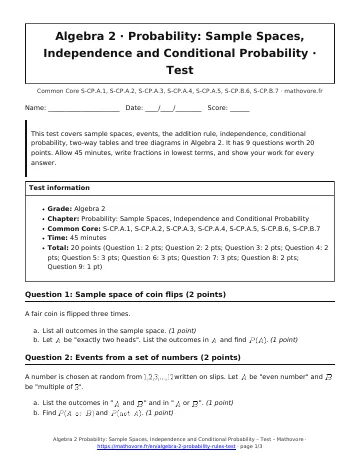
See every chapter on the Algebra 2 math page.