

Key takeaway: This algebra 2 quadratics complex solutions test contains eight questions that mix discriminants, graphs, the square root method, the quadratic formula, completing the square and a balloon launch. Simplify every complex answer to the form \(p\pm qi\). A calculator is allowed. Show your steps, because partial credit depends on them.
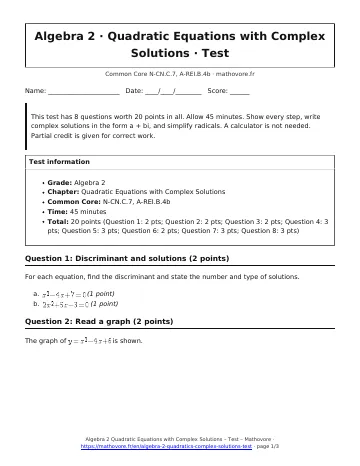
This test has 8 questions worth 20 points in all. Allow 45 minutes. Show every step, write complex solutions in the form a + bi, and simplify radicals. A calculator is not needed. Partial credit is given for correct work.
- Grade: Algebra 2
- Chapter: Quadratic Equations with Complex Solutions
- Common Core: N-CN.C.7, A-REI.B.4b
- Time: 45 minutes
- Total: 20 points (Question 1: 2 pts; Question 2: 2 pts; Question 3: 2 pts; Question 4: 3 pts; Question 5: 3 pts; Question 6: 2 pts; Question 7: 3 pts; Question 8: 3 pts)
Algebra 2 Quadratics Complex Solutions Test: questions 1–5
1. Discriminant and solutions (2 points)
For each equation, find the discriminant and state the number and type of solutions.
- \(x^{2}-4x+7=0\) (1 point)
- \(2x^{2}+5x-3=0\) (1 point)
2. Read a graph (2 points)
The graph of \(y=x^{2}-4x+6\) is shown.
- How many real solutions does \(x^{2}-4x+6=0\) have? (1 point)
- Find the discriminant and describe the solutions. (1 point)
3. Square root method (2 points)
Solve each equation.
- \(4x^{2}+100=0\) (1 point)
- \((x+3)^{2}=-16\) (1 point)
4. Quadratic formula (3 points)
Solve \(x^{2}-6x+25=0\).
5. Complete the square (3 points)
Solve \(x^{2}+10x+34=0\) by completing the square.
Algebra 2 Quadratics Complex Solutions Test: questions 6–8
6. A quadratic with fractions (2 points)
Solve \(x^{2}+x+1=0\). (2 points)
7. Solutions in the plane (3 points)
The points \(p\) and \(q\) are the two solutions of \(x^{2}+bx+c=0\), where \(b\) and \(c\) are real.
- Write \(p\) and \(q\) as complex numbers. (1 point)
- Find \(b\). (1 point)
- Find \(c\). (1 point)
8. Will the balloon reach 20 feet? (3 points)
Sofia launches a water balloon. Its height in feet after \(t\) seconds is \(h=-16t^{2}+32t\). Does the balloon ever reach a height of 20 ft? Solve an equation and explain.

What do the first three questions test?
Begin with discriminants for equations such as \(x^{2}-4x+7=0\), where you state the number and type of solutions. Then read the graph of \(x^{2}-4x+6\), and decide how many real solutions it has. After that, solve \(4x^{2}+100=0\) and \((x+3)^{2}=-16\) with the square root method.
How should you approach the longer questions?
For \(x^{2}-6x+25=0\), substitute carefully into the formula, since the radicand is \(36-100\). For \(x^{2}+10x+34=0\), complete the square and keep the added 25 on both sides. The fraction question \(x^{2}+x+1=0\) has two points, so show the radical simplification. A plotted pair of roots in question 7 lets you read \(b\) and \(c\) from the sum and product.
What does the balloon question ask?
The height \(h=-16t^{2}+32t\) peaks at 16 feet. Therefore setting \(h=20\) leads to a negative discriminant, and you must explain in a sentence what that means for the balloon.
What should you do before time runs out?
Plug one complex root into each equation you solved. If the arithmetic with \(i^{2}=-1\) works out to zero, you are safe. Afterward, use the key to see where partial credit applied, and note the method you trust least.

See every chapter on the Algebra 2 math page.