


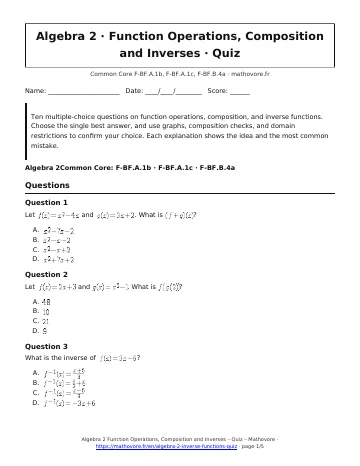
Ten multiple-choice questions on function operations, composition, and inverse functions. Choose the single best answer, and use graphs, composition checks, and domain restrictions to confirm your choice. Each explanation shows the idea and the most common mistake.
Algebra 2Common Core: F-BF.A.1b · F-BF.A.1c · F-BF.B.4a
🎯 Function Operations, Composition and Inverses – Algebra 2 math quiz
Question 1
Let \(f(x)=x^{2}-4x\) and \(g(x)=3x+2\). What is \((f+g)(x)\)?
A
\(x^{2}-7x-2\)
B
\(x^{2}-x-2\)
C
\(x^{2}-x+2\)
D
\(x^{2}+7x+2\)
Question 2
Let \(f(x)=2x+3\) and \(g(x)=x^{2}-1\). What is \(f(g(2))\)?
A
\(48\)
B
\(10\)
C
\(21\)
D
\(9\)
Question 3
What is the inverse of \(f(x)=3x-6\)?
A
\(f^{-1}(x)=\frac{x+6}{3}\)
B
\(f^{-1}(x)=\frac{x}{3}+6\)
C
\(f^{-1}(x)=\frac{x-6}{3}\)
D
\(f^{-1}(x)=-3x+6\)
Question 4
Which line is the graph of \(f^{-1}\)?The graph of f (blue) and four candidate lines.
A
Line A
B
Line B
C
Line C
D
Line D
Question 5
Let \(f(x)=\sqrt{x}\) and \(g(x)=x+6\). What is the domain of \(f(g(x))\)?
A
\(x\ge 6\)
B
\(x\ge -6\)
C
\(x\ge 0\)
D
\(x\le -6\)
Question 6
Which pair of functions are inverses of each other?
A
\(f(x)=4x+1\) and \(g(x)=\frac{x+1}{4}\)
B
\(f(x)=4x+1\) and \(g(x)=\frac{x-1}{4}\)
C
\(f(x)=4x+1\) and \(g(x)=\frac{1}{4x+1}\)
D
\(f(x)=4x+1\) and \(g(x)=-4x-1\)
Question 7
The graph shows \(f(x)=(x-1)^{2}-2\). Which domain restriction makes \(f\) one-to-one?The graph of f(x) = (x − 1)² − 2.
A
\(x\ge -2\)
B
\(-1\le x\le 3\)
C
\(x\ge 1\)
D
all real numbers
Question 8
Using the graph of \(f(x)=x^{2}-1\) for \(x\ge 0\), what is \(f^{-1}(3)\)?The graph of f(x) = x² − 1 for x ≥ 0.
A
\(8\)
B
\(10\)
C
\(\sqrt{2}\)
D
\(2\)
Question 9
The radius of a circle is \(r(t)=4t\) and its area is \(A(r)=\pi r^{2}\). What is \(A(r(t))\)?
A
\(4\pi t^{2}\)
B
\(16\pi t^{2}\)
C
\(16\pi^{2}t^{2}\)
D
\(8\pi t^{2}\)
Question 10
Let \(f(x)=x+2\) and \(g(x)=x-5\). What is \((fg)(x)\)?
A
\(x^{2}+3x-10\)
B
\(2x-3\)
C
\(x^{2}-10\)
D
\(x^{2}-3x-10\)
🎉 Quiz complete!
0 / 10
Remember:
- Composition: (f ∘ g)(x) = f(g(x)); the inner function g runs first and order usually matters.
- Inverse method: write y = f(x), swap x and y, solve for y, rename it f⁻¹(x).
- Two functions are inverses when f(g(x)) = x and g(f(x)) = x for every x in the domains.
- The graph of f⁻¹ is the reflection of the graph of f across the line y = x; points (a, b) become (b, a).
- Only one-to-one functions have inverses; restrict the domain (such as x ≥ 0 for x²) when needed.
See every chapter on the Algebra 2 math page.