



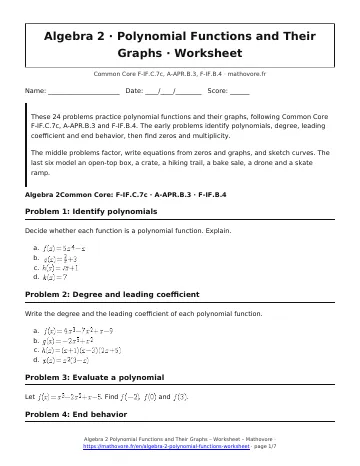
These 24 problems practice polynomial functions and their graphs, following Common Core F-IF.C.7c, A-APR.B.3 and F-IF.B.4. The early problems identify polynomials, degree, leading coefficient and end behavior, then find zeros and multiplicity.
The middle problems factor, write equations from zeros and graphs, and sketch curves. The last six model an open-top box, a crate, a hiking trail, a bake sale, a drone and a skate ramp.
Problem 1: Identify polynomials
Decide whether each function is a polynomial function. Explain.
- \(f(x)=5x^{4}-x\)
- \(g(x)=\frac{2}{x}+3\)
- \(h(x)=\sqrt{x}+1\)
- \(k(x)=7\)
Problem 2: Degree and leading coefficient
Write the degree and the leading coefficient of each polynomial function.
- \(f(x)=4x^{3}-7x^{2}+x-9\)
- \(g(x)=-2x^{5}+x^{2}\)
- \(h(x)=(x+1)(x-3)(2x+5)\)
- \(p(x)=x^{2}(3-x)\)
Problem 3: Evaluate a polynomial
Let \(f(x)=x^{3}-2x^{2}+x-5\). Find \(f(-2)\), \(f(0)\) and \(f(3)\).
Problem 4: End behavior
Describe the end behavior of each function: what happens at the left end and at the right end.
- \(f(x)=3x^{4}-x\)
- \(g(x)=-2x^{3}+5\)
- \(h(x)=-x^{6}+x\)
- \(k(x)=5x^{5}-x^{2}\)
Problem 5: Zeros from factored form
Find all zeros of each function.
- \(f(x)=(x-4)(x+1)\)
- \(g(x)=x(x-5)(x+3)\)
- \(h(x)=(2x-6)(x+7)\)
- \(p(x)=x^{2}(x-2)(x+6)\)
Problem 6: Multiplicity
For each function, list every zero with its multiplicity, say whether the graph crosses or touches the x-axis there, and give the degree.
- \(f(x)=x(x+3)^{2}(x-1)^{3}\)
- \(g(x)=-2(x-5)^{4}(x+2)\)
Problem 7: Factor to find zeros
Factor completely and list the zeros.
- \(x^{3}-9x\)
- \(x^{3}+2x^{2}-8x\)
- \(x^{4}-16x^{2}\)
- \(x^{3}-5x^{2}-4x+20\)
Problem 8: Write a polynomial from its zeros
Write each polynomial in standard form.
- Zeros \(-2\), \(1\) and \(4\), leading coefficient \(1\)
- Zeros \(0\) and \(3\) with \(3\) a zero of multiplicity \(2\), leading coefficient \(2\)
Problem 9: Find the y-intercept
Find the y-intercept of each function.
- \(f(x)=2(x-3)(x+1)(x-4)\)
- \(g(x)=-(x+2)^{2}(x-5)\)
- \(h(x)=x^{3}-4x^{2}+6\)
Problem 10: Where is the function positive?
Let \(f(x)=(x+3)(x-1)(x-4)\). Find the intervals where \(f(x)>0\) and where \(f(x)< 0\).
Problem 11: Turning points
The graph of a polynomial function is shown.
- How many turning points does it have?
- What is the least possible degree?
- Is the leading coefficient positive or negative?
- What is the greatest number of turning points a degree-\(7\) polynomial can have?
Problem 12: Equation from a graph
The graph of a polynomial function crosses the x-axis at \(-2\) and \(3\), touches it at \(1\), and passes through \((0,-3)\). Write a possible equation in factored form.
Problem 13: Sketch a cubic
Sketch the graph of \(f(x)=x(x+3)(x-2)\). Label the zeros, the y-intercept and the end behavior.
Problem 14: Sketch with a double zero
Sketch the graph of \(g(x)=-(x+1)^{2}(x-2)\). Label the zeros and the y-intercept.
Problem 15: Degree 5 with a negative leading coefficient
A polynomial function has degree \(5\) and a negative leading coefficient. Describe its end behavior, then state the greatest possible number of turning points, the greatest possible number of real zeros, and the least possible number of real zeros.
Problem 16: Factor a quartic
Let \(f(x)=x^{4}-5x^{2}+4\). Factor it completely, find the zeros and the y-intercept, and describe the end behavior.
Problem 17: Equation from zeros and a point
A polynomial has a zero at \(2\) with multiplicity \(2\) and a zero at \(-3\) with multiplicity \(1\). Its graph passes through \((0,-24)\). Write the function in factored form.
Problem 18: Read a table
The table gives \(f(x)=(x+2)(x-1)^{2}\).
| \(x\) | \(-3\) | \(-2\) | \(-1\) | \(0\) | \(1\) | \(2\) | \(3\) |
|---|---|---|---|---|---|---|---|
| \(f(x)\) | \(-16\) | \(0\) | \(4\) | \(2\) | \(0\) | \(4\) | \(20\) |
- List the zeros.
- On which intervals does the table show \(f\) increasing and decreasing?
- Identify the relative maximum and relative minimum.
Problem 19: Open-top box
Jamal cuts a square of side \(x\) inches from each corner of a \(10\)-inch by \(16\)-inch sheet and folds up the sides to make an open box. Its volume is \(V(x)=x(10-2x)(16-2x)\).
- State a sensible domain for \(x\).
- Find \(V(1)\), \(V(2)\), \(V(3)\) and \(V(4)\).
- Which whole-number cut gives the greatest volume, and what is it?
- List all zeros of \(V\).
Problem 20: Shipping crate
A crate has width \(x\) feet, length \((x+4)\) feet and height \((x-2)\) feet, so \(V(x)=x(x+4)(x-2)\).
- Write \(V(x)\) in standard form.
- Explain why \(x\) must be greater than \(2\).
- Show that \(x=4\) gives a volume of \(64\) cubic feet.
Problem 21: Hiking trail
Priya’s trail elevation, in feet relative to the trailhead, is \(E(x)=x(x-3)(x-6)\) after \(x\) miles, for \(0\le x\le 7\).
- At which distances is she level with the trailhead?
- Between which distances is she below the trailhead?
- Find \(E(7)\).
- Find \(E(1)\), \(E(2)\), \(E(4)\) and \(E(5)\). Which whole-mile point is the lowest?
Problem 22: Bake sale profit
Sofia bakes \(x\) dozen cookies a week. Her weekly profit in dollars is \(P(x)=-0.5x(x-10)(x-30)\), for \(0\le x\le 30\).
- Find the break-even amounts, where \(P(x)=0\).
- Find \(P(15)\), \(P(20)\), \(P(22)\) and \(P(25)\).
- Which of these four amounts gives the greatest profit?
- Does she gain or lose money when she bakes \(5\) dozen?
Problem 23: Drone flight
Noah’s drone flies at height \(d(t)=t(t-6)^{2}\) feet, \(t\) seconds after launch, for \(0\le t\le 6\).
- Find \(d(4)\) and \(d(5)\).
- Compare \(d(1)\) through \(d(5)\) and name the greatest height.
- What does the double zero at \(t=6\) mean for the drone?
Problem 24: Skate ramp
Diego’s ramp profile is \(h(x)=a\,x(x-12)^{2}\), where \(x\) is the horizontal distance in feet and \(h\) is the height in feet. The ramp is \(8\) feet high at \(x=4\).
- Find \(a\) and write \(h(x)\).
- Find the height at \(x=6\).
- Compare \(h(3)\), \(h(4)\) and \(h(5)\). Where is the ramp highest?

See every chapter on the Algebra 2 math page.