

Key takeaway: This algebra 2 exponential log equations worksheet has 23 problems that run from easy to hard. Students solve with a common base, take logarithms, rewrite log equations and reject extraneous answers. Also, the last problems use interest, a bacteria colony, a drug half-life, earthquakes and pH. As a result, you practice solving for time in real settings. A matching answer key walks through each solution.
These problems practice solving exponential equations with a common base or with logarithms, solving logarithmic equations, and checking for extraneous solutions. The last problems apply the methods to interest, population, half-life, earthquakes and pH.
Problems run from easy to hard and match Common Core standards F-LE.A.4 and A-SSE.B.3c at the Algebra 2 level. Round only at the final step.
Algebra 2 Exponential Log Equations Worksheet: problems 1–5
1. Same base
Solve each equation.
- \(2^{x}=32\)
- \(3^{x}=81\)
- \(5^{x}=\frac{1}{125}\)
- \(4^{x}=8\)
2. Rewrite to a common base
Solve each equation by writing both sides with the same base.
- \(2^{3x-1}=64\)
- \(9^{x}=27^{x-1}\)
- \((\frac{1}{4})^{x+1}=16\)
- \(8^{x}=\frac{1}{32}\)
3. Logarithmic to exponential form
Solve each equation by rewriting it in exponential form.
- \(\log_{6} x=2\)
- \(\log_{2} x=-4\)
- \(\log_{4} x=\frac{3}{2}\)
- \(\ln x=3\) (give a decimal to three places)
4. One-step exponential equations
Solve each equation. Round to four decimal places.
- \(3^{x}=20\)
- \(2^{x}=100\)
- \(10^{x}=45\)
- \(e^{x}=12\)
5. Isolate the power first
Solve each equation. Give exact answers when possible and decimals to three places otherwise.
- \(4\cdot 5^{x}=100\)
- \(3\cdot 2^{x}+5=53\)
- \(7(1.5)^{x}=50\) (the graph of \(y=7(1.5)^{x}\) and the line \(y=50\) is shown)
Algebra 2 Exponential Log Equations Worksheet: problems 6–10
6. Exponents with a coefficient
Solve each equation. Round to three decimal places.
- \(2^{3x}=50\)
- \(5^{2x-1}=40\)
7. Equations with base e
Solve each equation. Round to four decimal places.
- \(3e^{2x}=45\)
- \(5e^{0.3x}-2=18\)
8. Solve a formula for time
Solve each formula for \(t\). Then find \(t\) when \(P=2000\), \(A=3500\) and \(r=0.05\), to two decimal places.
- \(A=Pe^{rt}\)
- \(A=P(1+r)^{t}\)
9. Simple logarithmic equations
Solve each equation.
- \(\log_{2}(x+5)=4\)
- \(\log_{3}(2x-1)=2\)
- \(\log(x-4)=1\)
- \(\ln(3x)=2\) (decimal to three places)
10. Isolate the logarithm
Solve each equation.
- \(3\log_{2} x-4=8\)
- \(2\ln(x+1)=6\) (decimal to three places)
- \(4\log_{5}(x-2)+3=11\)
Algebra 2 Exponential Log Equations Worksheet: problems 11–15
11. Equal logarithms
Solve each equation. Check every answer in the original equation.
- \(\log_{5}(3x+1)=\log_{5}(x+9)\)
- \(\ln(2x-3)=\ln(x+5)\)
- \(\log_{2}(x^{2})=\log_{2}(5x-6)\)
12. Add two logarithms
Solve each equation. The graph of \(y=\log_{2} x+\log_{2}(x-6)\) is shown for part (a).
- \(\log_{2} x+\log_{2}(x-6)=4\)
- \(\log_{3} x+\log_{3}(x+6)=3\)
13. Subtract two logarithms
Solve each equation.
- \(\log_{3}(x+8)-\log_{3} x=2\)
- \(\ln(x+5)-\ln(x-1)=\ln 3\)
14. Reject extraneous solutions
Solve each equation and name any extraneous solution.
- \(\log x+\log(x-3)=1\)
- \(\log_{4}(x+2)+\log_{4}(x-1)=1\)
15. Quadratic form
Solve \(2^{2x}-6\cdot 2^{x}+8=0\). Use the substitution \(u=2^{x}\). The graph of \(y=4^{x}-6\cdot 2^{x}+8\) is shown.
Algebra 2 Exponential Log Equations Worksheet: problems 16–20
16. Quadratic form with e
Solve \(e^{2x}-5e^{x}+6=0\). Round to four decimal places.
17. Equivalent growth rates
A town has population \(P(t)=12000(1.035)^{t}\), where \(t\) is in years. Write \(P\) in the form \(12000e^{kt}\), and find the equivalent growth rate per month as a percent to three decimal places.
18. Bacteria growth
A colony starts with 200 cells and grows 8% each hour, so \(N(t)=200(1.08)^{t}\). When does it reach 1,000 cells? Find the doubling time too. The graph with the line \(N=1000\) is shown.
19. Compound interest
Aisha invests \$3,000 at 4.5% compounded quarterly, so \(A=3000(1+\frac{0.045}{4})^{4t}\). How many years until the account reaches \$5,000?
20. Continuous compounding
Liam deposits \$1,500 at 3.2% compounded continuously, so \(A=1500e^{0.032t}\). Find the time to double, and the time to reach \$4,000.
Algebra 2 Exponential Log Equations Worksheet: problems 21–23
21. Medicine half-life
A patient takes a 200 mg dose of a drug with half-life 6 hours, so \(N(t)=200(\frac{1}{2})^{t/6}\). When do 15 mg remain? The graph with the line \(N=15\) is shown.
22. Earthquake comparison
Magnitude is \(M=\log\frac{I}{I_{0}}\). Noah compares two earthquakes. (a) How many times as intense is a magnitude 7.6 quake as a magnitude 5.2 quake? (b) A quake is 250 times as intense as a magnitude 5.2 quake. Find its magnitude to the nearest tenth.
23. pH and decibels
(a) Sofia measures a drink with pH 3.8. Find \([H^{+}]\) from \(\text{pH}=-\log[H^{+}]\), in scientific notation with three significant digits. (b) A siren is 95 dB. Find \(\frac{I}{I_{0}}\) from \(L=10\log\frac{I}{I_{0}}\), in scientific notation with three significant digits.

What skills does the algebra 2 exponential log equations worksheet build?
Problems 1 and 2 use a common base. For example, \(4^{x}=8\) becomes \(2^{2x}=2^{3}\), so \(x=\frac{3}{2}\). Then problem 2 rewrites \(9^{x}=27^{x-1}\) with base 3, which gives \(2x=3x-3\). Because the exponents must match, \(x=3\). Meanwhile, problem 4 uses logarithms on \(3^{x}=20\), \(2^{x}=100\), \(10^{x}=45\) and \(e^{x}=12\). Therefore, check that each decimal rounds to four places.
How do the logarithmic equations work?
Problem 9 rewrites four logs in exponential form, such as \(\log_{2}(x+5)=4\) giving \(x=11\). Then problem 10 isolates the log before rewriting. Likewise, problem 13 turns a difference of logs into a quotient. However, problem 14 asks for extraneous solutions, so test \(x=5\) and \(x=-2\) in \(\log x+\log(x-3)=1\). In addition, the second part leads to \(x^{2}+x-6=0\), and one root fails.
Which application problems need extra care?
Problem 15 uses the substitution \(u=2^{x}\), so \(u^{2}-6u+8=0\). Next, problem 16 does the same with \(e^{x}\). Meanwhile, problem 18 asks when 200 cells at 8 percent per hour reach 1,000. Because the answer is about 20.9 hours, round up only if the question asks for full hours. Finally, problem 20 doubles money at 3.2 percent continuous growth, so \(t=\frac{\ln 2}{0.032}\).
How can you check your solutions?
Substitute each answer into the original equation. Then confirm that every log argument is positive. Also, compare a decimal with a quick estimate from two powers. After that, redo problem 14 and name the extraneous root.

Printable PDF · Worksheet
Algebra 2 Solving Exponential and Logarithmic Equations worksheet
Download the PDF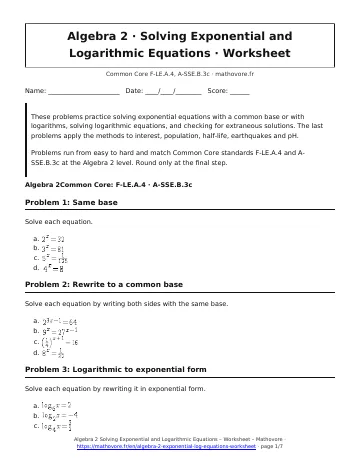
See every chapter on the Algebra 2 math page.