



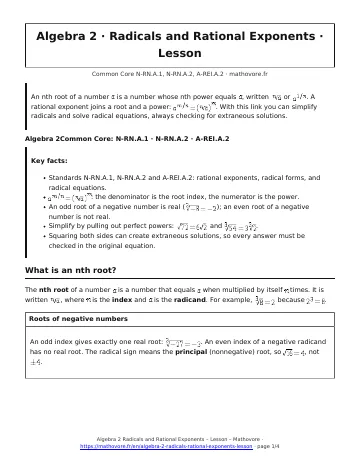
An nth root of a number \(a\) is a number whose nth power equals \(a\), written \(\sqrt[n]{a}\) or \(a^{1/n}\). A rational exponent joins a root and a power: \(a^{m/n}=(\sqrt[n]{a})^{m}\). With this link you can simplify radicals and solve radical equations, always checking for extraneous solutions.
Key facts:
- Standards N-RN.A.1, N-RN.A.2 and A-REI.A.2: rational exponents, radical forms, and radical equations.
- \(a^{m/n}=(\sqrt[n]{a})^{m}\): the denominator is the root index, the numerator is the power.
- An odd root of a negative number is real (\(\sqrt[3]{-8}=-2\)); an even root of a negative number is not real.
- Simplify by pulling out perfect powers: \(\sqrt{72}=6\sqrt{2}\) and \(\sqrt[3]{54}=3\sqrt[3]{2}\).
- Squaring both sides can create extraneous solutions, so every answer must be checked in the original equation.
What is an nth root?
The nth root of a number \(a\) is a number that equals \(a\) when multiplied by itself \(n\) times . It is written \(\sqrt[n]{a}\), where \(n\) is the index and \(a\) is the radicand. For example, \(\sqrt[3]{8}=2\) because \(2^{3}=8\).
An odd index gives exactly one real root: \(\sqrt[3]{-27}=-3\). An even index of a negative radicand has no real root. The radical sign means the principal (nonnegative) root, so \(\sqrt{16}=4\), not \(\pm 4\).
How do rational exponents relate to radicals?
A rational exponent is a radical in disguise: \(a^{1/n}=\sqrt[n]{a}\) and \(a^{m/n}=(\sqrt[n]{a})^{m}=\sqrt[n]{a^{m}}\). The denominator is the index and the numerator is the power. A negative exponent means a reciprocal: \(a^{-m/n}=\frac{1}{a^{m/n}}\). Take the root first to keep the numbers small, and the usual exponent rules still apply, such as \(x^{1/2}\cdot x^{1/3}=x^{5/6}\).
How do you simplify a radical?
Use the product property \(\sqrt[n]{ab}=\sqrt[n]{a}\cdot\sqrt[n]{b}\). Pull out the largest factor that is a perfect \(n\)th power. Since \(72=36\cdot 2\), we get \(\sqrt{72}=\sqrt{36}\cdot\sqrt{2}=6\sqrt{2}\). Likewise \(\sqrt[3]{54}=\sqrt[3]{27}\cdot\sqrt[3]{2}=3\sqrt[3]{2}\). Like radicals add as like terms do: \(2\sqrt{3}+5\sqrt{3}=7\sqrt{3}\).
A radical should not stay in a denominator. To rationalize, multiply the top and bottom by a radical that makes the denominator a whole number: \(\frac{6}{\sqrt{3}}=\frac{6\sqrt{3}}{3}=2\sqrt{3}\). The table below collects the forms you will convert most often.
| Exponent form | Radical form | Value |
|---|---|---|
| \(49^{1/2}\) | \(\sqrt{49}\) | \(7\) |
| \(8^{2/3}\) | \((\sqrt[3]{8})^{2}\) | \(4\) |
| \(81^{-3/4}\) | \(\frac{1}{(\sqrt[4]{81})^{3}}\) | \(\frac{1}{27}\) |
How do you solve a radical equation?
- Isolate the radical on one side.
- Raise both sides to the power equal to the index.
- Solve the new equation.
- Substitute every answer into the original equation.
Solve \(\sqrt{x+3}=x-3\). Squaring gives \(x+3=x^{2}-6x+9\), so \(x^{2}-7x+6=0\) and \(x=1\) or \(x=6\). Check \(x=1\): \(\sqrt{4}=2\), but \(1-3=-2\), so it fails. Check \(x=6\): \(\sqrt{9}=3\) and \(6-3=3\). The only solution is \(x=6\); \(x=1\) is extraneous, an answer created by squaring.
Radicals and Rational Exponents: frequently asked questions
Is \(\sqrt{16}\) equal to \(4\) or \(\pm 4\)?
The radical sign means the principal root, so \(\sqrt{16}=4\). The equation \(x^{2}=16\) has two solutions, \(x=\pm 4\), because you add the negative root yourself when solving.
Why can you take the cube root of a negative number but not the square root?
A negative number times itself three times stays negative, so \(\sqrt[3]{-27}=-3\). A negative number times itself twice is always positive, so no real number squares to \(-27\).
How do you evaluate \(32^{3/5}\)?
Read the denominator as the root and the numerator as the power: \(32^{3/5}=(\sqrt[5]{32})^{3}=2^{3}=8\). Taking the root first keeps the numbers small.
What is an extraneous solution?
It is an answer that appears while solving but fails in the original equation. Raising both sides to a power can produce one, for example \(x=1\) in \(\sqrt{x+3}=x-3\).
Do the laws of exponents work with fractional exponents?
Yes. Add exponents when multiplying like bases, subtract when dividing, and multiply for a power of a power: \((x^{2/3})^{3/4}=x^{1/2}\). For even roots, assume the variable is nonnegative.
See every chapter on the Algebra 2 math page.