

Key takeaway: This algebra 2 rational functions test is a 20-point paper of eight items. It covers domain and asymptotes, a hole, a graph you must draw, an equation read from a graph, inverse variation, a driving-time model and average cost. Use graph paper and a straightedge. Show your reasoning, because each part carries its own points.
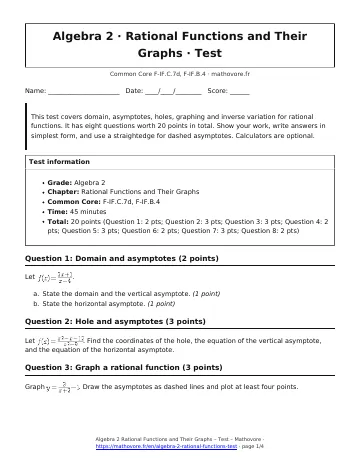
This test covers domain, asymptotes, holes, graphing and inverse variation for rational functions. It has eight questions worth 20 points in total. Show your work, write answers in simplest form, and use a straightedge for dashed asymptotes. Calculators are optional.
- Grade: Algebra 2
- Chapter: Rational Functions and Their Graphs
- Common Core: F-IF.C.7d, F-IF.B.4
- Time: 45 minutes
- Total: 20 points (Question 1: 2 pts; Question 2: 3 pts; Question 3: 3 pts; Question 4: 2 pts; Question 5: 3 pts; Question 6: 2 pts; Question 7: 3 pts; Question 8: 2 pts)
Algebra 2 Rational Functions Test: questions 1–5
1. Domain and asymptotes (2 points)
Let \(f(x)=\frac{2x+1}{x-4}\).
- State the domain and the vertical asymptote. (1 point)
- State the horizontal asymptote. (1 point)
2. Hole and asymptotes (3 points)
Let \(f(x)=\frac{x^{2}-x-12}{x^{2}-9}\). Find the coordinates of the hole, the equation of the vertical asymptote, and the equation of the horizontal asymptote.
3. Graph a rational function (3 points)
Graph \(y=\frac{3}{x+2}-1\). Draw the asymptotes as dashed lines and plot at least four points.
4. Equation from a graph (2 points)
Write an equation of the form \(y=\frac{a}{x-h}+k\) for the graph.
5. Inverse variation (3 points)
The variable \(y\) varies inversely with \(x\), and \(y=9\) when \(x=4\).
- Write an equation relating \(x\) and \(y\). (1 point)
- Find \(y\) when \(x=12\). (1 point)
- Find \(x\) when \(y=2.25\). (1 point)
Algebra 2 Rational Functions Test: questions 6–8
6. Graph with a hole (2 points)
The graph of \(f(x)=\frac{x^{2}-4}{x+2}\) is shown.
- Give the coordinates of the open circle. (1 point)
- State the domain of \(f\). (1 point)
7. Driving time (3 points)
Sofia drives 180 miles. The time is \(t=\frac{180}{r}\) hours at an average speed of \(r\) miles per hour.
- Find the time at 45 mph. (1 point)
- Find the speed that gives a time of 2.5 hours. (1 point)
- Describe what happens to \(t\) as \(r\) gets very large, and name the horizontal asymptote. (1 point)
8. Average cost (2 points)
Liam prints T-shirts. The setup costs $120 and each shirt costs $4 to print. The average cost per shirt for \(n\) shirts is \(C(n)=\frac{4n+120}{n}\) dollars.
- Find the average cost for 30 shirts. (1 point)
- How many shirts give an average cost of $5? (1 point)

What does the opening block ask?
The first question uses \(f(x)=\frac{2x+1}{x-4}\), so name the domain and both asymptotes. The second uses \(\frac{x^{2}-x-12}{x^{2}-9}\), which has a hole, a vertical asymptote and a horizontal asymptote. Factor before you decide which is which. A value that cancels gives the hole.
How do you handle the graph questions?
For \(y=\frac{3}{x+2}-1\), draw dashed lines at \(x=-2\) and \(y=-1\), then plot four points, two on each side. When writing an equation from a graph, read the asymptotes first to get \(h\) and \(k\), and use one point to find \(a\). The graph of \(\frac{x^{2}-4}{x+2}\) is a line with an open circle, so give the circle’s coordinates.
What do the word problems measure?
Inverse variation starts from \(y=9\) at \(x=4\), so find the constant before you write the equation. Sofia’s 180-mile drive gives \(t=\frac{180}{r}\), which you evaluate at chosen speeds. Liam’s shirts have average cost \(\frac{120+4n}{n}\), and its limit shows the per-shirt price.
What deserves a glance before you submit?
Look at each graph and ask whether the curve ever touches a dashed line. It should not. Then reread each word problem answer for units. Once you finish, the key will show which skill lost you points.

See every chapter on the Algebra 2 math page.