
Key takeaway: This algebra 2 trig unit circle worksheet gives you 23 printable problems on radian measure, arc length, exact values and the Pythagorean identity. The set targets F-TF.A.2 and F-TF.C.8, and a full answer key comes with the PDF. Problems 1 to 5 build conversions and arcs, problems 6 to 17 drill exact values, and problems 18 to 23 turn the circle into wheels, clocks and pizzas. Plan about 50 minutes, and keep a calculator nearby for the decimal answers in problem 4 and the word problems.
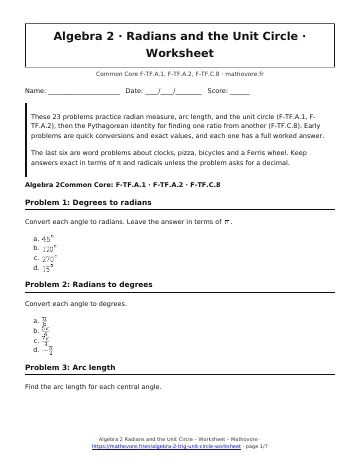
These 23 problems practice radian measure, arc length, and the unit circle (F-TF.A.1, F-TF.A.2), then the Pythagorean identity for finding one ratio from another (F-TF.C.8). Early problems are quick conversions and exact values, and each one has a full worked answer.
The last six are word problems about clocks, pizza, bicycles and a Ferris wheel. Keep answers exact in terms of π and radicals unless the problem asks for a decimal.
Algebra 2 Trig Unit Circle Worksheet: problems 1–5
1. Degrees to radians
Convert each angle to radians. Leave the answer in terms of \(\pi\).
- \(45^{\circ}\)
- \(120^{\circ}\)
- \(270^{\circ}\)
- \(15^{\circ}\)
2. Radians to degrees
Convert each angle to degrees.
- \(\frac{\pi}{6}\)
- \(\frac{5\pi}{4}\)
- \(\frac{7\pi}{3}\)
- \(-\frac{\pi}{2}\)
3. Arc length
Find the arc length for each central angle.
- Radius 6 inches and central angle \(\frac{\pi}{3}\). Give the exact length and a decimal rounded to hundredths.
- Radius 4 feet and central angle 2.5 radians.
4. Angle from an arc
An arc of length 9 inches lies on a circle of radius 6 inches. Find the central angle in radians and in degrees to the nearest tenth.
5. Locating the quadrant
Name the quadrant of the terminal side of each angle.
- \(\frac{5\pi}{6}\) (point A)
- \(\frac{4\pi}{3}\) (point B)
- \(\frac{7\pi}{4}\) (point C)
- \(\frac{\pi}{3}\) (point D)
Algebra 2 Trig Unit Circle Worksheet: problems 6–10
6. Special angle values
Write the exact value of each expression.
- \(\sin\frac{\pi}{6}\)
- \(\cos\frac{\pi}{4}\)
- \(\tan\frac{\pi}{3}\)
- \(\cos\frac{\pi}{3}\)
7. Unit circle coordinates
Find the exact coordinates of the point where the terminal side of each angle meets the unit circle.
- \(\frac{2\pi}{3}\)
- \(\frac{5\pi}{4}\)
- \(\frac{11\pi}{6}\)
8. Reference angles
Find the reference angle for each angle.
- \(\frac{5\pi}{6}\)
- \(\frac{7\pi}{6}\)
- \(\frac{5\pi}{3}\)
- \(\frac{3\pi}{4}\)
9. Quadrantal angles
Complete the table of exact values. Write undefined where it applies.
| \(\theta\) | \(\sin\theta\) | \(\cos\theta\) | \(\tan\theta\) |
|---|---|---|---|
| \(0\) | |||
| \(\frac{\pi}{2}\) | |||
| \(\pi\) | |||
| \(\frac{3\pi}{2}\) |
10. Evaluating in other quadrants
Find the exact value.
- \(\sin(\frac{7\pi}{6})\)
- \(\cos(\frac{5\pi}{3})\)
- \(\tan(\frac{3\pi}{4})\)
Algebra 2 Trig Unit Circle Worksheet: problems 11–15
11. Negative and large angles
Find the exact value.
- \(\cos(-\frac{\pi}{3})\)
- \(\sin(-\frac{\pi}{4})\)
- \(\sin\frac{13\pi}{6}\)
- \(\cos\frac{9\pi}{4}\)
12. Solving for the angle
Find all angles \(\theta\) with \(0\le\theta< 2\pi\) that satisfy each equation.
- \(\sin\theta=\frac{\sqrt{3}}{2}\)
- \(\cos\theta=-\frac{\sqrt{2}}{2}\)
13. Checking the identity
Verify that \(\sin^{2}\theta+\cos^{2}\theta=1\) for each angle by substituting exact values.
- \(\theta=\frac{\pi}{6}\)
- \(\theta=\frac{5\pi}{4}\)
14. Sine and tangent from cosine
Given \(\cos\theta=\frac{5}{13}\) with the terminal side of \(\theta\) in Quadrant IV, find \(\sin\theta\) and \(\tan\theta\).
15. Sine from cosine
Given \(\cos\theta=\frac{5}{13}\) with the terminal side in Quadrant IV, find \(\sin\theta\) and \(\tan\theta\).
Algebra 2 Trig Unit Circle Worksheet: problems 16–20
16. Using the tangent
Given \(\tan\theta=\frac{4}{3}\) with the terminal side in Quadrant III, find \(\sin\theta\) and \(\cos\theta\).
17. Radical values
Given \(\cos\theta=-\frac{\sqrt{5}}{3}\) with the terminal side in Quadrant III, find \(\sin\theta\) and \(\tan\theta\).
18. Ferris wheel height
A Ferris wheel has radius 25 feet and its center is 30 feet above the ground. Mei’s height is \(h=30+25\sin\theta\), where \(\theta\) is measured from the horizontal through the center.
Find Mei’s height for each angle. Round to the nearest tenth when needed.
- \(\theta=\frac{\pi}{6}\)
- \(\theta=\frac{\pi}{2}\)
- \(\theta=\frac{5\pi}{4}\)
- \(\theta=\frac{3\pi}{2}\)
19. Clock hand
Sofia’s wall clock has a minute hand 5 inches long. In 20 minutes the hand turns through \(\frac{1}{3}\) of a full circle.
- Write the angle in radians.
- How far does the tip of the minute hand travel? Give the exact value and a decimal to the nearest hundredth.
20. Pizza slice
Liam cuts a pizza of radius 8 inches into slices with a central angle of \(45^{\circ}\).
- Convert \(45^{\circ}\) to radians.
- Find the length of the crust on one slice to the nearest hundredth of an inch.
Algebra 2 Trig Unit Circle Worksheet: problems 21–23
21. Bicycle wheel
A bicycle wheel has radius 13 inches. Noah rides until the wheel turns exactly 3 full revolutions.
- Find the angle the wheel turns through, in radians.
- Find the distance he travels in inches and in feet, to the nearest hundredth.
22. Point on the circle
The point \(P(-\frac{12}{13},\ y)\) lies on the unit circle in Quadrant III, and it is on the terminal side of angle \(\theta\). Find \(y\), then \(\sin\theta\), \(\cos\theta\) and \(\tan\theta\).
23. When is the rider low
On the same wheel, \(h=30+25\sin\theta\). Find all angles \(\theta\) with \(0\le\theta< 2\pi\) for which Mei is 17.5 feet above the ground.

Which problems build the basics?
First, problem 1 converts angles such as \(45^{\circ}\) and \(120^{\circ}\) into multiples of \(\pi\). Going the other way, problem 2 starts from \(\frac{5\pi}{4}\) and \(\frac{7\pi}{3}\). Then you meet a circle of radius 6 inches in problem 3 and need its arc. After that, an arc of 9 inches on the same circle gives a central angle of 1.5 radians in problem 4. Notice that a radian answer carries no unit.
How should you approach the exact-value problems?
Problems 6 to 13 reward one habit: find the reference angle first, then decide the sign. For instance, the reference angle of \(\frac{7\pi}{6}\) in problem 8 is \(\frac{\pi}{6}\). Meanwhile, a table at the quadrantal angles in problem 9 shows tangent as undefined. Because a sine value in problem 12 leads to two angles, look in both quadrants where sine has that sign.
What do the identity problems practice?
Both problems 14 and 15 start from \(\cos\theta=\frac{5}{13}\) in Quadrant IV. Because the point lies below the axis, sine is negative. In contrast, problem 16 begins with \(\tan\theta=\frac{4}{3}\) in Quadrant III, so both ratios are negative. Finally, problem 17 raises the difficulty with a radical cosine.
What changes in the word problems?
A Ferris wheel height \(h=30+25\sin\theta\) opens the set at problem 18. Next, a 5-inch minute hand sweeps an arc in 20 minutes. Three full turns of a 13-inch bicycle wheel give an angle of \(6\pi\) in problem 21. Last, the rider in problem 23 drops below the center, so you need the sine sign table.
How can you check your progress?
Count which problem types you missed, because errors usually cluster around signs or reference angles. Then redo those problems after a short break. Later, check the key, and take the quiz to prove that the skill holds without notes.

See every chapter on the Algebra 2 math page.