Key takeaway: This algebra 2 sequences series test has nine questions on graphs of sequences, an alternating pattern, recursive and explicit rules, sigma notation, a lecture hall, a negative ratio, missing terms, growing deposits and a loan. A calculator is allowed. Show every formula you use, and label each answer with units where they apply.
This 45-minute test has 9 questions worth 20 points on sequences, sigma notation, series sums and applications. Show all work, and round money to the nearest cent unless told otherwise. A calculator is allowed.
- Grade: Algebra 2
- Chapter: Sequences and Series
- Common Core: A-SSE.B.4, F-BF.A.2, F-IF.A.3
- Time: 45 minutes
- Total: 20 points (Question 1: 2 pts; Question 2: 2 pts; Question 3: 2 pts; Question 4: 2 pts; Question 5: 2 pts; Question 6: 2 pts; Question 7: 2 pts; Question 8: 3 pts; Question 9: 3 pts)
Algebra 2 Sequences Series Test: questions 1–5
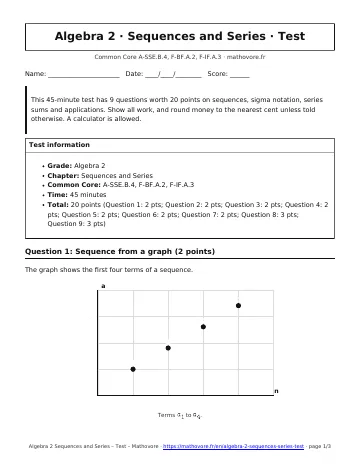
1. Sequence from a graph (2 points)
The graph shows the first four terms of a sequence.
- Write an explicit formula for \(a_{n}\). (1 point)
- Find \(a_{30}\). (1 point)
2. Alternating sequence (2 points)
A sequence begins \(6,\,-12,\,24,\,-48\), and each term is found the same way from the one before it.
- Write an explicit formula for \(a_{n}\). (1 point)
- Find \(a_{9}\). (1 point)
3. Recursive to explicit (2 points)
A sequence is defined by \(a_{1}=9,\quad a_{n}=a_{n-1}-4\).
- List the first four terms. (1 point)
- Write an explicit formula and find \(a_{25}\). (1 point)
4. Sigma evaluation (2 points)
Consider \(\sum_{k=1}^{6}(2k+3)\).
- Write out all the terms. (1 point)
- Find the sum. (1 point)
5. Lecture hall (2 points)
A lecture hall has 20 rows. Row 1 has 12 seats and every row has 3 more seats than the row before it.
- How many seats are in row 20? (1 point)
- How many seats are in the hall? (1 point)
Algebra 2 Sequences Series Test: questions 6–9
6. Series with negative ratio (2 points)
Evaluate \(\sum_{k=1}^{8}3(-2)^{k-1}\).
7. Missing terms (2 points)
A geometric sequence of positive terms has \(a_{4}=24\) and \(a_{6}=96\).
- Find the common ratio and \(a_{1}\). (1 point)
- Find \(a_{8}\). (1 point)
8. Growing deposits (3 points)
Aisha deposits $100 into a savings jar in month 1 and increases the deposit by $15 each month after that. The chart shows the first four months.
- Find her deposit in month 24. (1 point)
- Find the total she has deposited after 24 months. (2 points)
9. Loan amount (3 points)
Liam repays a loan with 24 monthly payments of $400. The interest rate is 0.5% per month, so a payment made \(k\) months from now is worth \(400(1.005)^{-k}\) today. The amount borrowed equals the value today of all 24 payments.
- Write the amount borrowed in sigma notation. (1 point)
- Find the amount borrowed to the nearest cent. (1 point)
- Find the total interest Liam pays. (1 point)

What do the first four questions require?
A graph of four terms leads to an explicit formula once you find the common difference or ratio. The sequence 6, \(-12\), 24, \(-48\) alternates, so the ratio is negative. Then convert a recursive rule such as \(a_{1}=9\), \(a_{n}=a_{n-1}-4\) into the explicit form \(a_{n}=13-4n\). Finally, write out the terms of \(\sum_{k=1}^{6}(2k+3)\) before you add.
How should you handle the sum questions?
The lecture hall has 20 rows, with 12 seats in row 1 and 3 more in each next row. Find the last row first, and then use the arithmetic sum. For \(\sum_{k=1}^{8}3(-2)^{k-1}\), the ratio is \(-2\), so the formula gives \(-255\). Be careful with the sign when you raise a negative ratio to an even power.
What do the last two problems test?
Two positive terms of a geometric sequence give \(r\) from a square root, so choose the positive value. Aisha’s growing deposits form an arithmetic pattern, while Liam’s loan question discounts 24 payments of $400 at 0.5% per month. That calls for a geometric series in reverse order.
What should you do before time is up?
Recount the number of terms in every sum, since that single number drives each formula. Then check that a negative ratio carries its sign. Once you score the test, record whether your errors involved rules, sums or finance.

See every chapter on the Algebra 2 math page.