



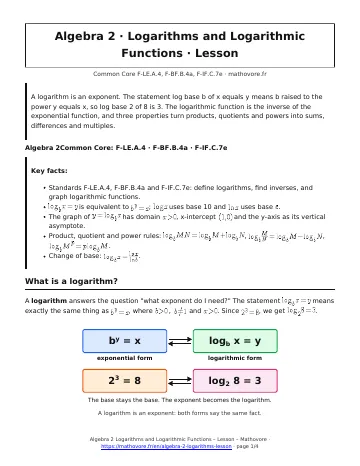
A logarithm is an exponent. The statement log base b of x equals y means b raised to the power y equals x, so log base 2 of 8 is 3. The logarithmic function is the inverse of the exponential function, and three properties turn products, quotients and powers into sums, differences and multiples.
Key facts:
- Standards F-LE.A.4, F-BF.B.4a and F-IF.C.7e: define logarithms, find inverses, and graph logarithmic functions.
- \(\log_{b} x=y\) is equivalent to \(b^{y}=x\); \(\log x\) uses base 10 and \(\ln x\) uses base \(e\).
- The graph of \(y=\log_{b} x\) has domain \(x > 0\), x-intercept \((1,0)\) and the y-axis as its vertical asymptote.
- Product, quotient and power rules: \(\log_{b} MN=\log_{b} M+\log_{b} N\), \(\log_{b}\frac{M}{N}=\log_{b} M-\log_{b} N\), \(\log_{b} M^{p}=p\log_{b} M\).
- Change of base: \(\log_{b} x=\frac{\ln x}{\ln b}\).
What is a logarithm?
A logarithm answers the question “what exponent do I need?” The statement \(\log_{b} x=y\) means exactly the same thing as \(b^{y}=x\), where \(b > 0\), \(b\neq 1\) and \(x > 0\). Since \(2^{3}=8\), we get \(\log_{2} 8=3\).
Common logarithm: base 10, written \(\log x\). For example \(\log 1000=3\).
Natural logarithm: base \(e\approx 2.718\), written \(\ln x\). For example \(\ln e^{5}=5\).
Inverse functions: \(f(x)=b^{x}\) and \(g(x)=\log_{b} x\) undo each other, so \(\log_{b} b^{x}=x\) and \(b^{\log_{b} x}=x\).
What does the graph of a logarithmic function look like?
Because \(y=\log_{b} x\) is the inverse of \(y=b^{x}\), its graph is the reflection of the exponential graph across the line \(y=x\). Each point \((a,c)\) on one graph matches the point \((c,a)\) on the other.
- Domain: \(x > 0\). Range: all real numbers.
- The x-intercept is \((1,0)\) because \(\log_{b} 1=0\).
- The y-axis is a vertical asymptote. The graph rises when \(b > 1\).
Transformations work as usual. The graph of \(y=\log_{2}(x-1)+2\) is the basic graph moved 1 unit right and 2 units up, so its asymptote is \(x=1\) and its domain is \(x > 1\).
What are the properties of logarithms?
Each property is an exponent rule in disguise. For \(M > 0\) and \(N > 0\):
Product: \(\log_{b} (MN)=\log_{b} M+\log_{b} N\)
Quotient: \(\log_{b} \frac{M}{N}=\log_{b} M-\log_{b} N\)
Power: \(\log_{b} M^{p}=p\log_{b} M\)
How do you change the base of a logarithm?
Calculators have only \(\log\) and \(\ln\) keys, so use \(\log_{b} x=\frac{\ln x}{\ln b}=\frac{\log x}{\log b}\). Worked example: evaluate \(\log_{5} 20\).
- Write the quotient \(\frac{\ln 20}{\ln 5}\).
- Find \(\ln 20\approx 2.9957\) and \(\ln 5\approx 1.6094\).
- Divide: \(\frac{2.9957}{1.6094}\approx 1.8614\).
- Check: \(5^{1.8614}\approx 20\).
Logarithms and Logarithmic Functions: frequently asked questions
What does a logarithm mean in plain words?
A logarithm is the exponent that a base must be raised to in order to produce a number. So \(\log_{3} 81=4\) because \(3^{4}=81\).
Why can you not take the log of a negative number?
A positive base raised to any real power is always positive, so \(b^{y}=x\) never gives \(x \le 0\). That is why the domain of \(\log_{b} x\) is \(x > 0\).
What is the difference between log and ln?
\(\log x\) means base 10 and \(\ln x\) means base \(e\approx 2.718\). Both follow the same properties; only the base differs.
Is \(\log(x+3)\) the same as \(\log x+\log 3\)?
No. The product rule gives \(\log 3x=\log 3+\log x\), but there is no rule for a log of a sum. For example \(\log_{2}(5+3)=3\), while \(\log_{2} 5+\log_{2} 3\approx 3.907\).
How do you find the inverse of an exponential function?
Swap \(x\) and \(y\), then solve for \(y\) using a logarithm. The inverse of \(f(x)=2^{x}+1\) is \(f^{-1}(x)=\log_{2}(x-1)\).
See every chapter on the Algebra 2 math page.