Key takeaway: This grade 7 probability models test is worth 20 points across eight questions and fits a 45 minute period. It covers likelihood, spinner and cube probabilities, a missing value in a model, experimental results, and a bus schedule. A matching key gives point values for every part, so scoring stays consistent between classrooms.
Students write answers as fractions in lowest terms and justify each prediction. Two questions ask them to judge whether a probability model or a cube is fair.
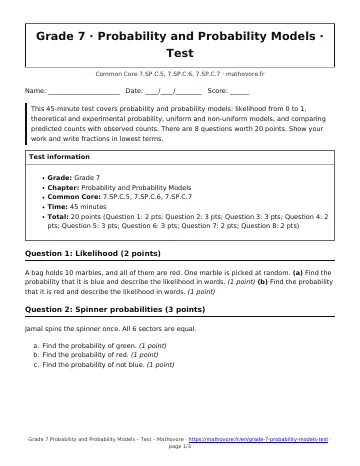
This 45-minute test covers probability and probability models: likelihood from 0 to 1, theoretical and experimental probability, uniform and non-uniform models, and comparing predicted counts with observed counts. There are 8 questions worth 20 points. Show your work and write fractions in lowest terms.
- Grade: Grade 7
- Chapter: Probability and Probability Models
- Common Core: 7.SP.C.5, 7.SP.C.6, 7.SP.C.7
- Time: 45 minutes
- Total: 20 points (Question 1: 2 pts; Question 2: 3 pts; Question 3: 3 pts; Question 4: 2 pts; Question 5: 3 pts; Question 6: 3 pts; Question 7: 2 pts; Question 8: 2 pts)
Grade 7 Probability Models Test: questions 1–5
1. Likelihood (2 points)
A bag holds 10 marbles, and all of them are red. One marble is picked at random. (a) Find the probability that it is blue and describe the likelihood in words. (1 point) (b) Find the probability that it is red and describe the likelihood in words. (1 point)
2. Spinner probabilities (3 points)
Jamal spins the spinner once. All 6 sectors are equal.
- Find the probability of green. (1 point)
- Find the probability of red. (1 point)
- Find the probability of not blue. (1 point)
3. Spinner experiment (3 points)
Sofia spun a different color spinner 40 times .
- Find the experimental probability of green. (1 point)
- Find the experimental probability of red. (1 point)
- Predict how many times blue will come up in 200 spins. (1 point)
4. Fair cube (2 points)
A fair number cube has faces 1 to 6. (a) Find the probability of rolling a number greater than 4. (1 point) (b) Find the probability of rolling an odd number. (1 point)
5. Missing probability (3 points)
A game spinner has four outcomes with this probability model.
- Find the missing probability for D. (1 point)
- Find the probability of C or D. (1 point)
- Predict how many times B will occur in 200 spins. (1 point)
Grade 7 Probability Models Test: questions 6–8
6. Fair or not (3 points)
Priya rolled a number cube 30 times .
- How many times should each face appear if the cube is fair? (1 point)
- Which faces differ the most from that number, and by how much? (1 point)
- Is it reasonable to think the cube is fair? Explain. (1 point)
7. Tossing a cup (2 points)
Noah tossed a paper cup 80 times . It landed open end up 12 times , open end down 36 times , and on its side 32 times . (a) Write a probability model as decimals. (1 point) (b) Predict how many times the cup lands on its side in 300 tosses. (1 point)
8. Bus schedule (2 points)
The probability that Mei’s school bus is late on a given day is \(\frac{3}{20}\). (a) Find the probability that the bus is on time. (1 point) (b) About how many late days should she expect in 40 school days? (1 point)

What does the grade 7 probability models test ask first?
The first question uses a bag of 10 marbles that are all red, so the probability of red is 1 and the probability of blue is 0. Then Jamal spins a spinner with 6 equal sectors. Next, Sofia spins a different spinner 40 times , and students find the experimental probability of green. After that, a fair cube asks for a number greater than 4.
How do the three-point questions differ?
Question 5 gives a model for four outcomes with one missing probability, and students subtract the known values from 1. Question 6 has Priya roll a cube 30 times , so each face should appear 5 times if the cube is fair. Because real counts vary, students must decide which counts look unusual. Finally, Question 2 and Question 3 combine a probability with a prediction.
How should you finish the last questions?
Noah tosses a paper cup 80 times , and the cup lands open end up 12 times , open end down 36 times , and on its side 32 times . Divide each count by 80. In the last question, a bus is late with probability three twentieths, so the chance it is on time is seventeen twentieths.
Study tips for the probability test
First, practice finding a missing probability by subtracting from 1. Next, write the expected count formula on a card, and test it with 60 rolls. On test day, check that each model adds to 1 before you hand the paper in.

See every chapter on the Grade 7 math page.