


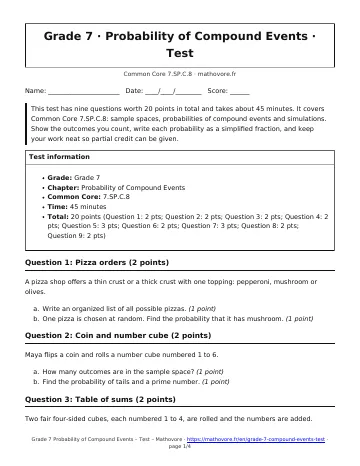
- Grade: Grade 7
- Chapter: Probability of Compound Events
- Common Core: 7.SP.C.8
- Time: 45 minutes
- Total: 20 points (Question 1: 2 pts; Question 2: 2 pts; Question 3: 2 pts; Question 4: 2 pts; Question 5: 3 pts; Question 6: 2 pts; Question 7: 3 pts; Question 8: 2 pts; Question 9: 2 pts)
Question 1: Pizza orders (2 points)
A pizza shop offers a thin crust or a thick crust with one topping: pepperoni, mushroom or olives.
- Write an organized list of all possible pizzas. (1 point)
- One pizza is chosen at random. Find the probability that it has mushroom. (1 point)
Question 2: Coin and number cube (2 points)
Maya flips a coin and rolls a number cube numbered 1 to 6.
- How many outcomes are in the sample space? (1 point)
- Find the probability of tails and a prime number. (1 point)
Question 3: Table of sums (2 points)
Two fair four-sided cubes, each numbered 1 to 4, are rolled and the numbers are added.
- Complete the table of sums. (1 point)
- Find the probability that the sum is greater than 5. (1 point)
Question 4: Draw without replacement (2 points)
A bag holds two red marbles (R1 and R2) and one blue marble (B). Sofia draws two marbles without putting the first back.
- List the sample space. (1 point)
- Find the probability that exactly one marble is red. (1 point)
Question 5: Sums of two number cubes (3 points)
The table shows every sum when two fair number cubes are rolled.
- Find the probability of a sum of 8. (1 point)
- Find the probability of a sum less than 5. (1 point)
- Find the probability that the sum is a multiple of 5. (1 point)
Question 6: Predict from probability (2 points)
In a game, Ethan spins the spinner and flips a coin.
- Find the probability of heads and a 3. (1 point)
- Ethan plays 120 times . Predict how many times he gets heads and a 3. (1 point)
Question 7: Simulate three children (3 points)
Mei wants to estimate the probability that a family with three children has three girls. She reads random digits and lets an even digit stand for a girl and an odd digit for a boy. Each group of three digits is one trial.
- Explain why even and odd digits are a fair model for one child. (1 point)
- Use the twelve trials to estimate the probability of three girls. (1 point)
- List the sample space for three children (G or B each) and find the theoretical probability of three girls. (1 point)
Question 8: Lunch tree diagram (2 points)
Jamal picks a sandwich and a side at random. The tree diagram shows the choices.
- Find the probability that the side is soup. (1 point)
- Find the probability of a veggie sandwich with an apple. (1 point)
Question 9: Design a simulation (2 points)
A baseball player gets a hit in about one-third of his at-bats. Describe a simulation with a number cube to estimate the probability of at least one hit in two at-bats. Tell what each number means, what one trial is and what to count.

See every chapter on the Grade 7 math page.