



Percent change measures how much a quantity went up or down compared with its original amount: subtract the original from the new amount, divide by the original, and write the result as a percent. A rise from \(\$40\) to \(\$50\) is a \(25\%\) increase. Percent error compares a measurement with the actual value in the same way.
Key facts:
- Percent change \(=\frac{\text{new}-\text{original}}{\text{original}}\times 100\%\); always divide by the original.
- A \(p\%\) increase multiplies by \(1+\frac{p}{100}\); a \(p\%\) decrease multiplies by \(1-\frac{p}{100}\).
- To find the original amount, divide the new amount by the multiplier.
- Percent error \(=\frac{|\text{measured}-\text{actual}|}{\text{actual}}\times 100\%\) and is never negative.
- A percent increase can be larger than \(100\%\); a percent decrease can never exceed \(100\%\).
What is percent change?
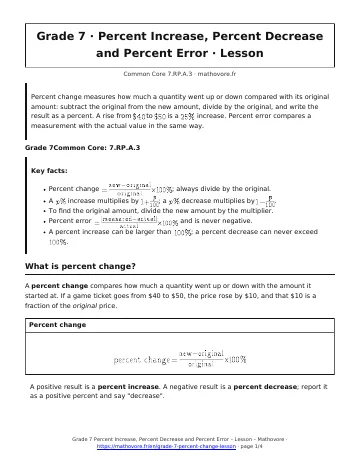
A percent change compares how much a quantity went up or down with the amount it started at. If a game ticket goes from $40 to $50, the price rose by $10, and that $10 is a fraction of the original price.
\[\text{percent change}=\frac{\text{new}-\text{original}}{\text{original}}\times 100\%\]
A positive result is a percent increase. A negative result is a percent decrease; report it as a positive percent and say "decrease".
How do you find a percent increase or decrease?
- Subtract the original from the new amount to get the change.
- Divide the change by the original amount.
- Write the quotient as a percent.
- Name it an increase if the new amount is larger, a decrease if it is smaller.
Example. Ana's shirt cost $80 and is now $60. The change is \(60-80=-20\). Then \(\frac{20}{80}=0.25=25\%\), so the price had a \(25\%\) decrease.
How do you find a new amount after a percent change?
Multiply the original by a single number. For a \(p\%\) increase the multiplier is \(1+\frac{p}{100}\). For a \(p\%\) decrease it is \(1-\frac{p}{100}\).
How do you find the original amount?
Since \(\text{new}=\text{multiplier}\times \text{original}\), divide the new amount by the multiplier. After a \(20\%\) increase a membership costs $60, so the original was \(60: 1.20=50\) dollars. Do not subtract \(20\%\) of $60; the \(20\%\) was taken from the unknown original, not from $60.
What is percent error?
\[\text{percent error}=\frac{|\text{measured}-\text{actual}|}{\text{actual}}\times 100\%\]
Percent error tells how far a measurement or estimate is from the true value, compared with that true value. It is never negative.
Liam measures a table as \(12.6\text{ ft}\) when its actual length is \(12\text{ ft}\). The error is \(0.6\text{ ft}\), and \(\frac{0.6}{12}=0.05\), so the percent error is \(5\%\).
- Always divide by the original (or actual) value, not by the new one.
- A \(20\%\) increase followed by a \(20\%\) decrease does not return to the start, because the second percent is taken of a larger amount.
Percent Increase, Percent Decrease and Percent Error: frequently asked questions
How do I find a percent increase?
Subtract the original from the new amount, divide that difference by the original amount, and multiply by \(100\). For example, going from \(50\) to \(65\) gives \(\frac{15}{50}=0.30\), a \(30\%\) increase.
Why do I divide by the original amount?
The original amount is the starting point that the percent is measured against. Dividing by the new amount answers a different question and gives a wrong percent.
Can a percent decrease be more than 100%?
No. A quantity cannot lose more than all of itself, so a decrease is at most \(100\%\). An increase can be any size; doubling a price is a \(100\%\) increase and tripling it is a \(200\%\) increase.
How do I find the original price after a discount?
Divide the sale price by the multiplier. If a \(25\%\) discount leaves a price of $45, the multiplier is \(0.75\), so the original price is \(45: 0.75=\$60\).
Can percent error be negative?
No. Percent error uses the absolute value of measured minus actual, so it only tells how far off the measurement is, not whether it was too high or too low.
- Percent Increase, Percent Decrease and Percent Error worksheet (20 problems)
- Percent Increase, Percent Decrease and Percent Error quiz (10 questions)
- Percent Increase, Percent Decrease and Percent Error test (45 minutes)
- Previous lesson: Percent Problems: Tax, Tips, Markups and Discounts
- Next lesson: Adding and Subtracting Integers and Rational Numbers
See every chapter on the Grade 7 math page.