Key takeaway: This grade 7 unit rates fractions lesson shows how to find the amount of one quantity for each single unit of another when the numbers are fractions. Divide the first quantity by the second, and the quotient is the unit rate. A runner who covers 1/2 mile in 1/4 hour, for example, goes 2 miles per hour.
Standard 7.RP.A.1 calls the setup a complex fraction. Seventh graders solve it by multiplying by the reciprocal and then check the result.
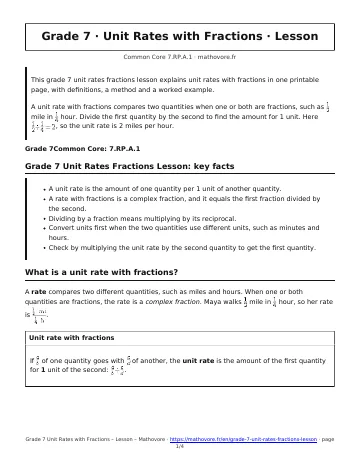
A unit rate with fractions compares two quantities when one or both are fractions, such as \(\frac{1}{2}\) mile in \(\frac{1}{4}\) hour. Divide the first quantity by the second to find the amount for 1 unit. Here \(\frac{1}{2}: \frac{1}{4}=2\), so the unit rate is 2 miles per hour.
Grade 7 Unit Rates Fractions Lesson: key facts
- A unit rate is the amount of one quantity per 1 unit of another quantity.
- A rate with fractions is a complex fraction, and it equals the first fraction divided by the second.
- Dividing by a fraction means multiplying by its reciprocal.
- Convert units first when the two quantities use different units, such as minutes and hours.
- Check by multiplying the unit rate by the second quantity to get the first quantity.
What is a unit rate with fractions?
A rate compares two different quantities, such as miles and hours. When one or both quantities are fractions, the rate is a complex fraction. Maya walks \(\frac{1}{2}\) mile in \(\frac{1}{4}\) hour, so her rate is \(\dfrac{\frac{1}{2}\text{ mi}}{\frac{1}{4}\text{ h}}\).
If \(\frac{a}{b}\) of one quantity goes with \(\frac{c}{d}\) of another, the unit rate is the amount of the first quantity for 1 unit of the second: \(\frac{a}{b}: \frac{c}{d}\).
How do you find a unit rate when the numbers are fractions?
- Write the rate as (first quantity) \(: \) (second quantity).
- Change the division into multiplication by the reciprocal of the second fraction.
- Multiply, then simplify.
- Say the answer with units: miles per hour, cups per batch, dollars per pound.
Example. Sofia reads \(\frac{2}{3}\) of a chapter in \(\frac{1}{6}\) hour. \(\frac{2}{3}: \frac{1}{6}=\frac{2}{3}\times \frac{6}{1}=\frac{12}{3}=4\), so she reads 4 chapters per hour. Check: \(4\times \frac{1}{6}=\frac{2}{3}\).
What if the two quantities use different units?
Convert one of them first so the rate is in the unit you want. Ethan walks \(\frac{1}{2}\) mile in 10 minutes. Since 10 minutes is \(\frac{1}{6}\) of an hour, \(\frac{1}{2}: \frac{1}{6}=\frac{1}{2}\times 6=3\) miles per hour.
Can a unit rate involve area?
Yes. Priya paints \(\frac{3}{4}\) square foot of a poster in \(\frac{1}{8}\) hour. \(\frac{3}{4}: \frac{1}{8}=\frac{3}{4}\times 8=6\) square feet per hour.
What mistakes should you avoid?
- Multiplying the two fractions instead of dividing. A rate of \(\frac{1}{2}\) mile in \(\frac{1}{4}\) hour is not \(\frac{1}{8}\) mile per hour.
- Dividing in the wrong order. The unit named before the word per goes first, so miles per hour is miles \(: \) hours.
- Forgetting to convert. Ten minutes must become \(\frac{1}{6}\) hour before you divide to get miles per hour.
- Leaving off the units. The number 3 means little until you write 3 miles per hour.
How can you use a table of rates?
| Situation | Division | Unit rate |
|---|---|---|
| \(\frac{1}{2}\) mi in \(\frac{1}{4}\) h | \(\frac{1}{2}: \frac{1}{4}\) | 2 mi per h |
| \(\frac{3}{4}\) cup per \(\frac{1}{2}\) batch | \(\frac{3}{4}: \frac{1}{2}\) | \(1\frac{1}{2}\) cups per batch |
| $3 for \(\frac{3}{4}\) lb | \(3: \frac{3}{4}\) | $4 per lb |
Unit Rates with Fractions: frequently asked questions
What is a complex fraction?
A complex fraction has a fraction in its numerator, its denominator, or both. In a rate such as \(\frac{1/2\text{ mi}}{1/4\text{ h}}\), the fraction bar means division, so it equals \(\frac{1}{2}: \frac{1}{4}\).
How do you divide by a fraction?
Multiply by the reciprocal of the fraction you are dividing by. For example, \(\frac{3}{4}: \frac{1}{8}=\frac{3}{4}\times \frac{8}{1}=6\).
Why does dividing by a small fraction give a big rate?
A small fraction of an hour fits many times into 1 hour. If you cover \(\frac{1}{2}\) mile in only \(\frac{1}{4}\) hour, you would cover four times as much in a full hour, which is 2 miles.
Which quantity goes first in the division?
The quantity named before the word per goes first. Miles per hour means miles \(: \) hours, and cups per batch means cups \(: \) batches.
How can I check a unit rate?
Multiply the unit rate by the second quantity. If the unit rate is 3 miles per hour and the time is \(\frac{1}{6}\) hour, then \(3\times \frac{1}{6}=\frac{1}{2}\) mile, which matches the original distance.
Which steps handle a rate built from fractions?
Set the rate up as a fraction stacked on a fraction, and then divide. For 2/3 chapter in 1/6 hour, compute 2/3 divided by 1/6. Flip the second fraction and multiply, so 2/3 times 6 equals 4 chapters per hour. A small divisor makes a large rate, because many small pieces fit into one hour.
What if the two quantities use different units?
Convert first. A walker covers 1/2 mile in 10 minutes, and 10 minutes is 1/6 of an hour. Then 1/2 divided by 1/6 gives 3 miles per hour. If you skip the conversion, you get a rate in miles per minute, which is correct but not what the question asked.
How does a grade 7 unit rates fractions lesson handle area?
Rates can compare area with volume or with time. A painter who covers 2/3 square yard with 1/6 quart of paint covers 4 square yards per quart. The same division works, because only the quantities change.
How can you check a unit rate?
Multiply the rate by the second quantity, and you should recover the first. Since 4 times 1/6 equals 2/3, the paint answer holds. In addition, use a quick estimate to decide whether the answer should be larger or smaller than the starting amounts.
Practice with a kitchen recipe
Find a recipe that uses fractions of a cup for a fraction of a batch. Next, work out the amount for one full batch with a complex fraction. Then check your result by multiplying back, and move on to the printable set.

See every chapter on the Grade 7 math page.