Key takeaway: This grade 7 cross sections quiz presents ten multiple-choice questions on slices of prisms and pyramids. Only one option per question is right, and the note afterward names the shape or area step and the usual slip. Try it before the lesson or after it.
Picture the plane first. Then decide whether the cut is parallel or perpendicular to the base, and whether it passes through the apex. Those two choices decide the shape. Each takes under a minute.
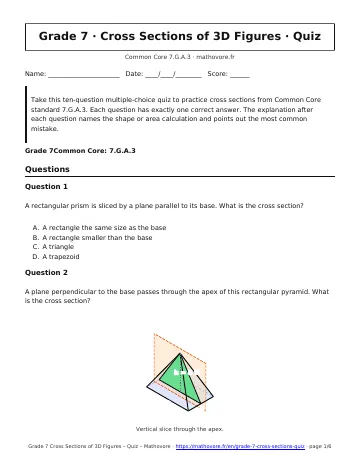
Take this ten-question multiple-choice quiz to practice cross sections from Common Core standard 7.G.A.3. Each question has exactly one correct answer. The explanation after each question names the shape or area calculation and points out the most common mistake.
Question 1
A rectangular prism is sliced by a plane parallel to its base. What is the cross section?
Question 2
A plane perpendicular to the base passes through the apex of this rectangular pyramid. What is the cross section?
Question 3
The plane is parallel to the base and halfway up the pyramid. What are the dimensions of the cross section?
Question 4
The plane is perpendicular to the base and parallel to the 4 cm by 5 cm end. What is the area of the cross section?
Question 5
A plane is perpendicular to the base of a rectangular pyramid and parallel to one base edge. It does not pass through the apex. What is the cross section?
Question 6
The plane cuts across the base diagonal, which is 10 in. long. The prism is 5 in. tall. What is the area of the cross section?
Question 7
The cross section of a pyramid is the trapezoid shown. What is its area?
Question 8
A pyramid has a 9 cm by 6 cm base and a height of 12 cm. A plane parallel to the base cuts it 4 cm above the base. What is the area of the cross section?
Question 9
Which plane cuts a cube so that the cross section is a square?
Question 10
Noah slices a loaf shaped like a rectangular prism that is 15 in. long. Each cut is perpendicular to the length, and each slice is \(\frac{1}{2}\) in. thick. How many slices does he get?
🎉 Quiz complete!
Remember:
- A cross section is the two-dimensional shape where a plane meets a solid.
- Any slice of a right rectangular prism that is parallel or perpendicular to the base is a rectangle.
- A slice of a right rectangular pyramid parallel to the base is a smaller rectangle.
- A slice of a right rectangular pyramid perpendicular to the base is a triangle if it passes through the apex, and a trapezoid if it does not.
- The area of a cross section is found with the usual area formula for its shape.
What does the 7th grade cross sections quiz ask?
The first item slices a rectangular prism parallel to its base, and the answer is a rectangle the same size as the base. Another item cuts a pyramid straight through the tip, so the shape is a triangle. One more asks which plane cuts a cube into a square, and any plane parallel to a face does.
How do you find sizes on a grade 7 cross sections quiz?
A pyramid with a 12 by 8 inch base is cut halfway up, so the slice measures 6 by 4 inches. A pyramid with a 9 by 6 centimeter base and a height of 12 centimeters is cut 4 centimeters above the base. The remaining height is 8, which is two thirds of 12, so the slice is 6 by 4 and has an area of 24 square centimeters.
How do prism slices differ from pyramid slices?
Cutting a prism parallel to an end keeps that end, so a 4 by 5 centimeter end yields 20 square centimeters. A slice across a base diagonal of 10 inches in a prism that is 5 inches tall has an area of 50 square inches. Straight down beside the tip, a pyramid gives a trapezoid, and one trapezoid in the quiz has an area of 22.5 square feet.
How does the loaf of bread question work?
Noah cuts a 15-inch loaf with cuts perpendicular to the length. Divide the length by the thickness of each slice to find how many slices result, which is 30 in this problem.
Follow-up steps after the cross sections quiz
Go back to each miss and draw the plane through the solid before choosing again. Then write the scale factor for any pyramid slice you missed. After that, work a few worksheet problems with real objects to see the shapes in context.

See every chapter on the Grade 7 math page.