


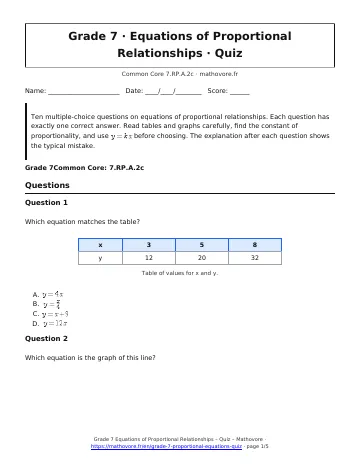
Ten multiple-choice questions on equations of proportional relationships. Each question has exactly one correct answer. Read tables and graphs carefully, find the constant of proportionality, and use \(y=kx\) before choosing. The explanation after each question shows the typical mistake.
Which equation matches the table?
Which equation is the graph of this line?
Tickets to the school play cost $9.50 each. Which equation gives the total cost \(c\) of \(n\) tickets?
The equation \(y=2.5x\) describes a proportional relationship. What is \(y\) when \(x=12\)?
Which equation does not represent a proportional relationship?
Line A and Line B are shown. Which statement is true?
A car travels \(d=28g\) miles on \(g\) gallons of gas. How far can it go on 7.5 gallons?
In the equation \(t=pn\), where \(t\) is the total cost of \(n\) items, what does \(p\) represent?
Pizza slices at a school fair cost \(c=1.75s\) dollars for \(s\) slices. Jamal paid $14.00. How many slices did he buy?
Diego's pay is \(y=9x\). Aisha's pay is in the table. Who earns more per hour?
🎉 Quiz complete!
Remember:
- Every proportional relationship has the form \(y=kx\), and its graph is a straight line through the origin \((0,0)\).
- The constant \(k=\frac{y}{x}\) is the same for every pair of values with \(x\neq 0\).
- For total cost \(t=pn\), the price per item \(p\) is the constant of proportionality.
- To find a missing value, substitute the known number into \(y=kx\) and solve.
- Compare two proportional relationships by comparing their constants \(k\), whatever form each is given in.
See every chapter on the Grade 7 math page.