Key takeaway: This grade 7 proportional equations lesson shows how to write y = kx for any relationship where y stays a fixed multiple of x. The number k is the constant of proportionality, which equals y divided by x for every pair. Find it from one pair, substitute it, and the equation is done.
The same constant of proportionality appears in a table, on a graph, or in a price. Its graph is always a line through the origin, which makes it easy to spot.
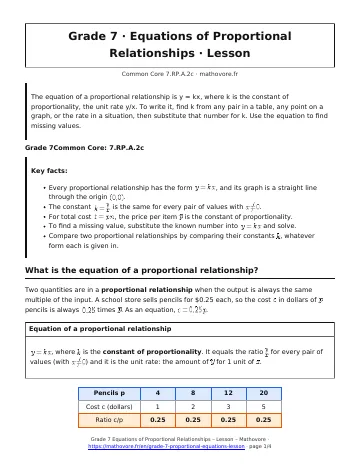
The equation of a proportional relationship is y = kx, where k is the constant of proportionality, the unit rate y/x. To write it, find k from any pair in a table, any point on a graph, or the rate in a situation, then substitute that number for k. Use the equation to find missing values.
Grade 7 Proportional Equations Lesson: key facts
- Every proportional relationship has the form \(y=kx\), and its graph is a straight line through the origin \((0,0)\).
- The constant \(k=\frac{y}{x}\) is the same for every pair of values with \(x\neq 0\).
- For total cost \(t=pn\), the price per item \(p\) is the constant of proportionality.
- To find a missing value, substitute the known number into \(y=kx\) and solve.
- Compare two proportional relationships by comparing their constants \(k\), whatever form each is given in.
What is the equation of a proportional relationship?
Two quantities are in a proportional relationship when the output is always the same multiple of the input. A school store sells pencils for $0.25 each, so the cost \(c\) in dollars of \(p\) pencils is always \(0.25\) times \(p\). As an equation, \(c=0.25p\).
\(y=kx\), where \(k\) is the constant of proportionality. It equals the ratio \(\frac{y}{x}\) for every pair of values (with \(x\neq 0\)) and it is the unit rate: the amount of \(y\) for 1 unit of \(x\).
In the table, every ratio \(\frac{c}{p}\) is \(0.25\), so \(k=0.25\). An equation such as \(y=2x+3\) is not proportional: the added 3 means its graph misses the origin.
How do you write the equation from a table or a graph?
- Choose any pair \((x,y)\) from the table, or any point on the line other than the origin.
- Divide to find the constant: \(k=\frac{y}{x}\).
- Write \(y=kx\) with that number in place of \(k\).
- Check a second pair. The ratio must be the same.
Worked example. The graph is a line through the origin and the point \((4,6)\). Then \(k=\frac{6}{4}=1.5\), so \(y=1.5x\). Check with \((2,3)\): \(1.5\times 2=3\). It matches.
How do you write the equation from a situation?
Look for the rate “per one”: the price per item, the miles per hour, or the pay per hour. That rate is \(k\). Pick letters that fit the story.
| Situation | Equation | Constant \(k\) |
|---|---|---|
| Apples cost $3.50 per pound (cost \(c\), pounds \(p\)) | \(c=3.5p\) | \(3.5\) |
| A car drives 55 miles per hour (distance \(d\), hours \(h\)) | \(d=55h\) | \(55\) |
| Total cost \(t\) of \(n\) items at price \(p\) each | \(t=pn\) | \(p\) |
How do you use the equation and compare relationships?
Substitute the value you know and solve. With \(c=3.5p\), 6 pounds cost \(3.5\times 6=21\) dollars, and $28 buys \(p=28: 3.5=8\) pounds.
To compare two proportional relationships, find \(k\) for each one, whether it comes as a table, a graph, an equation, or words. Priya saves $2 each week (\(y=2x\)) and Noah saves $3 each week (\(y=3x\)). Noah’s line is steeper because his \(k\) is larger.
Equations of Proportional Relationships: frequently asked questions
What does k mean in y = kx?
The letter \(k\) is the constant of proportionality. It is the unit rate, meaning how much \(y\) changes for each 1 unit of \(x\). In \(c=0.25p\), \(k=0.25\) means each pencil costs $0.25.
How can you tell if an equation is proportional?
A proportional equation can be written as \(y=kx\) with nothing added or subtracted. The equation \(y=4x\) is proportional, but \(y=4x+1\) is not because its graph does not pass through the origin.
How do you find k from a graph?
Pick a point on the line, other than the origin, whose coordinates are easy to read. Divide its \(y\)-coordinate by its \(x\)-coordinate. The point \((1,k)\), if you can read it, shows \(k\) directly.
Does it matter which quantity is x and which is y?
Yes. If \(y\) is pay and \(x\) is hours, then \(k\) is dollars per hour. If you swap the roles, the new constant is the reciprocal and means hours per dollar, so both forms describe the same relationship.
How do you compare two proportional relationships in different forms?
Find the constant of proportionality for each one: divide in a table, read a point on a graph, or take the number multiplying the variable in an equation. Then compare the two values of \(k\) using the same units.
How do you find k from a table or a graph?
First, pick any pair with x not equal to zero and divide y by x. If a table lists the pair (5, 35), then k is 35 divided by 5, which is 7. Check a second pair to be safe, because a proportional table gives the same k every time. Likewise, on a graph, read a point that sits on a grid crossing, such as (4, 3), and divide again to get three fourths.
How do you write the equation from a situation?
Look for the rate per one unit. For example, muffins that cost $2.75 each give c = 2.75m, where m counts muffins. Similarly, trail mix at $6.40 per pound gives c = 6.4p. In both cases the price per item plays the role of k, so the other letter simply names the quantity.
How does a grade 7 proportional equations lesson tell proportional from not proportional?
An equation such as y = 3x + 2 is not proportional, since x = 0 gives y = 2 and the line misses the origin. A proportional equation has no added constant. Therefore y = 3x passes the test, and y = 3x + 2 fails it.
How do you use the equation?
Substitute the known value and solve. For d = 28g, for instance, a trip on 7.5 gallons covers 28 times 7.5, or 210 miles. To compare two relationships, also compare their constants, even if one is a table and the other an equation.
Practice with prices around you
Find a grocery item sold by weight, and write its cost equation with the price per pound as k. Then predict the cost of three different weights and check them against the shelf. Once that works, tackle the worksheet and lead off with the potato price table.

See every chapter on the Grade 7 math page.