



Adding integers means moving along a number line: add a positive number by moving right and a negative number by moving left. Opposites such as \(5\) and \(-5\) add to \(0\). To subtract, add the opposite: \(p – q = p + (-q)\). The distance between two numbers is \(|p – q|\).
Key facts:
- Opposites add to zero: \(p + (-p) = 0\).
- Subtraction is adding the opposite: \(p – q = p + (-q)\).
- Subtracting a negative number gives a sum: \(5 – (-7) = 12\).
- The distance between \(p\) and \(q\) on a number line is \(|p – q|\).
How do you add integers on a number line?
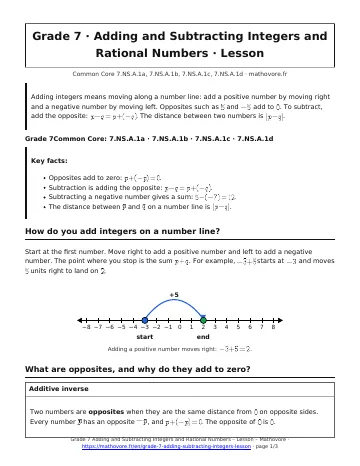
Start at the first number. Move right to add a positive number and left to add a negative number. The point where you stop is the sum \(p + q\). For example, \(-3 + 5\) starts at \(-3\) and moves \(5\) units right to land on \(2\).
What are opposites, and why do they add to zero?
Two numbers are opposites when they are the same distance from \(0\) on opposite sides. Every number \(p\) has an opposite \(-p\), and \(p + (-p) = 0\). The opposite of \(0\) is \(0\).
Opposites explain real situations. A gain of \(\$4\) and a loss of \(\$4\) cancel out, and a rise of \(4^{\circ}\text{F}\) followed by a drop of \(4^{\circ}\text{F}\) returns to the starting temperature.
| Signs of the addends | What to do | Example |
|---|---|---|
| Same signs | Add the absolute values, keep the sign | \(-5 + (-3) = -8\) |
| Different signs | Subtract the smaller absolute value from the larger, keep the sign of the larger | \(-9 + 4 = -5\) |
How do you subtract integers?
Subtracting a number is the same as adding its opposite: \(p – q = p + (-q)\). So \(3 – 7 = 3 + (-7) = -4\). Subtracting a negative number moves the other way: \(3 – (-7) = 3 + 7 = 10\).
How do you find the distance between two numbers?
The distance between two rational numbers \(p\) and \(q\) is the absolute value of their difference, \(|p – q|\). Distance is never negative, and \(|p – q| = |q – p|\). This works for decimals and fractions too.
What is the step-by-step method?
- Rewrite any subtraction as adding the opposite.
- Check the signs of the two addends.
- If they match, add the absolute values and keep the sign. If they differ, subtract the smaller absolute value from the larger.
- Use the sign of the addend with the larger absolute value.
Example: Find \(-8 – (-3)\). Rewrite it as \(-8 + 3\). The signs differ, and \(8 – 3 = 5\). The larger absolute value belongs to \(-8\), so the answer is \(-5\).
Adding and Subtracting Integers and Rational Numbers: frequently asked questions
What is an additive inverse?
The additive inverse of a number is its opposite, the number that adds to it to make \(0\). The additive inverse of \(8\) is \(-8\), and the additive inverse of \(-2.5\) is \(2.5\).
How do you add a negative number?
Move left on the number line by the size of the negative number. For example, \(2 + (-6)\) starts at \(2\), moves \(6\) units left, and lands on \(-4\).
Why does subtracting a negative number give a larger result?
Subtracting \(-7\) means adding the opposite, which is \(+7\). So \(3 – (-7) = 3 + 7 = 10\). Taking away a debt of \(\$7\) leaves you with \(\$7\) more.
Can a distance be negative?
No. Distance uses absolute value, so it is never negative. The distance between \(-4\) and \(9\) is \(|-4 – 9| = 13\), and \(|9 – (-4)|\) also equals \(13\).
How do I add integers with different signs?
Subtract the smaller absolute value from the larger one, then keep the sign of the number with the larger absolute value. For \(-9 + 4\), compute \(9 – 4 = 5\) and keep the negative sign to get \(-5\).
- Adding and Subtracting Integers and Rational Numbers worksheet (20 problems)
- Adding and Subtracting Integers and Rational Numbers quiz (10 questions)
- Adding and Subtracting Integers and Rational Numbers test (45 minutes)
- Previous lesson: Percent Increase, Percent Decrease and Percent Error
- Next lesson: Multiplying and Dividing Integers and Rational Numbers
See every chapter on the Grade 7 math page.