


To multiply or divide integers, multiply or divide the absolute values, then choose the sign: the result is positive when the signs are the same and negative when they differ. So \((-3)(-4) = 12\) and \(12 : (-4) = -3\). Division by zero is undefined.
Key facts:
- Same signs give a positive result; different signs give a negative result.
- \((-1)(-1) = 1\) follows from the distributive property and \(-1 + 1 = 0\).
- Division by \(0\) is undefined, but \(0 : q = 0\) when \(q \neq 0\).
- \(-\frac{p}{q} = \frac{-p}{q} = \frac{p}{-q}\) for \(q \neq 0\).
How do you multiply integers?
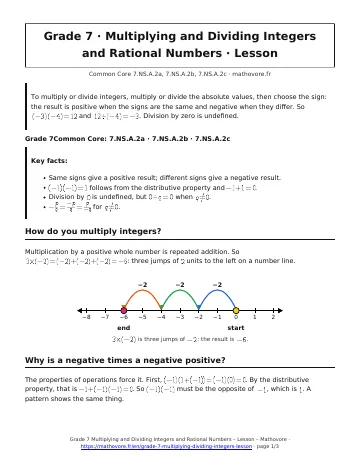
Multiplication by a positive whole number is repeated addition. So \(3 \times (-2) = (-2) + (-2) + (-2) = -6\): three jumps of \(2\) units to the left on a number line.
Why is a negative times a negative positive?
The properties of operations force it. First, \((-1)(1 + (-1)) = (-1)(0) = 0\). By the distributive property, that is \(-1 + (-1)(-1) = 0\). So \((-1)(-1)\) must be the opposite of \(-1\), which is \(1\). A pattern shows the same thing.
If the two numbers have the same sign, the product or quotient is positive. If they have different signs, it is negative. Zero times any number is \(0\).
How do you divide integers?
Division undoes multiplication. If \(q \neq 0\), then \(\frac{p}{q} = r\) means \(p = q \cdot r\). So \(-12 : 4 = -3\) because \(4 \cdot (-3) = -12\).
Division by zero is undefined. To compute \(8 : 0\), you would need a number \(r\) with \(0 \cdot r = 8\), and no such number exists. Note that \(0 : 8 = 0\) is fine.
How can a negative sign move in a fraction?
For integers \(p\) and \(q\) with \(q \neq 0\), \(-\frac{p}{q} = \frac{-p}{q} = \frac{p}{-q}\). For example, \(-\frac{12}{4} = \frac{-12}{4} = \frac{12}{-4} = -3\).
What is the step-by-step method?
- Count the negative factors. An even count gives a positive result, an odd count a negative result.
- Multiply or divide the absolute values.
- Attach the sign from step 1.
Example: Find \((-6)(-4) : (-8)\). Work left to right: \((-6)(-4) = 24\), then \(24 : (-8) = -3\). Three negative signs in total gives a negative answer.
Multiplying and Dividing Integers and Rational Numbers: frequently asked questions
Why is a negative times a negative positive?
If it were not, the distributive property would break. Since \(-1 + 1 = 0\), we get \((-1)(-1) + (-1)(1) = 0\), so \((-1)(-1)\) must be the opposite of \(-1\), which is \(1\).
What is the rule for multiplying integers with different signs?
The product is negative. Multiply the absolute values, then make the answer negative. For example, \(7 \times (-5) = -35\).
Why is division by zero undefined?
Division asks for the missing factor. For \(6 : 0\), you would need \(0 \cdot r = 6\), but zero times any number is \(0\), never \(6\). No answer exists, so we call it undefined.
How do you divide two negative integers?
Divide the absolute values and make the answer positive, because the signs are the same. For example, \(-36 : (-9) = 4\), since \((-9)(4) = -36\).
How many negative factors make a product negative?
An odd number of negative factors makes the product negative, and an even number makes it positive. For example, \((-2)(-3)(-4) = -24\) has three negative factors.
- Multiplying and Dividing Integers and Rational Numbers worksheet (20 problems)
- Multiplying and Dividing Integers and Rational Numbers quiz (10 questions)
- Multiplying and Dividing Integers and Rational Numbers test (45 minutes)
- Previous lesson: Adding and Subtracting Integers and Rational Numbers
- Next lesson: Rational Numbers: Decimals, Fractions and Word Problems
See every chapter on the Grade 7 math page.